Home / 6 August 1945
03 — 6 AUGUST 1945
6 August 1945
At 8:15 a.m., an atomic bomb exploded in the sky over Hiroshima — the first atomic bomb ever used in war. What happened in the city that morning, and how many lives were lost? We look back, following the record through places and numbers.
Labels: Factdocumented Likelysupported by most sources Legendoral tradition Urban legendlocal lore and rumour
The aiming point was a T-shaped bridge
FactOn the morning of 6 August 1945, the sky over Hiroshima was clear. The uranium atomic bomb dropped by the American B-29 bomber Enola Gay exploded at 8:15 a.m., about 600 metres above the centre of the city.
FactThe aiming point was the Aioi Bridge, which spans the point where the main channel of the Ota River and the Motoyasu River divide. Seen from the air it was an unusual T-shaped bridge, which made it an easy landmark. The actual point of the explosion was about 300 metres to the southeast, above Shima Hospital.
Heat, blast and radiation
FactAt the moment of the explosion a huge fireball formed, and the temperature of the ground at the hypocentre is estimated to have reached 3,000–4,000 degrees Celsius. The intense heat rays and blast destroyed or burned almost every building within 2 km of the hypocentre. Radiation, moreover, would go on to torment the bodies of those who survived for a long time afterwards.
FactIt is thought that about 350,000 people, including military personnel, were in Hiroshima at the time. That morning, many junior high school boys and girls' school students had been mobilised to demolish buildings to create firebreaks against the spread of fires (building evacuation). Many of the students working outdoors lost their lives that day.
FactAfter the explosion, "black rain" containing radioactive material fell on the northwest of the city and elsewhere. Those exposed to the bomb also included people from the Korean Peninsula who were living in Japan, and American servicemen being held as prisoners of war.
Look here: the A-Bomb Dome and the Aioi Bridge
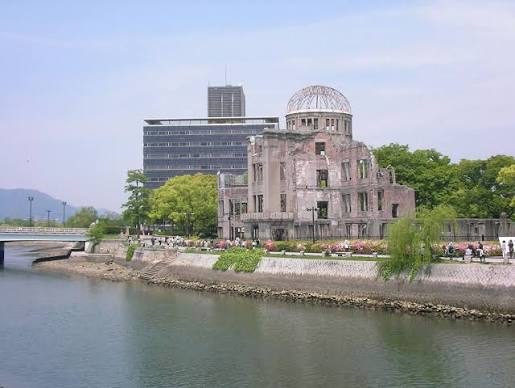
The A-Bomb Dome (Genbaku Dome) was built in 1915 as the Hiroshima Prefectural Commercial Exhibition Hall. It was hit by the bomb at a distance of about 160 metres from the hypocentre; everyone inside was killed, but part of the walls and the steel frame of the dome remained. The Aioi Bridge just to the north, though rebuilt after the war, is still T-shaped when seen from above.
Sadako and the thousand paper cranes
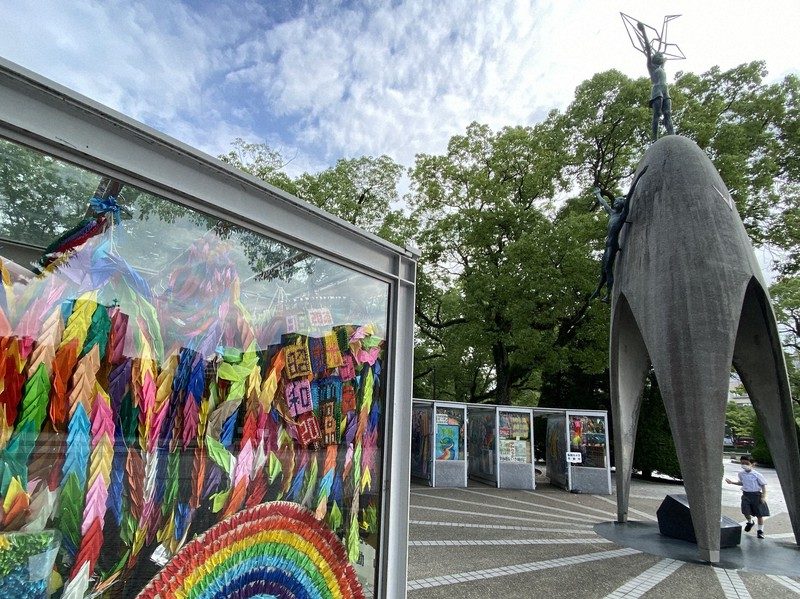
FactSasaki Sadako, who was exposed to the bomb at the age of two, was diagnosed with leukaemia ten years later, in 1955. Hoping to recover, she kept folding paper cranes from medicine wrappers and other scraps, but she died that October at the age of 12. At the call of her classmates, donations poured in from across Japan, and in 1958 the Children's Peace Monument was built in Peace Memorial Park. Paper cranes are still sent there from all over the world.

Keeping the memory of "Hiroshima" alive
Every year on 6 August, the Peace Memorial Ceremony is held in Peace Memorial Park, and a silent prayer is offered at 8:15 a.m. In the evening, lanterns are floated on the Motoyasu River in memory of the dead. The testimony of the hibakusha (atomic bomb survivors) has been handed down through the Hiroshima Peace Memorial Museum and the work of storytellers. For the journey from the scorched ruins, go to the Rising from the Ashes room.
Main sources: Hiroshima Peace Memorial Museum / City of Hiroshima, "Overview of the Atomic Bomb Damage" / Hiroshima National Peace Memorial Hall for the Atomic Bomb Victims