Home / The Carp and Its City
08 — CARP
The Carp and Its City
Five years after the atomic bomb, just as houses were starting to line the burned-out streets again, a professional baseball team was born in Hiroshima. It had no big company behind it, and its money soon ran out. What saved the club then were the coins and notes that citizens put in, one by one.
Labels: Factdocumented Likelysupported by most sources Legendoral tradition Urban legendlocal lore and rumour
1950: a citizens' team is born
FactIn 1950, the year professional baseball split into the Central League and the Pacific League, the Hiroshima Carp joined the Central League. Unlike most other clubs, the Carp had no parent company. It started out funded by local governments such as Hiroshima Prefecture and Hiroshima City and by local businesses: a citizens' team, so to speak.
LegendThe club's name, "Carp," is the English for koi, and is said to come from "Rijo" (Carp Castle), the other name of Hiroshima Castle. The story goes that when the name was being decided, there was a proposal to use the plural "Carps," but since "carp" is a word that does not change in the plural, the club became the "Carp."
Barrel donations
FactStruggling even to assemble a squad, the Carp performed poorly, its money ran out, and by 1951 it was having trouble even paying its players. There was talk of a merger with another club, or of folding altogether.
FactAt this point a supporters' association was formed, and sake barrels were set out at the ballpark entrance and elsewhere. Fans and citizens supported the club by putting money into the barrels, little by little. These were the barrel donations. At a time when life was still hard, citizens protected their own team, and this episode is still told as the starting point of the Carp.
1975: the "Red Helmets" win their first pennant
FactIn 1975 the Carp changed their helmets to a fiery red. That year the team went on a winning streak, and on 15 October, in its 26th year, won the league title for the first time. The "Red Helmets" became a byword for the Carp, and the city of Hiroshima was painted red. The Carp went on to enjoy a golden age, becoming champions of Japan in 1979 and 1980.
Look here: the site of the old Hiroshima Municipal Stadium
Hiroshima Municipal Stadium, the Carp's home from 1957 to 2008, stood right beside the A-Bomb Dome. In the very heart of the bombed city, people cheered themselves hoarse for baseball. Today the site has been turned into an open plaza. Mazda Stadium, the team's home since 2009, is near Hiroshima Station and is known for the view of Shinkansen trains from the stands.
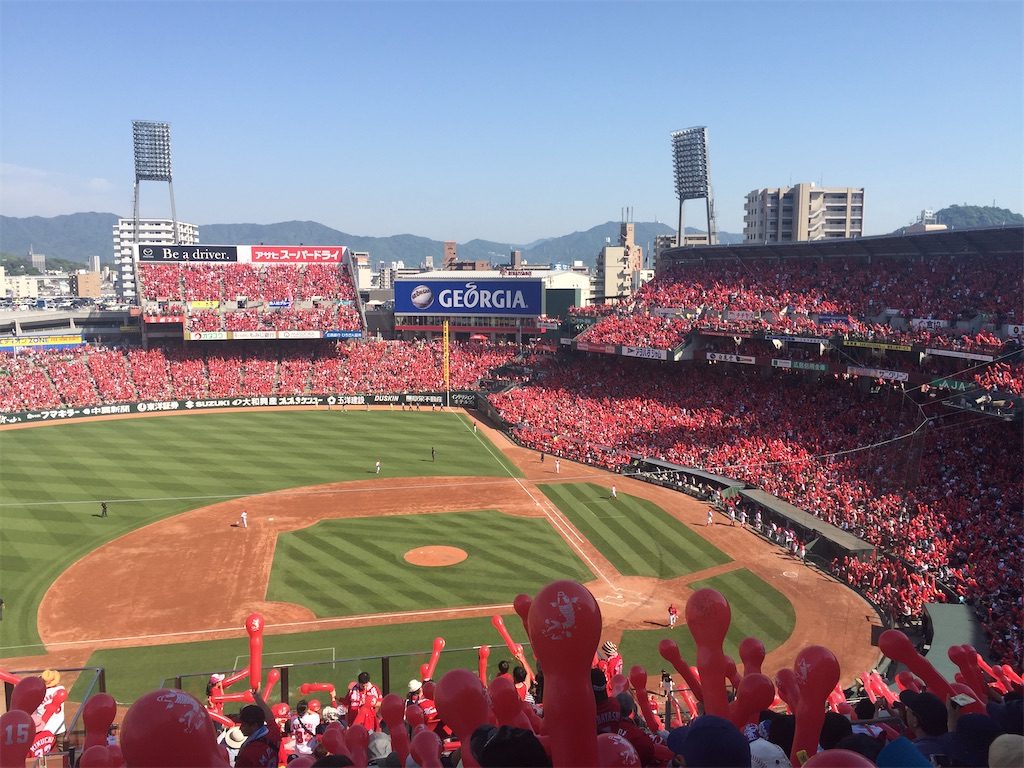
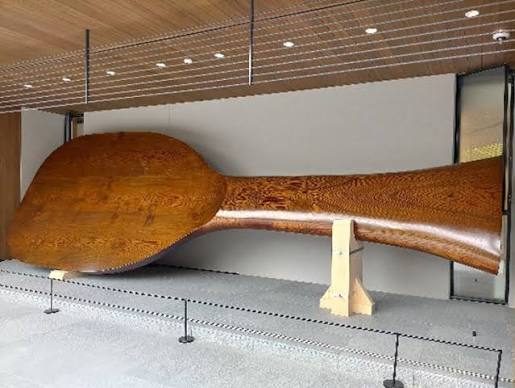
Why fans cheer with shamoji
At Carp games you may see fans clapping shamoji (rice ladles) together. The shamoji of Miyajima is a good-luck charm, known because around the time of the First Sino-Japanese War and the Russo-Japanese War soldiers dedicated them with prayers for victory, as a way to "meshi-toru" — "scoop up" the enemy, a pun on scooping rice. For the history of the Miyajima shamoji, go to the Crafts room.
Main sources: Hiroshima Toyo Carp, "Club History" / City of Hiroshima, "Former Hiroshima Municipal Stadium Site" / Hiroshima City Archives