Home / Legends and Urban Legends
10 — LEGENDS
Legends and Urban Legends
Taira no Kiyomori, who beckoned back the setting sun with his fan; Ito Hirobumi, who likened a teahouse girl's hands to maple leaves; the origin of the city's name; and a rivalry between naval port towns over who came "first." We introduce the stories told in Hiroshima, marking where history ends and legend begins.
Labels: Factdocumented Likelysupported by most sources Legendoral tradition Urban legendlocal lore and rumour
Kiyomori, who called back the setting sun
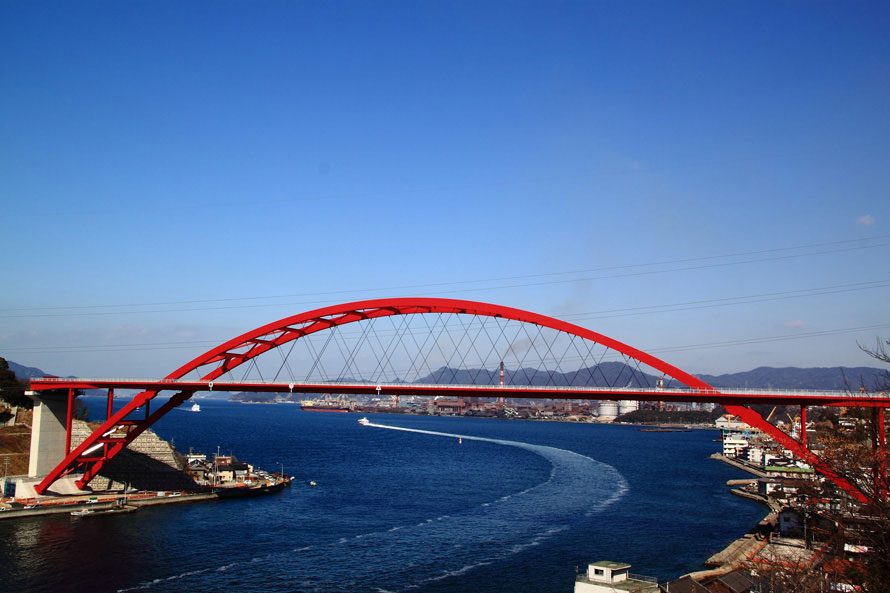
Between the mainland part of Kure City and Kurahashi Island runs a strait called Ondo no Seto, only about 90 metres wide. As a shortcut for ships on the Seto Inland Sea, it has been busy with shipping since ancient times.
"Kiyomori cut it through in a single day"
Legend has it that Taira no Kiyomori drove the work of cutting this strait on at full speed, and when it looked as though sunset would halt the work, he beckoned the setting sun back with his fan and finished the job in a single day. Nearby are the "Himaneki" (Sun-Beckoning) statue and the Kiyomorizuka mound, dedicated to Kiyomori.
The records of the work are unclear
It is certain that Kiyomori put great effort into improving the sea lanes of the Inland Sea. But there is no reliable record showing that Kiyomori opened Ondo no Seto, and one view holds that he widened a waterway that already existed.
Momiji manju and Ito Hirobumi
"What sweet little hands, like maple leaves"
A well-known story says that momiji manju began when Ito Hirobumi, visiting Miyajima, looked at the hands of a girl at a teahouse and joked, "What sweet hands, like maple leaves. I bet they'd taste good grilled."
It was devised by a confectioner
Momiji manju is thought to have been devised by Takatsu Tsunesuke, a confectioner on Miyajima. It was born around the end of the Meiji era at the request of an inn in Momijidani. It is certain that Ito Hirobumi loved to visit Miyajima, and the story is thought to have spread from there (the Food room).
The name "Hiroshima"
Two names combined
It has been widely said that Mori Terumoto named the city by combining "Hiro" from Oe no Hiromoto, an ancestor of the Mori family, with "shima" from Fukushima Motonaga, a local warrior who guided him when choosing the site for the castle.
Or "broad islands"
Another theory holds that the name "broad islands" (hiroi shima) referred to the islands spread across the Ota River delta. No reliable record survives, and the origin remains unclear (the Castle Town on a Delta room).
Where was nikujaga born?
"Togo Heihachiro's beef stew"
A widely known story says that Togo Heihachiro, who had studied in Britain, missed the beef stew he ate there and had his ship's cook make it; the cook came up with a lookalike using soy sauce and sugar, and that was the beginning of nikujaga (meat and potato stew).
It certainly was a navy dish
It is certain that a cookery textbook of the former Imperial Navy includes an "amani" (sweet simmered dish) close to nikujaga. In the 1990s, Maizuru in Kyoto Prefecture, where Togo served, and Kure in Hiroshima Prefecture each declared themselves "the birthplace of nikujaga," and it is still a talking point in both cities. There is no reliable record backing up the Togo anecdote.
The deer of Miyajima, and the customs of the island of the gods
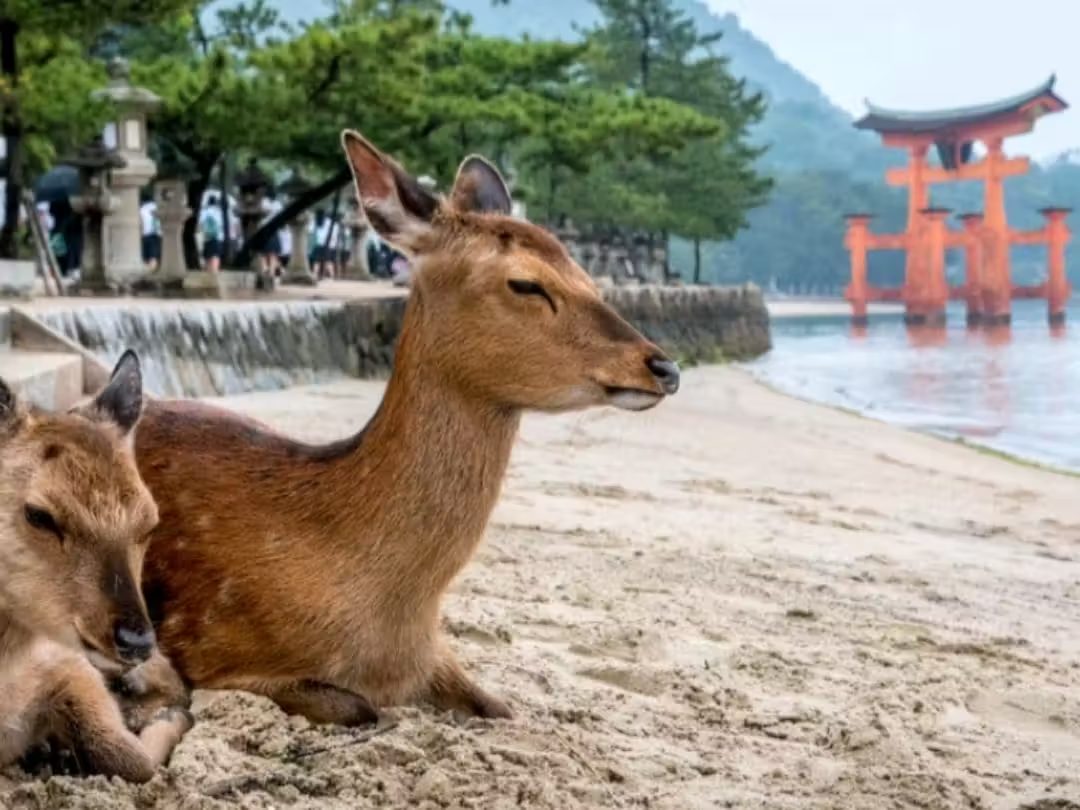
LikelyOn Miyajima, where the whole island has been regarded as sacred ground, it is said there was once a custom of facing death and childbirth off the island (the Miyajima room). The island's deer are also regarded as messengers of the gods, and live leisurely lives alongside people. But the deer are wild animals. Take care that they don't nibble your paper map or your souvenir bags.
Main sources: Kure City, "Ondo no Seto" / Miyajima Tourist Association / City of Hiroshima, "Origin of the Place Name Hiroshima" / Kure City and Maizuru City tourism materials