Home / A Castle Town on a Delta
00 — ORIGINS
A Castle Town on a Delta
Walk around central Hiroshima and you soon notice how often you cross a river. The city stands on a delta built from sediment carried down by the Ota River. Why, in 1589, did the warlord Mori Terumoto build his castle on low-lying land by the sea?
Labels: Factdocumented Likelysupported by most sources Legendoral tradition Urban legendlocal lore and rumour
From a mountain castle to a castle by the sea
FactThe Mori family was originally based at Yoshida-Koriyama Castle, a mountain castle in what is now Akitakata City. In the time of Mori Motonari they became lords of most of the Chugoku region, and his grandson Mori Terumoto became one of the great lords serving Toyotomi Hideyoshi.
FactIn 1589 Terumoto began building a new castle on the delta spreading out at the mouth of the Ota River. A castle on a mountaintop is strong in defence, but inconvenient for feeding a large army or moving goods and people. What he wanted was a castle on the plain that commanded transport by river and sea. It is said that Terumoto felt this need after seeing Osaka Castle and the Jurakudai palace. In 1591 he moved into the castle while it was still unfinished.
Fukushima Masanori and the "unauthorised repairs"
FactHaving served as commander-in-chief of the Western Army at the Battle of Sekigahara, Terumoto was cut back after the war to the two provinces of Suo and Nagato (today's Yamaguchi Prefecture), and left Hiroshima. In his place came Fukushima Masanori, a general who had been raised in Toyotomi Hideyoshi's own service. Masanori put the castle town in order and routed the Saigoku Kaido highway through it, creating the framework of the town.
FactBut in 1617 a flood damaged the castle's stone walls and other parts, and Masanori repaired them. The shogunate judged these to be unauthorised repairs, made without proper notification, and in 1619 it punished Masanori and confiscated his domain. The castle on the delta always lived side by side with the threat of flooding.
250 years of the Asano
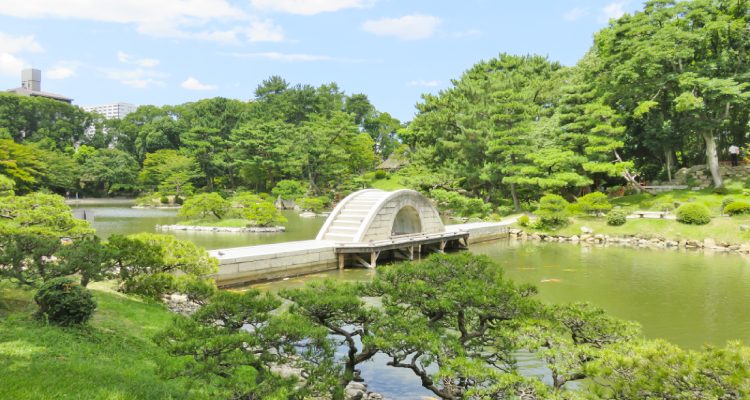
FactIn 1619 Asano Nagaakira arrived from Wakayama in Kishu, and from then until the Meiji Restoration, some 250 years, the Asano family ruled the Hiroshima domain. The daimyo garden said to have been created by Ueda Soko, Nagaakira's chief retainer and also a master of the tea ceremony, is today's Shukkeien.
FactIn the Edo period, Hiroshima pressed ahead with land reclamation, filling in the tidal flats south of the castle town one after another. The new land created in this way was called "shingai" (newly opened land), and became farmland and town. Much of southern Hiroshima City today was once sea.
Look here: the stone walls and moats of "Rijo"
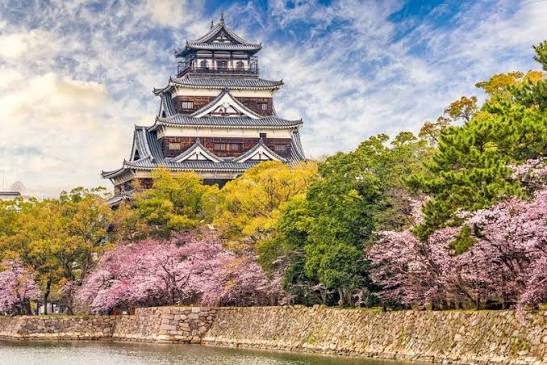
Hiroshima Castle is also known as "Rijo" (Carp Castle). Its keep collapsed in the atomic bombing of 1945, and in 1958 a reinforced-concrete keep reproducing the original exterior was built, but it was closed on 22 March 2026, owing to its age among other reasons (the exterior can still be viewed). Even so, the stone walls and moats of the main enclosure largely keep their appearance from the time the castle was built. Look out for the marks carved into the stones of the walls.
Where does the name "Rijo" come from?
There are various theories about why Hiroshima Castle is called "Rijo" (Carp Castle): because the area around the castle was known as "Koi-no-ura" (koi also means carp), or because there were many carp in the moats, and so on. There is no clear answer, but the name would later lead to the name of the citizens' baseball team: the "Carp" (the Carp room).
Main sources: Hiroshima Castle, "History of Hiroshima Castle" / City of Hiroshima, "On the Closure of the Hiroshima Castle Keep" / Shukkeien / Hiroshima City Archives