Home / 9 August 1945
08 — 9 AUGUST 1945
9 August 1945
At 11:02 a.m., an atomic bomb exploded in the sky over Urakami. Nagasaki was not the primary target that day. What happened, and how has the city moved forward since? We look back, following the record through numbers and places.
Labels: Factdocumented Likelysupported by most sources Legendoral tradition Urban legendlocal lore and rumour
The primary target was Kokura
FactOn 9 August 1945, the American B-29 carrying the atomic bomb first headed for Kokura in Fukuoka Prefecture. But visibility over Kokura was poor because of smoke and haze from an air raid the day before, and the bomb could not be dropped by sight. With fuel running low, the bomber turned toward its secondary target: Nagasaki.
FactThe sky over Nagasaki was also heavily clouded, but the bomb was released through a gap in the clouds. At 11:02 a.m., it exploded about 500 metres above the Urakami district, some 3 km north of the city centre.
Urakami — above a land of faith
FactUrakami, near the hypocentre, was an area where many descendants of the Hidden Christians who had kept their faith lived (see the Hidden Christians room). Urakami Cathedral, which the faithful had spent many years building, collapsed, and the priests and believers inside were killed.
Nagasaki Medical College (now the Nagasaki University School of Medicine) also stood near the hypocentre, and many of its faculty, staff and students lost their lives. Nagai Takashi, a doctor who cared for the injured despite being exposed to the bomb himself, recorded his experiences in works such as The Bells of Nagasaki (see Further Reading).
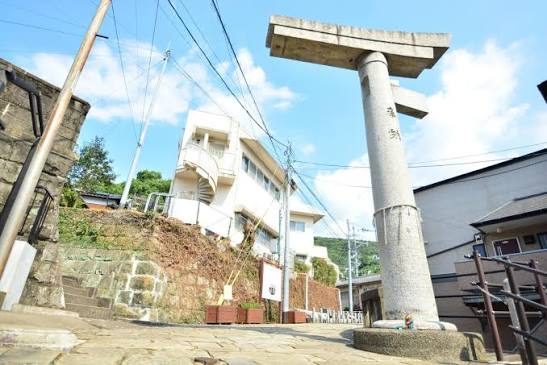
Look here: the one-legged torii and the A-bombed camphor trees of Sanno Shrine
At Sanno Shrine, about 800 metres southeast of the hypocentre, stands a torii gate that had one of its pillars blown away by the blast — a torii that still stands on a single pillar. The great camphor trees in the shrine grounds, thought to have been burned to death, later sprouted again.
As a city of prayer
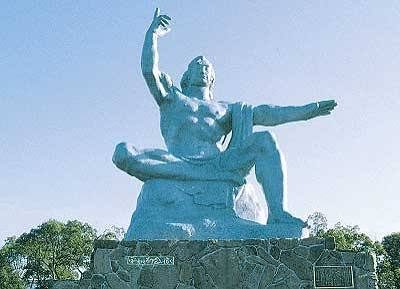
FactPeace Park was laid out near the hypocentre, and in 1955 the Peace Statue by the sculptor Kitamura Seibo was completed. Its right hand pointing to the sky is said to represent the threat of atomic weapons, and its outstretched left hand, peace. Every 9 August a Peace Memorial Ceremony is held, and at 11:02 a.m. the city falls silent in prayer.
"Let Nagasaki be the last place to suffer an atomic bombing"
These words have been spoken again and again in Nagasaki. The testimony of the survivors, the buildings and trees that remain, and the prayers offered each year: as one of the two cities, along with Hiroshima, to have suffered the effects of nuclear weapons, Nagasaki remains a place that passes its memory on to the next generation.
Main sources: City of Nagasaki, "Peace in Nagasaki" / Nagasaki Atomic Bomb Museum / City of Nagasaki, "Damage Caused by the Atomic Bomb"