Home / Gunkanjima and Industrial Heritage
07 — INDUSTRIAL HERITAGE
Gunkanjima and Industrial Heritage
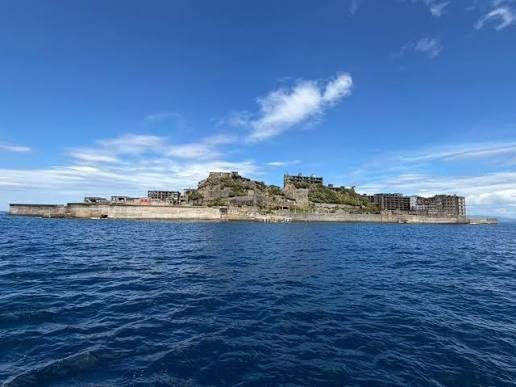
Off Nagasaki harbour, a small island floats on the sea looking like a warship. This is Hashima, better known as Gunkanjima — "Battleship Island." Born of an undersea coal mine, it was home to Japan's oldest reinforced-concrete apartment building, and people once lived here at what is said to have been the highest population density in the world.
Labels: Factdocumented Likelysupported by most sources Legendoral tradition Urban legendlocal lore and rumour
Coal under the sea made the island grow
Hashima lies in the sea about 19 km southwest of Nagasaki harbour. It was originally a small reef, but from the Meiji era onwards it was repeatedly enlarged by land reclamation to mine the high-quality coal beneath the seabed. Today it measures about 480 m north to south, about 160 m east to west, and about 1.2 km around.
FactAfter Mitsubishi took over its operation in 1890, miners and their families came to live on the island, and a complete town grew up there — with a school, a hospital, shops and even a cinema.
1916: Japan's oldest reinforced-concrete apartment building
FactTo house many people on so little land, one high-rise apartment block after another was built on the island. Building No. 30, built in 1916, is considered the oldest reinforced-concrete apartment building in Japan. It was originally four storeys and was later extended to seven. It is built around a hollow central courtyard, in a square "ro" shape (like the Japanese character 口).
LikelyAt its peak around 1960, about 5,300 people lived here, and the population density is said to have been more than nine times that of Tokyo at the time — the highest in the world. When the mine closed in 1974, the residents left within just a few months, and Hashima became an uninhabited island.
Look here: the angle that makes it a "battleship"
Viewed from a landing-tour boat, there is a moment when the sea walls and high-rise apartments line up and the island looks like a battleship. The name "Gunkanjima" is said to have spread in the Taisho era, when people remarked on its resemblance to the battleship Tosa of the day.
Nagasaki, city of shipbuilding
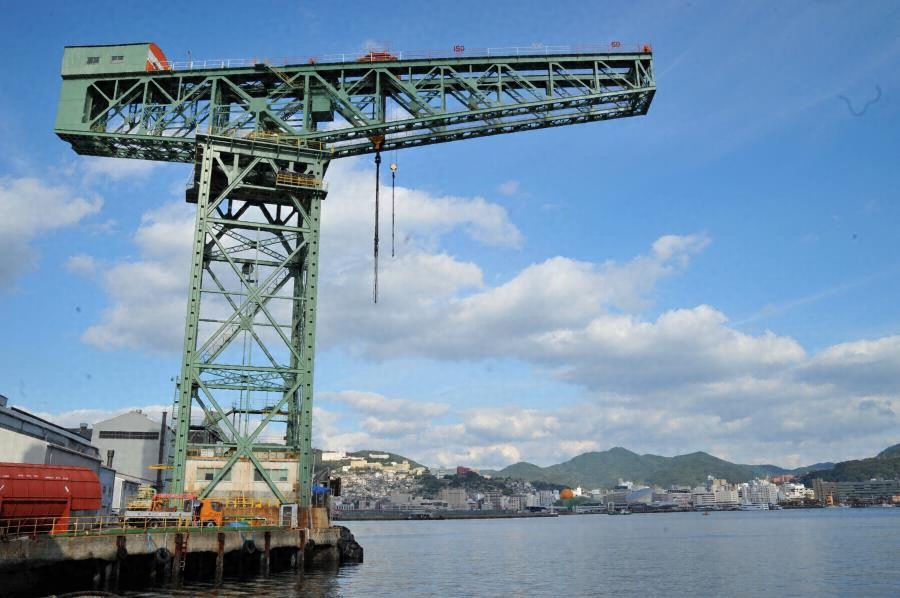
FactThe other pillar of Nagasaki's modernisation was shipbuilding. It began with the Nagasaki Iron Works, which the shogunate started building in 1857 at the end of the Edo period, and which later became Mitsubishi's Nagasaki Shipyard. The Giant Cantilever Crane, brought in from Britain in 1909, is still in operation more than 100 years later.
FactIn 2015, the Hashima Coal Mine, the Nagasaki Shipyard crane, the Former Glover House and other sites were inscribed as World Heritage as part of the "Sites of Japan's Meiji Industrial Revolution".
"It was attacked after being mistaken for a warship"
A story often told is that during the war, an American submarine mistook the island for a real warship and attacked it. However, no reliable record of this has been found.
An island that became World Heritage
Inscribed in 2015 as a component of the "Sites of Japan's Meiji Industrial Revolution." On landing tours, you can see part of the island from the visitor walkways.
It should also be noted that, for the industrial heritage sites including Hashima, attention has been drawn to the history of labour by people mobilised from the Korean Peninsula and elsewhere during the war. Knowing both the light and the shadow is key to understanding this heritage.
Main sources: City of Nagasaki, "Gunkanjima (Hashima)" / Industrial Heritage Information Centre / Mitsubishi Heavy Industries, "Nagasaki Shipyard Museum"