Home / The Chinese Quarter
02 — CHINA TOWN
The Chinese Quarter and Nagasaki's China
Say "the window of the closed country," and most people picture the Dutch on Dejima. But most of the foreigners who lived in Edo-period Nagasaki were Chinese. The Chinese Quarter, the Chinese temples, the dragon dance at Kunchi — deep within Nagasaki's culture, you will find China.
Labels: Factdocumented Likelysupported by most sources Legendoral tradition Urban legendlocal lore and rumour
Far more numerous than the Dutch
In the Edo period, the countries allowed to trade at Nagasaki were the Netherlands and China. While the Dutch on Dejima usually numbered only a dozen or so, Chinese ships came in their dozens in busy years, and their crews and merchants could number in the thousands.
FactAt first the Chinese could live anywhere in town, but to prevent smuggling, in 1689 the shogunate completed the Tojin Yashiki (Chinese Quarter) at Juzenji-go, south of the town, and required them to live there. It covered about 9,400 tsubo and is said to have housed around 2,000 people at a time — more than twice the size of Dejima.
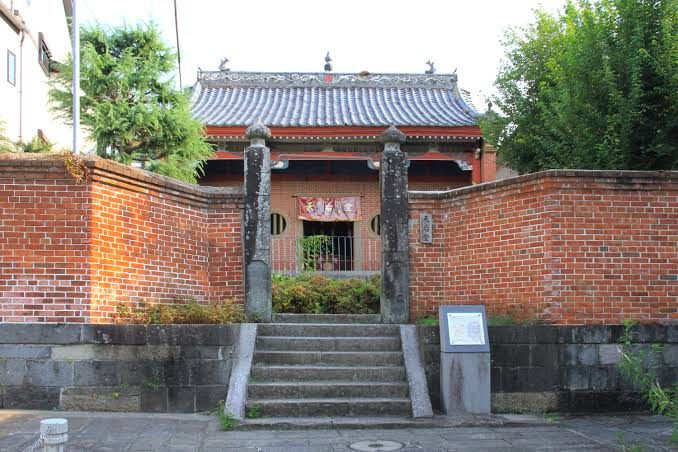
After the port opened in 1859 the Chinese Quarter fell into decline, and in 1870 it burned down. In today's Kannai-machi, buildings such as the Dojindo, Tenkodo and Kannondo halls, along with stone walls, survive and still convey the feel of the old lanes.
Look here: Mazu at the Tenkodo
The Tenkodo hall enshrines Mazu, the guardian goddess of seafarers. Chinese ships crossed the sea carrying statues of Mazu, and on reaching Nagasaki they entrusted them to the Chinese temples and halls. Mazu, widely worshipped in Taiwan too, lives on in the back lanes of Nagasaki.
Chinese temples — one for each homeland
FactIn the early Edo period, the Chinese of Nagasaki built temples according to where they came from: Kofukuji (c. 1620) for people from the Nanjing area, Fukusaiji for those from Quanzhou and Zhangzhou in Fujian, and Sofukuji (1629) for those from Fuzhou. Together they are known as the "Three Fuku Temples of Nagasaki." Sofukuji's Daiippomon Gate and Daiyuhoden Hall are designated National Treasures.
Mokusu Nyojo, head priest of Kofukuji, built a stone arch bridge over the Nakashima River in 1634. This is the Meganebashi (Spectacles Bridge) that still stands today. Chinese engineering helped shape the very streetscape of Nagasaki.
The dragon dance of Kunchi, the winter of lanterns
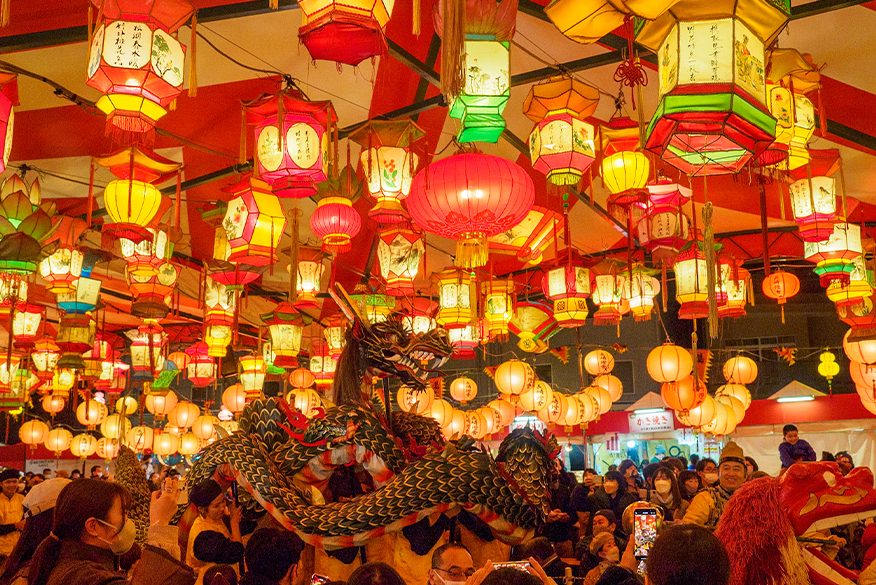
FactEvery October at Nagasaki Kunchi, each neighbourhood presents a dedicatory performance. The most famous of all, the ja odori (dragon dance), belongs to the area where the Chinese Quarter once stood and is based on a dance brought by the Chinese.
FactThe winter Nagasaki Lantern Festival began as the Lunar New Year (Spring Festival) celebration of the people of Shinchi Chinatown. It was expanded into its current form in 1994, and with some 15,000 lanterns said to light up the city, it has become a signature sight of Nagasaki in winter.
Butterfly effect: confine them, and a Chinatown is born
Gathering the Chinese into their quarter meant that warehouses were needed on the waterfront to store the cargo of Chinese ships. In 1702, land was reclaimed for that purpose to create the "Shinchi Kurasho" storehouses. After the port opened, Chinese people moved in here — the beginning of today's Nagasaki Shinchi Chinatown.
Main sources: City of Nagasaki, "History of the Chinese Quarter" / City of Nagasaki, "Nagasaki Lantern Festival" / Temple histories of Sofukuji and Kofukuji