Home / Nagasaki at the End of the Shogunate
06 — BAKUMATSU
Late-Edo Nagasaki and Its Young Revolutionaries
With the opening of the port in 1859, Western-style houses for foreign residents sprang up on Nagasaki's hills. To a harbour where weapons, ships and information changed hands came Sakamoto Ryoma and other young men determined to move the times. And one photographer was capturing them on camera.
Labels: Factdocumented Likelysupported by most sources Legendoral tradition Urban legendlocal lore and rumour
The settlement on the hill
FactIn 1859, Nagasaki was opened as a free-trade port along with Yokohama and Hakodate. The Dutch trading post on Dejima had served its purpose, and on the hills of Minamiyamate and Higashiyamate overlooking the harbour, a foreign settlement took shape where merchants from many countries lived. The cobbled Oranda-zaka (Dutch Slope) is one of this settlement's streets.
Thomas Glover — the merchant on the hill
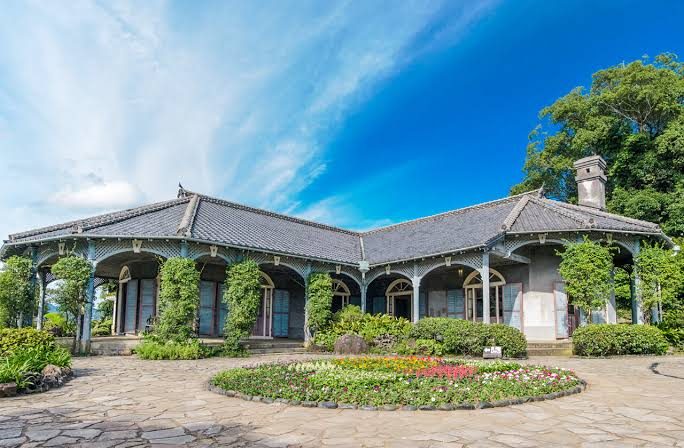
FactThe Scotsman Thomas Glover came to Japan in 1859 and set up a trading company in Nagasaki. Starting with tea exports, he went on to trade in ships and weapons, becoming deeply involved with the domains of the late Edo period. His residence, built in 1863, is considered the oldest surviving Western-style wooden building in Japan, and is open to the public as the centrepiece of Glover Garden.
Glover is also known for helping young men from the Choshu domain to travel secretly to Britain — the "Choshu Five," including the future Ito Hirobumi. See also the Choshu Five room on Hagi Historia.
Kameyama Shachu — Japan's first "company"?
FactIn 1865, Sakamoto Ryoma and his associates founded the Kameyama Shachu at Kameyama in Nagasaki. Backed by the Satsuma domain, it was an organisation that used ships to transport goods and carry on trade. The Shachu served as a link between the rival domains of Satsuma and Choshu — for example, buying weapons and warships in Satsuma's name and passing them on to Choshu. In 1867 it was reorganised as the Kaientai under the Tosa domain.
"Kameyama Shachu was Japan's first joint-stock company"
You often hear it described this way, but it did not work like a modern joint-stock company. "A forerunner of Japan's trading companies" is a more accurate way to see it.
Logistics that joined Satsuma and Choshu
The Shachu's trade drew Satsuma and Choshu closer on a practical level, leading to the Satsuma–Choshu Alliance of 1866.
Look here: Ryoma's boots and the Kameyama Shachu Memorial Museum
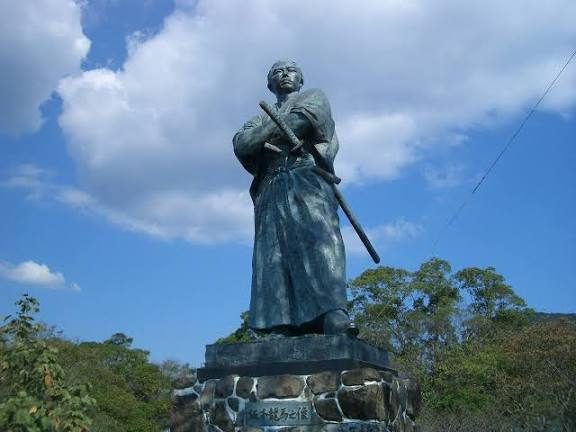
Climb the sloping lane at the foot of Mt. Kazagashira and you reach the memorial museum built on the site of the Kameyama Shachu. In a nearby plaza stands a sculpture of a giant pair of boots that you can step into for a souvenir photo — a nod to Ryoma's famous photograph in which he is wearing boots.
Ueno Hikoma — the man who photographed Ryoma
FactNagasaki's Ueno Hikoma learned chemistry and photography from the Dutch and, in 1862, opened a photo studio (the Ueno Satsueikyoku) in Nagasaki, making him one of the pioneers of Japanese photography. Many of the late-Edo revolutionaries and foreigners had their pictures taken here.
LikelyThe famous photograph of Sakamoto Ryoma standing in boots with his elbow resting on a stand is most likely to have been taken at Ueno Hikoma's studio (another theory credits his pupil, Inoue Shunzo).
Butterfly effect: the "information" that gathered at the port
Nagasaki had "sources of information": foreign newspapers, weapons, steamships and foreign merchants. It was a place where you could get your hands on real things and real business that debates in Edo or Kyoto could never offer — and that is what drew the young revolutionaries to Nagasaki.
Main sources: Glover Garden official website / Nagasaki City Kameyama Shachu Memorial Museum / Nagasaki University Library, "Japanese Old Photographs in Bakumatsu-Meiji Period"