Home / Hidden Christians
03 — HIDDEN FAITH
250 Years of the Hidden Christians
In the years of prohibition, in villages without priests, people passed their prayers and the church calendar from parent to child. Then, in 1865, in a newly completed church, a woman whispered to a priest: "Our hearts are the same as yours."
Labels: Factdocumented Likelysupported by most sources Legendoral tradition Urban legendlocal lore and rumour
The town called "Little Rome"
For some time after the port opened, Nagasaki was a Christian town lined with churches. LikelyBased on records left by missionaries of the time, Nagasaki is said to have been called "Little Rome."
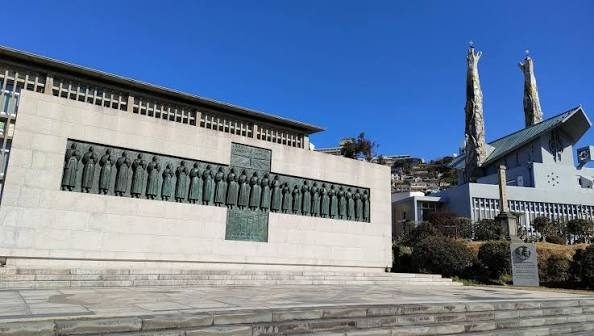
FactBut in 1587 Toyotomi Hideyoshi issued his edict expelling the Jesuit missionaries, and in 1597, 26 missionaries and believers arrested in Kyoto and Osaka were executed on Nagasaki's Nishizaka Hill. They are the Twenty-Six Martyrs of Japan. Then in 1614, the Tokugawa shogunate banned Christianity throughout the country and expelled the missionaries.
The Shimabara Rebellion and "ebumi"
FactIn 1637, the people of Shimabara and Amakusa, suffering under heavy taxes and persecution, rose up and barricaded themselves in Hara Castle (the Shimabara Rebellion). After it was crushed the following year, 1638, the shogunate tightened its crackdown even further.
In Nagasaki, every New Year, people were made to tread on images of Christ or Mary to prove they were not believers. This was called ebumi ("picture-treading"). The images to be trodden on, called fumie, were kept by the Nagasaki Magistrate's Office. It is said that people stepped on the images, then went home and prayed for forgiveness.
250 years without priests
Living outwardly as Buddhists, people went on keeping their faith. These were the Senpuku Kirishitan (Hidden Christians). They appointed leaders within their villages, administered baptism, and kept the days of prayer according to the church calendar. Their prayers, the "orasho" (from the Latin oratio), were handed down by word of mouth, still carrying echoes of Latin and Portuguese.
Look here: Maria Kannon
The Hidden Christians sometimes prayed to statues of Kannon, the Buddhist goddess of mercy, as if they were Mary. At first glance it is a Kannon holding a child, but the prayers offered to it were of another kind. You can sometimes see them in museums and churches.
1865: the "Discovery of the Hidden Christians"
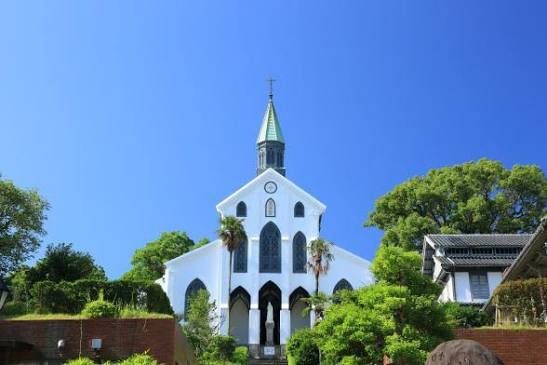
FactAfter the port opened, Oura Church (Oura Cathedral) was built for the foreign residents of the settlement and completed in 1864. On 17 March 1865, villagers from Urakami visited the church, and one of the women among them confided her faith to Father Petitjean. It was the moment the existence of a faith thought to have died out nearly 250 years earlier came to light, and it is known as the "Discovery of the Hidden Christians".
A defining moment: a quiet whisper in the church
Her words are said to have been "Warera no mune, anata no mune to onaji" — "Our hearts are the same as your heart." Then she asked, "Where is the statue of Santa Maria?" The news reached the Pope in Rome and astonished the world as "the Miracle of the Orient".
FactBut the ban was still in force. In 1867, believers in Urakami were arrested en masse, and many were sent into exile across the country (the Fourth Urakami Persecution, or "Urakami Yonban Kuzure"). The public notice boards banning Christianity were not taken down until 1873.
"All the Hidden Christians returned to Catholicism"
In fact, even after the ban was lifted, some people did not join the Catholic Church and kept the form of faith handed down from their ancestors. They are often distinguished by the name "kakure kirishitan" (literally "concealed Christians").
The World Heritage Site has 12 components
It consists of 12 components, including Oura Church, the ruins of Hara Castle, and villages in Sotome and the Goto Islands. What was recognised was the very form of the communities that kept their faith through the era of hiding.
Main sources: Nagasaki Prefecture, "Hidden Christian Sites in the Nagasaki and Amakusa Region" / Oura Church Kirishitan Museum / Twenty-Six Martyrs Museum