Home / Bridge of Nations: the Age of Trade
02 — BRIDGE OF NATIONS
Bankoku Shinryo — The Great Age of Trade
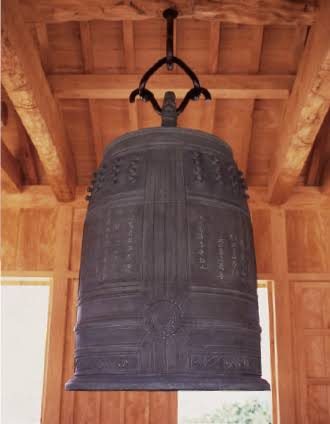
In 1458, a bell was hung in the Seiden of Shuri Castle. Inscribed on it are words meaning "with ships, we shall be a bridge between all nations." We trace the age when a small kingdom with few resources prospered through trade that linked the seas of Asia.
Labels: Factdocumented Likelysupported by most sources Legendoral tradition Urban legendlocal lore and rumour
A nation's identity, cast in a bell
FactThe bell said to have been cast in 1458 on the orders of King Sho Taikyu and hung in the Seiden of Shuri Castle is the Bankoku Shinryo Bell (Bell of the Bridge of Nations). Its inscription says that Ryukyu lies in a blessed place in the southern seas, gathers the finest things of Korea, and stands between Ming China and Japan in a relationship of mutual support. It goes on: "with boats and oars, it makes itself the shinryo of all nations" — in other words, using ships, it becomes a bridge between the countries of the world.
Shinryo means "harbour and bridge." The phrase is still used today to express the spirit of Okinawa, and the venue of the 2000 Kyushu-Okinawa Summit was named the Bankoku Shinryokan. The original bell is held by the Okinawa Prefectural Museum & Art Museum in Naha.
Tribute to the Ming, and entrepôt trade
FactThe core of Ryukyu's trade was tribute to Ming China. The king sent tribute to the Chinese emperor and was recognised by the emperor as king (investiture). In return, he received goods worth more than the tribute, and the missions were also allowed to trade in China. The number of Ryukyuan tribute missions recorded in Ming sources was far greater than that of any other tributary state.
FactAt the time, the Ming prohibited private individuals from trading freely overseas (the haijin, or maritime ban). Ryukyu therefore took on the role of an entrepôt trader, carrying silk and porcelain obtained in China to Japan, Korea and Southeast Asia, and bringing Japanese swords and copper, and Southeast Asian spices and sappanwood (a dye), to China. Ryukyuan ships called at ports such as Siam (Thailand), Malacca, Palembang and Java.
Look here: the "Lequeos" described by a Portuguese writer
In the early 16th century, Tomé Pires, a Portuguese who stayed in Malacca, wrote in his Suma Oriental about the "Lequeos" (Ryukyuans) who came to the port. The figures of Ryukyuan sailors survive even in records from faraway Europe.
Kume Village — a town of people from China
LikelyNear the port of Naha was Kume Village (Kumemura, or Kuninda), a town of people who had settled there from Fujian in China. It is said to have begun with the "Thirty-Six Families from Min", said to have been sent to Ryukyu by the Ming emperor. The people of Kume Village handled the drafting of documents in Chinese, interpreting and navigation, and supported the kingdom's diplomacy.
FactKume Village produced several figures whose names are recorded in the kingdom's history. The 18th-century statesman Sai On is known as a reformer who promoted forest conservation and flood control. And the moral primer Rikuyu Engi, published in Fuzhou by Tei Junsoku, reached the shogun Tokugawa Yoshimune via Satsuma; its commentary, Rikuyu Engi Taii, was widely used as a textbook in the terakoya schools of the Edo period.
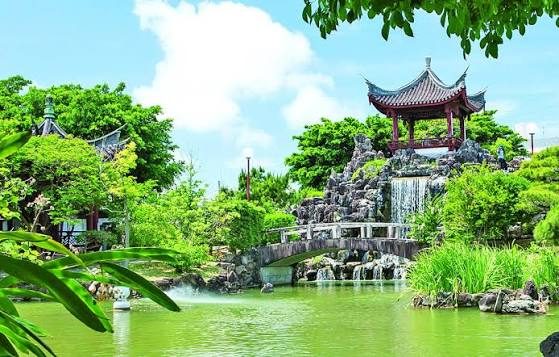
FactThe Chinese port used by Ryukyuan tribute ships was at first Quanzhou, and later Fuzhou. In Fuzhou there was a "Ryukyu House" where Ryukyuans stayed, and the ties between Naha and Fuzhou continue today. Naha and Fuzhou are sister cities, and in Kume, Naha, there is a Chinese-style garden, Fukushu-en.
Butterfly effect: when the maritime ban eased, the kingdom's role shrank
Ryukyu's entrepôt trade depended on the Ming "maritime ban." In the 16th century, the Portuguese pushed into Asian waters, and around 1567 the Ming also partly permitted private overseas trade. Once Chinese merchants began sailing directly to Southeast Asia, there was less need for Ryukyu as a go-between, and the great age of trade gradually drew to a close. Then, in 1609, the kingdom was invaded by Satsuma (the Ryukyu Disposition room).
Main sources: Okinawa Prefectural Museum & Art Museum, "The Bankoku Shinryo Bell" / Okinawa Prefectural Board of Education, Rekidai Hoan / City of Naha, "Fukushu-en"