Home / Miyako, Yaeyama, Yonaguni and Taiwan
09 — ISLANDS
Miyako, Yaeyama, Yonaguni and Taiwan
Travel some 300 km southwest from Okinawa Island and you reach the Miyako Islands, and beyond them the Yaeyama Islands. Their languages and festivals differ from those of the main island — and Taiwan is right next door. From Yonaguni Island to Taiwan is about 111 km. This is the story of neighbours far closer than Tokyo.
Labels: Factdocumented Likelysupported by most sources Legendoral tradition Urban legendlocal lore and rumour
There is more than one "Okinawa"
The islands of Okinawa Prefecture fall broadly into groups such as the Okinawa Islands, the Miyako Islands and the Yaeyama Islands. Languages differ greatly from island to island: the languages of the main island, Miyako, Yaeyama and Yonaguni are so different that their speakers cannot understand one another. In 2009, UNESCO listed each of them as an endangered language.
FactMiyako and Yaeyama came under the rule of the Ryukyu Kingdom between the late 15th and early 16th centuries. Oyake Akahachi, remembered as a hero of Ishigaki Island, fought the royal government's army in 1500 and was defeated. The royal records call him a "rebel," but on Ishigaki he is honoured as a hero who tried to protect the island, and a statue of him stands there today.
The poll tax — a heavy burden for over 260 years
FactAfter the Satsuma invasion of 1609, the burden of the tribute owed to Satsuma weighed on every part of the kingdom. In Miyako and Yaeyama, from around 1637, a poll tax, levied according to the number of people rather than the area of land, was imposed. The tax continued even after Okinawa became a prefecture, and was not abolished until 1903.
"Grow taller than this stone and you pay tax"
A stone pillar a little over 140 cm tall in Hirara, Miyakojima City, is called the "Jintozeiseki" (poll tax stone) or "Bubakari-ishi," and a widely known story says that anyone who grew taller than it had to pay the tax.
In reality, age decided it
According to the records, the poll tax was levied on men and women aged 15 to 50 by traditional Japanese age reckoning. One view holds that the pillar's original role was as a marker for property boundaries or directions.
Yonaguni — the island where you can see Taiwan
FactFrom Yonaguni Island, Japan's westernmost point, it is about 111 km to Taiwan. On days when the air is clear, you can sometimes see Taiwan's mountains beyond the horizon from Irizaki, the western tip of the island (it is said to be visible only a few times a year).
FactFrom 1895 to 1945, Taiwan was under Japanese rule. In this era, for the people of Yaeyama and Yonaguni, Taiwan was the nearest big city "within the country." Many crossed to Taiwan for work, study or shopping, and people from Okinawa lived in Taipei and Keelung.
LikelyAfter the war, when a border was drawn between Taiwan and Okinawa, smuggling using Yonaguni as a relay point flourished against a backdrop of shortages. In the late 1940s, the island's port is said to have overflowed with people and goods from Taiwan and the main island, and its population swelled greatly for a time.
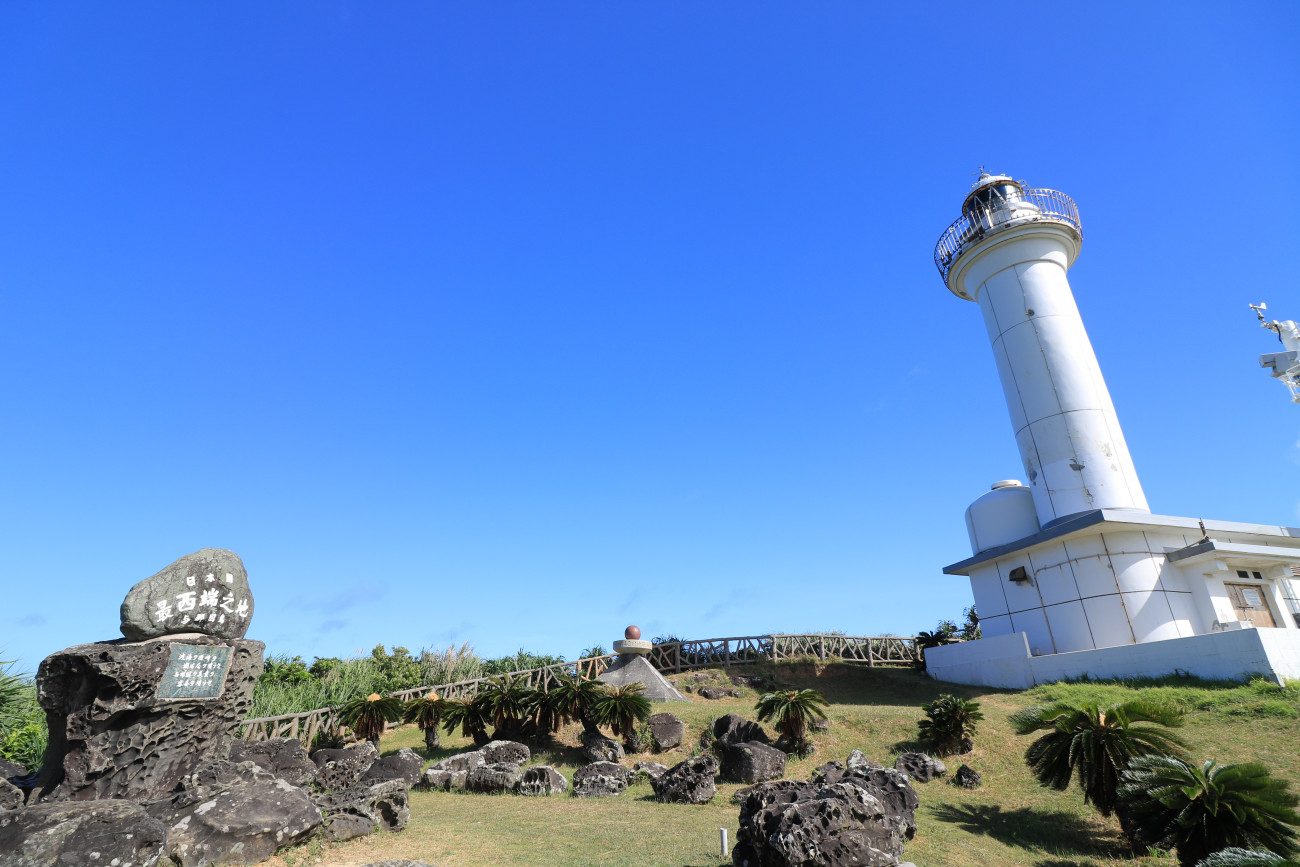
Look here: the "Westernmost Point of Japan" monument at Irizaki
Beside the lighthouse at Irizaki stands a monument marking "the Westernmost Point of Japan." It is also known as the last place in Japan where the sun sets. Look in the direction of Taiwan and feel for yourself how close it is.
The Taiwanese who grew Ishigaki's pineapples
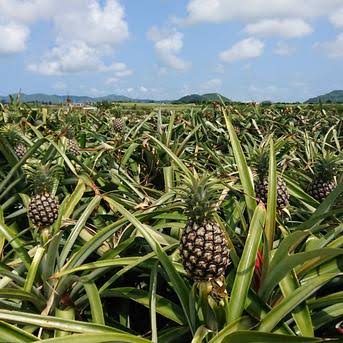
FactIn the 1930s, during the period of Japanese rule, groups of Taiwanese moved to Ishigaki Island. In 1935, Taiwanese farmers led by Lin Fa and others began growing pineapples at Nagura and elsewhere on Ishigaki. A cannery was built in 1938, and pineapples grew into Yaeyama's signature industry.
LikelyThe water buffalo used to plough the fields is also said to have been brought in by Taiwanese settlers around this time. The familiar scene of water-buffalo carts carrying tourists around Taketomi Island is said to be connected to this history too.
After the war, many of the Taiwanese settlers stayed on Ishigaki, acquiring Japanese nationality and making their lives there. On Ishigaki, the Tudigong (earth god) festival is still held by people of Taiwanese descent in the eighth lunar month. At Nagura there is also a monument honouring the achievements of the settlers from Taiwan.
The great tsunami of 1771
In 1771, a massive tsunami struck Yaeyama and Miyako (the Great Meiwa Tsunami). In Yaeyama alone, about 9,000 people — roughly a third of the population — are said to have died. On the coast of Ishigaki Island, huge boulders (tsunami stones) thought to have been thrown up by the waves at that time still remain today.
Main sources: Ishigaki City, History of Ishigaki City / Miyakojima City, "Jintozeiseki (Poll Tax Stone)" / Yonaguni Town / Okinawa Prefectural Library, materials on "Taiwan and Okinawa"