Home / Shisa and Island Lore
10 — LEGENDS
Shisa and Island Lore
Lions keeping watch over the town from the rooftops, stones set into walls at the ends of streets, a red-haired spirit living in a banyan tree. Everyday life in Okinawa is full of traditional wisdom for protecting yourself from unseen things. We introduce them here, marking where history ends and legend begins.
Labels: Factdocumented Likelysupported by most sources Legendoral tradition Urban legendlocal lore and rumour
Shisa — lions that turn back fire
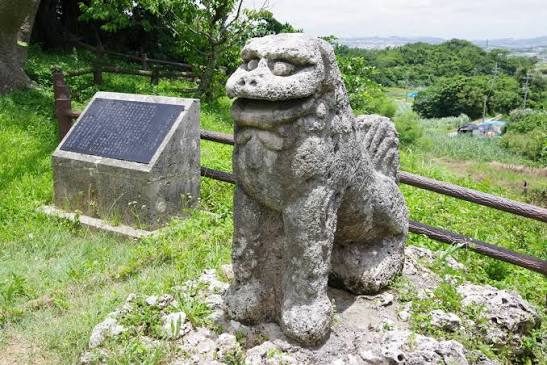
FactAmong Okinawa's shisa (guardian lion-dogs) that ward off evil, one of the oldest surviving examples made to protect a village is the Great Stone Lion of Tomori in Yaese Town. According to the Kyuyo, a history compiled by the royal government, fires kept breaking out in this village, so in 1689, on the advice of a feng shui master, the lion was set up facing Mt. Yaese, which was regarded as a "fire mountain" — in order to "turn back" the calamity of fire.
FactBullet marks from the Battle of Okinawa can still be seen on this great lion. In a village that became a battlefield, the lion, too, was wounded but kept standing.
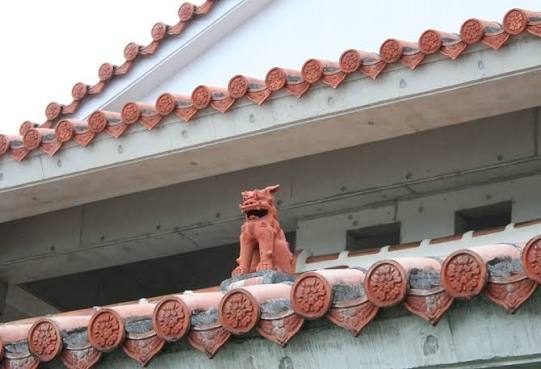
LikelyThe present-day custom of placing shisa on the roofs of houses is said to have spread after the Meiji period, once ordinary people were allowed to use red-tiled roofs. It is also said to have begun when tile makers fashioned lions from leftover tiles and plaster and set them on roofs.
"The one with its mouth open is the male"
A pair of shisa placed on either side of a gate is often explained this way: the one with its mouth open is the male, inviting good fortune in, and the one with its mouth closed is the female, keeping good fortune from escaping.
There is no rule, and it varies by area
Pairing an open-mouthed "a" with a closed-mouthed "un" follows the same idea as the komainu guardian dogs at Shinto shrines. Which one is male may be explained the opposite way depending on the area or the maker, and there is no fixed answer.
Ishiganto — spirits that can only go straight
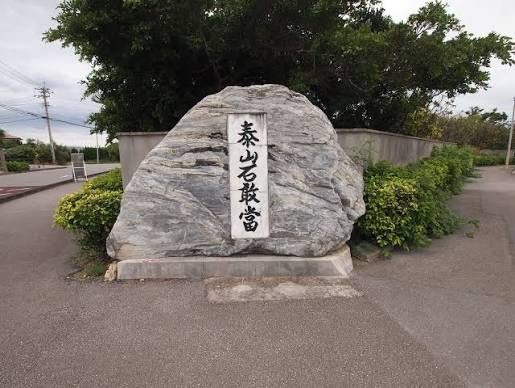
FactWalk around an Okinawan town and you will often see stones carved with the characters "ishiganto" (石敢當, a talismanic stone) set into the walls at the ends of T-junctions. It is a charm against evil that came from China, and it can also be found in Taiwan, Fujian, Kagoshima and elsewhere.
LegendIn Okinawa, it is said that evil spirits (majimun) can only travel in a straight line. The ishiganto bounces back any majimun that runs into the end of the street, so that it does not get into the house. The hinpun — a screen wall built between a house's gate and the main building — is likewise said to stop majimun from coming straight in.
Kijimuna and mabui
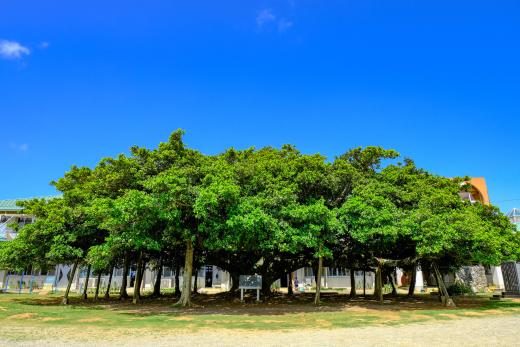
LegendOld banyan trees are said to be home to spirits called kijimuna (banyan tree sprites). They look like red-haired children, and their favourite food is fish eyes. They love playing tricks, but it is said that if you befriend one, it will help you with your fishing. They are said to dislike octopuses and chickens, and to hate having their tree damaged.
LegendIn Okinawa, a person's soul is called mabui. It has long been believed that a great fright or a fall can cause the mabui to drop out of the body. When that happens, people perform mabui-gumi ("putting the soul back"), calling it back at the spot where it fell by chanting "Mabuyaa, mabuyaa, uuti kuuyoo" ("Soul, soul, come back to me"). Some families still do this today, for example when a child has a fall.
Look here: the "san" on top of food
A san, made by knotting leaves of pampas grass or similar plants, is a talisman against evil. It is placed on offerings or on food being taken to someone. If you see one, it carries a wish: "may nothing bad get in along the way."
The habu and the mongoose
"The mongoose will get rid of the habu"
Fights between habu snakes and mongooses were once a star attraction at tourist facilities. Because of that image, the mongoose has long been thought of as the habu's natural enemy.
In reality, they hardly ever met
In 1910, mongooses were released on the main island in the hope that they would get rid of habu. But mongooses are active by day and habu mainly by night, so the two hardly ever meet. The mongooses instead began preying on native wildlife such as the Okinawa rail, and are now the target of eradication.
Main sources: Yaese Town, "The Great Stone Lion of Tomori" / Kyuyo / Okinawa Prefecture Department of Environmental Affairs, "Mongoose Control" / Okinawa Prefectural Museum & Art Museum