Home / Shuri Castle and the Ryukyu Kingdom
01 — SHURI CASTLE
Shuri Castle and the Ryukyu Kingdom
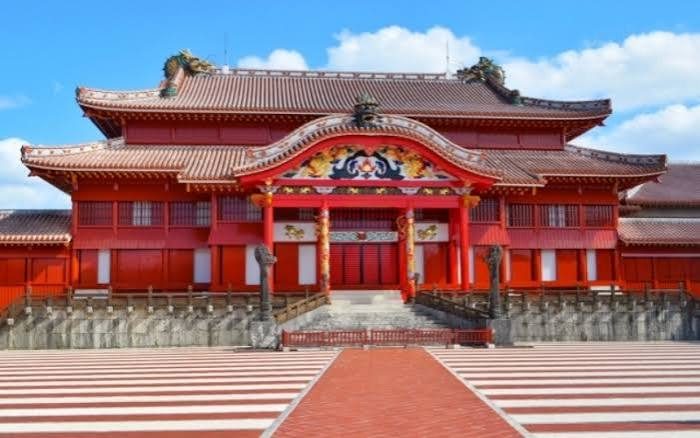
On a hill overlooking the town of Naha stood a red royal castle: Shuri Castle, the centre of government, ritual and diplomacy for the Ryukyu Kingdom, which lasted 450 years. In recorded history alone, this castle has burned five times — and been rebuilt each time.
Labels: Factdocumented Likelysupported by most sources Legendoral tradition Urban legendlocal lore and rumour
The castle of a kingdom that lasted 450 years
FactFrom Sho Hashi's unification of the Three Kingdoms in 1429 to the establishment of Okinawa Prefecture in 1879, the Ryukyu Kingdom lasted roughly 450 years. Along the way, in 1470, Sho En took the throne and the royal line changed. The dynasty before him is called the First Sho Dynasty, and the one after, the Second Sho Dynasty. The Second Sho Dynasty continued for about 400 years, through 19 generations.
Shuri Castle was the king's residence, but it was also the seat of government, a sacred site for prayer to the gods, and a diplomatic stage for receiving envoys from China and Japan. Within the castle was a sacred precinct called the Kyo-no-uchi, where rituals were held centring on the Kikoe-ogimi, the royal government's highest-ranking priestess (the Prayer room).
A Seiden where China and Japan meet
FactThe Seiden (main hall) of Shuri Castle is a uniquely Ryukyuan building, influenced by Chinese palaces while also drawing on Japanese building techniques: the curved karahafu gable over the front, the vermilion that colours the pillars and walls, and dragons painted everywhere. The courtyard in front of the Seiden, the Una, was used for ceremonies such as receiving the Chinese investiture envoys sent by the emperor.
LegendA well-known theory holds that the Seiden faces west rather than east because it was oriented towards China across the sea. Others, however, attribute its orientation to the terrain and the layout of the castle.
A castle burned five times, and five times rising again
FactIn recorded history alone, the Seiden of Shuri Castle has been destroyed by fire five times.
FactAfter the war, the campus of the University of the Ryukyus was built on the site of Shuri Castle, which the Battle of Okinawa had left without a trace. After the university moved away, plans for restoration went ahead, and in 1992 the Seiden was restored. Key sources for that restoration were drawings made in the early Showa period for its designation as a National Treasure, old photographs, and the records of the royal government.
After the 2019 fire, too, reconstruction began immediately. This time, one of the stated aims is to pass on techniques such as timberwork, red roof tiles and lacquering to the next generation, and the work has been open for the public to see. According to the national government's announcement, the Seiden is scheduled to open to the public from 23 November 2026 (as of September 2026).
Look here: the stone walls are "the real thing"
Unlike the buildings, which have burned and been rebuilt, the castle's stone walls still preserve a good deal of masonry from the kingdom era. The archaeological remains left in the ground beneath the Seiden are also a "genuine" part, registered as World Heritage. What was inscribed as World Heritage was not the buildings, but these remains underground.
The Shureimon Gate and the 2,000-yen note
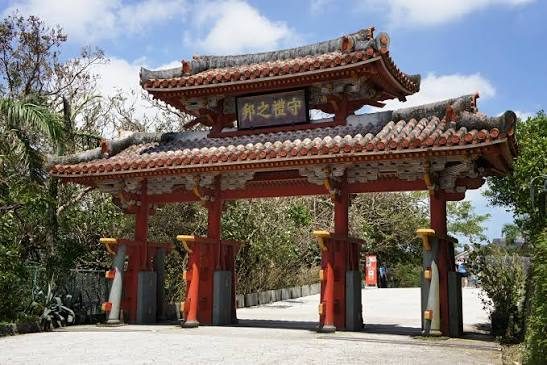
FactThe Shureimon Gate, which stands near the entrance to Shuri Castle, was first built in the 16th century. The inscription on its plaque, Shurei no Kuni, means "Ryukyu is a land that values propriety." Lost in the Battle of Okinawa, it was rebuilt in 1958 and became postwar Okinawa's signature tourist sight. In 2000 it also appeared on the 2,000-yen note, issued to coincide with the Kyushu-Okinawa Summit.
The World Heritage site: nine "gusuku and related properties"
The World Heritage site "Gusuku Sites and Related Properties of the Kingdom of Ryukyu," inscribed in 2000, is not just the site of Shuri Castle. It comprises nine places in all: four gusuku (Nakijin, Zakimi, Katsuren and Nakagusuku castle ruins), the royal mausoleum Tamaudun, the royal garden Shikinaen, the Sonohyan-utaki Stone Gate, and Sefa Utaki. Together, castles, a tomb, a garden and places of prayer convey the full picture of a kingdom.
Main sources: Shuri Castle Park (Okinawa Churashima Foundation) / Cabinet Office, Okinawa General Bureau, Okinawa Commemorative National Government Park Office, "Restoration of the Seiden of Shuri Castle" / Okinawa Prefecture, "Gusuku Sites and Related Properties of the Kingdom of Ryukyu"