Home / Islands and Gusuku Castles
00 — ORIGINS
The Islands and the Age of the Gusuku
Visit a castle ruin in Okinawa and you will notice that its stone walls trace soft, flowing curves — nothing like the castles of mainland Japan. We trace the era before the Ryukyu Kingdom was born, when powerful figures called aji built gusuku, fought one another, and gradually came together.
Labels: Factdocumented Likelysupported by most sources Legendoral tradition Urban legendlocal lore and rumour
People begin to live on the coral reef
FactMuch of the land in the Okinawan islands is limestone formed from ancient coral reefs that were pushed up above the sea — an environment in which bones survive well. As a result, many Palaeolithic human remains have been found here. Minatogawa Man, discovered in Yaese Town in the south of the main island, dates from about 20,000 years ago and is among the best-preserved Palaeolithic human remains in Japan.
For a long time afterwards, the islanders lived by gathering food from the sea and nuts from the trees. In Okinawa, this period — corresponding to the Jomon and Yayoi periods on the mainland — is called the Shell Midden period. Large sea snails from the southern seas, such as the gohoura conch and cone shells, were carried north as material for bracelets worn by the people of Kyushu. Even then, the islands were already linked by sea routes.
The age of the gusuku and the aji
FactFrom around the 12th century, farming spread, villages formed, and powerful figures known as aji (local lords) emerged across the islands. The aji built gusuku — enclosures ringed with stone walls on hills with commanding views. This era is called the Gusuku period.
LikelyGusuku are thought to have served not only as castles but also as sacred sites and places of worship for their communities. Even today there are utaki (sacred groves) inside gusuku, and local people come to pray at them. The character for "castle" (城) is read "gusuku" here — a word of these islands that is older than the castles themselves.
The Three Kingdoms, and unification
FactBy the 14th century, the aji had consolidated into three powers: Hokuzan in the north of the main island, Chuzan in the centre and Nanzan in the south. Each of the three kings sent envoys to Ming China and competed for the profits of trade.
FactThe man who ended this rivalry was Sho Hashi, who rose from being the aji of Sashiki in the south. Taking Chuzan and making Shuri his base, he destroyed Hokuzan in 1416 and Nanzan in 1429, unifying the Three Kingdoms. This is where the history of the Ryukyu Kingdom begins (the Shuri Castle room).
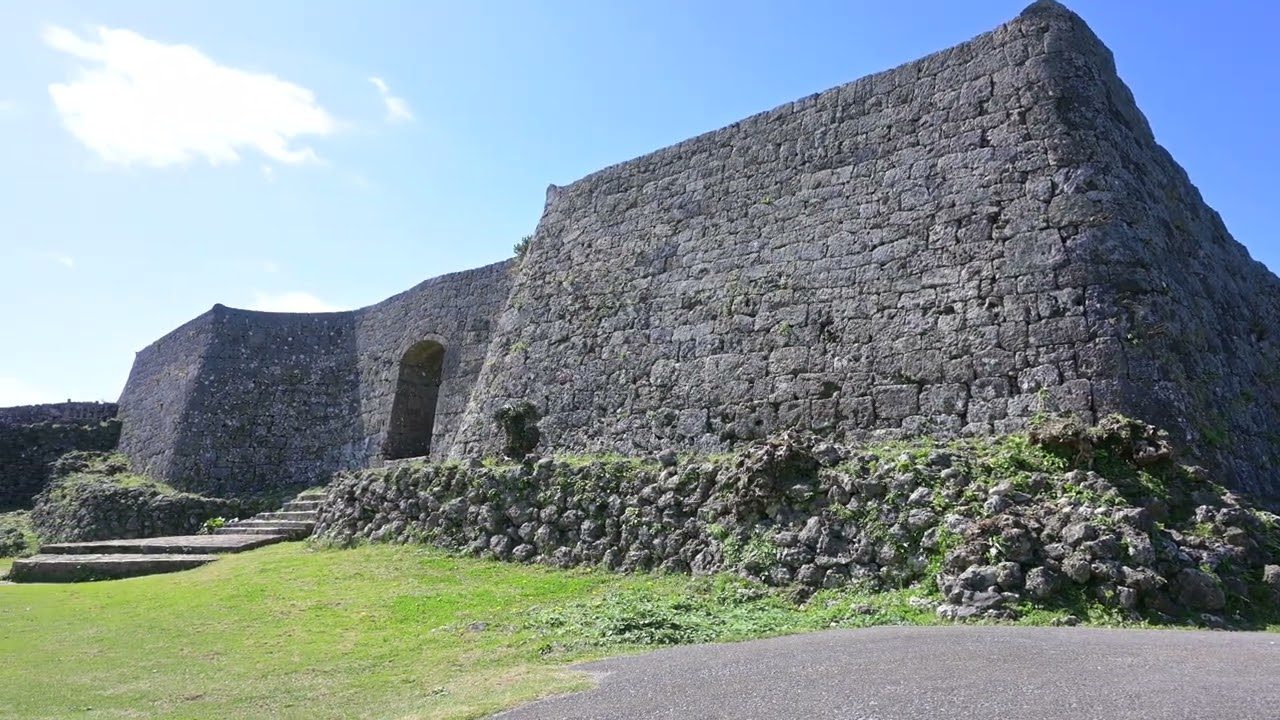
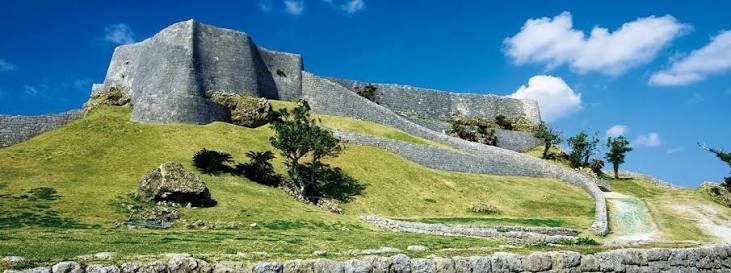
Look here: the "curves" of the walls and aikata-zumi masonry
The stone walls of the Nakagusuku, Nakijin and Katsuren castle ruins undulate gently, following the lie of the land. Pay attention to how the stones are laid, too. There are differences by period and place, from nuno-zumi, in which squared stones are set in horizontal courses, to aikata-zumi, in which polygonal stones are fitted together without gaps. At Nakagusuku Castle ruins you can compare both side by side.
The last aji: Amawari and Gosamaru
Even after the kingdom was founded, powerful aji remained across the islands. In 1458, Gosamaru of Nakagusuku and Amawari of Katsuren were destroyed one after the other. In the royal government's later official histories, this episode was portrayed as a tale of "the loyal retainer Gosamaru and the traitor Amawari," and it also became the subject of kumiodori (Ryukyuan musical drama). Yet in the Omoro Soshi, an old anthology of songs, Amawari is sung of as an aji beloved by the people of Katsuren. History written by the victors, and songs that survive locally: the gap between them is still talked about in the area today.
Main sources: Okinawa Prefectural Museum & Art Museum / Nakagusuku Castle Ruins Joint Management Council, "Nakagusuku Castle Ruins" / Uruma City, "Katsuren Castle Ruins" / Yaese Town, "Minatogawa Man"