Home / Sanshin, Eisa and Karate
07 — ARTS
Sanshin, Eisa and Karate
A stringed instrument covered in snakeskin, drums echoing on the nights of the lunar Obon, a stage that graced the banquets of the royal court, and a martial art for defending yourself with bare hands. Okinawa's culture of sound and movement took in influences from China and Japan, and grew into forms all its own on these islands.
Labels: Factdocumented Likelysupported by most sources Legendoral tradition Urban legendlocal lore and rumour
The sanshin — an instrument for the alcove
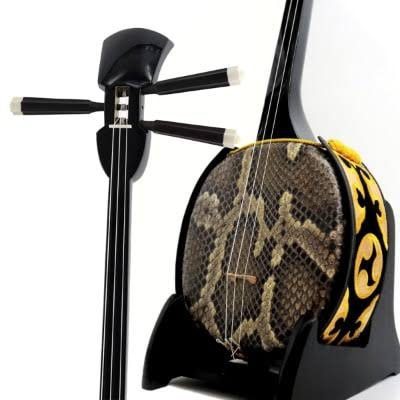
LikelyThe sanshin (three-stringed lute) is thought to have developed in Ryukyu from the Chinese sanxian, which arrived around the 14th to 15th centuries. Its body is covered with python skin, and it is known for its plucked, lilting tone. The royal government even had officials in charge of sanshin music, and it was prized as an accomplishment of the aristocracy.
FactIn the 18th century, a system of sanshin notation called kunkunshi was created — a distinctive score that represents pitches with Chinese characters.
LikelyIn the 16th century, the sanshin is said to have reached Sakai, near Osaka, where it became the shamisen, covered with cat or dog skin. In Okinawan homes, a fine sanshin was displayed in the tokonoma alcove and handed down as a family treasure.
Look here: the kankara sanshin
After the Battle of Okinawa, people in the camps made sanshin using empty cans for the body, scraps of wood for the neck and parachute cord for the strings. This instrument, known as the kankara sanshin ("tin-can sanshin"), is said to have sustained the spirits of people who had lost everything. Even today, it is sometimes made in hands-on workshops or used in school lessons.
Eisa — a dance to send off the ancestors
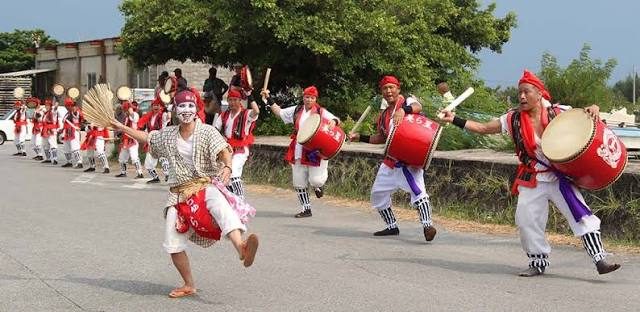
FactEisa is a dance for sending the spirits of the ancestors, who have returned for the lunar Obon, back to the other world. On the nights of the lunar Obon, the young people of each community beat drums and dance to the sanshin and song as they make their way from house to house (michijunee).
LikelyIts origins are said to lie in the nenbutsu odori (chanting dances) introduced by Taichu, a Pure Land Buddhist monk who visited Ryukyu in the early 17th century. After the war, a contest that began in 1956 in Okinawa City (then Koza) led to today's Okinawa Zento Eisa Festival, and eisa became the signature event of an Okinawan summer.
Kumiodori — a stage to entertain the investiture envoys
FactKumiodori is a Ryukyuan musical drama that combines spoken dialogue, music and dance. It was first performed in 1719 by Tamagusuku Chokun, the official in charge of dance, to entertain the Chinese investiture envoys sent by the emperor. It is a stage art created in Ryukyuan language and music, while learning from Japanese performing arts such as Noh and Kabuki.
FactKumiodori was designated a national Important Intangible Cultural Property in 1972, and in 2010 it was also inscribed on UNESCO's Intangible Cultural Heritage list. It is still performed today at the National Theatre Okinawa in Urasoe City.
Karate — from "Tang hand" to "empty hand"
LikelyKarate is thought to have been born when ti ("hand"), a martial art long practised in Ryukyu, was influenced by Chinese boxing. It was once written with the characters for "Tang hand" (tode, or karate).
FactIn 1922, Funakoshi Gichin introduced "Tang hand" in Tokyo, and it began to spread on the mainland as well. On 25 October 1936, at a round-table meeting of karate masters held in Naha, it was agreed to standardise the name as karate written with the characters for "empty hand." In honour of that date, 25 October is "Karate Day." Karate became an official Olympic event for the first time at the Tokyo Olympics held in 2021.
"There is no first attack in karate"
A saying often heard in the world of karate. It expresses the idea that karate is not for attacking others, but for defending yourself. In 2017, Okinawa Prefecture opened the Okinawa Karate Kaikan in Tomigusuku City. People come from all over the world to visit the "home" of karate.
Main sources: National Theatre Okinawa, "Kumiodori" / Okinawa Prefecture, "Karate Day" and Okinawa Karate Kaikan / Okinawa City, "Okinawa Zento Eisa Festival" / Okinawa Prefectural Museum & Art Museum