Home / The Battle of Okinawa
04 — THE BATTLE OF OKINAWA
The Battle of Okinawa
In the spring of 1945, Okinawa became the scene of a land battle in which the Japanese and US forces clashed fiercely. The battlefield was the very villages and towns where people lived. What happened in just over three months of fighting, and how many lives were lost? We look back, following the record.
Labels: Factdocumented Likelysupported by most sources Legendoral tradition Urban legendlocal lore and rumour
Before the battle
FactIn 1944, the Japanese army stationed the 32nd Army in Okinawa and began building airfields and defensive positions across the islands. Local residents were also mobilised for the construction work. On 22 August that year, the Tsushima Maru, which had left Naha to evacuate children to mainland Japan and Taiwan, was sunk by an American submarine, and more than 1,400 people died, including many schoolchildren.
FactOn 10 October, a large-scale air raid by American carrier-based aircraft burned about 90 percent of Naha's urban area (the 10 October Air Raid).
From 26 March to 23 June 1945
FactOn 26 March 1945, US forces landed in the Kerama Islands, west of Naha. Here a tragic event took place in which residents, driven into a corner, took their own lives together with family members and those close to them — known as "collective suicide" (forced mass death).
FactOn 1 April, US forces landed on the beaches of Yomitan and Chatan, on the west coast of central Okinawa Island. In total, more than 500,000 US troops were committed, and the sea was filled with ships. The Japanese army placed its headquarters underground at Shuri and fought a war of attrition in the central and southern parts of the island.
FactAt the end of May, as Shuri came under threat, the Japanese army abandoned its headquarters and withdrew to Mabuni, at the southern tip of the island. Many residents who had fled the fighting were there. Soldiers and civilians became intermingled in a small area, and civilian casualties rose even further during this period. Around 23 June, with the suicide of the commander, organised fighting by the Japanese army came to an end. This day is Okinawa's "Irei no Hi" (Memorial Day).
Figures are from Okinawa Prefecture, which gives the Japanese dead as 188,136 (122,228 military personnel, civilian employees of the military and civilians from Okinawa Prefecture, and 65,908 Japanese soldiers from outside the prefecture). The exact number of civilian victims is not known.
Gama — choices in the dark
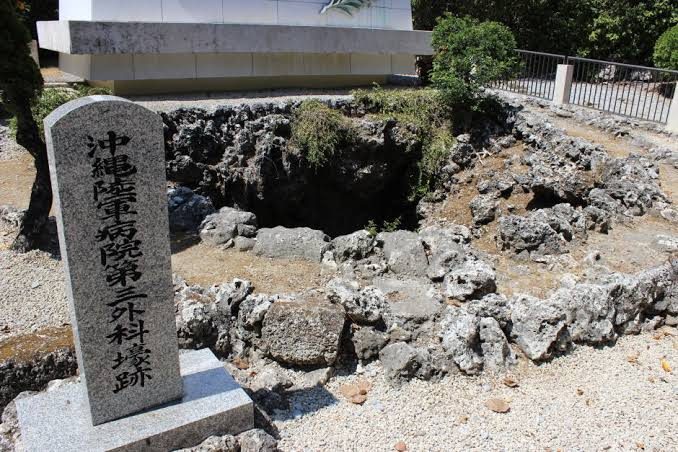
FactOkinawa has many natural caves called gama, formed in its limestone ground. Residents hid in the gama, and the Japanese army also used them as positions and hospitals.
FactIn Yomitan Village, where US forces first landed, there are two gama that are often spoken of side by side. At Chibichiri Gama, more than 80 of the residents sheltering there died in "collective suicide." At nearby Shimuku Gama, by contrast, two residents who had returned from emigrating to Hawaii and could speak English talked with the American soldiers, and about 1,000 residents are said to have been saved.
The mobilised students
FactIn the Battle of Okinawa, pupils from middle schools, girls' schools and other schools were also mobilised for the battlefield. Boys were assigned to the Tekketsu Kinnotai (Blood and Iron Student Corps) and to signal units, and girls to army hospitals and elsewhere as nursing aides. More than 2,000 students were mobilised, and many of them lost their lives on the battlefield.
Fact240 students and teachers from the women's division of the Okinawa Normal School and the Prefectural First Girls' High School were mobilised as nursing aides to the army hospital at Haebaru. They later came to be known as the Himeyuri Student Corps. Of them, 136 died. Beside the Himeyuri Monument in Itoman City stands the Himeyuri Peace Museum, which passes on the testimony of survivors.
Look here: the telegram at the Former Japanese Navy Underground Headquarters
The Former Japanese Navy Underground Headquarters in Tomigusuku City is the tunnel complex where the Imperial Japanese Navy's headquarters was located. Before his suicide, on 6 June 1945, the commander, Ota Minoru, sent a telegram to the Vice-Minister of the Navy describing the devotion and suffering of the local people. It closes: 「沖縄県民斯ク戦ヘリ 県民ニ対シ後世特別ノ御高配ヲ賜ランコトヲ」 ("Thus fought the people of Okinawa Prefecture. I ask that special consideration be given to them in the future."). On the walls of the commander's room inside the tunnels, the marks of hand-grenade fragments can still be seen.
The Cornerstone of Peace
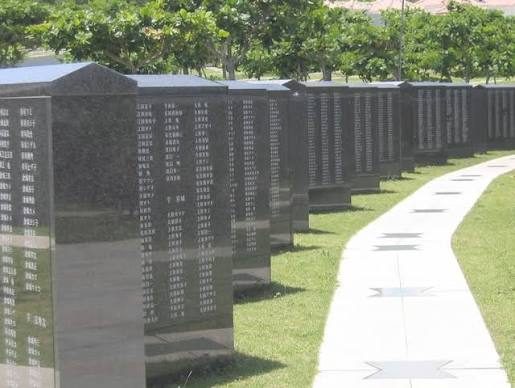
FactIn 1995, to mark 50 years since the Battle of Okinawa, the Cornerstone of Peace (Heiwa no Ishiji) was erected in Peace Memorial Park at Mabuni, Itoman City. On its black granite monuments are inscribed the names of those who died in the Battle of Okinawa and related events, regardless of nationality or whether they were soldiers or civilians. They include the names of people from the United States, the United Kingdom, South Korea, North Korea and Taiwan. More than 240,000 names are inscribed, and newly identified names are still added every year.
Every year on 23 June, the Okinawa Memorial Service for All War Dead is held here, and a peace poem written by a child from the prefecture is read aloud. At noon, moments of silent prayer are observed in many places across the prefecture.
"Nuchi du takara"
A phrase often heard in Okinawa. It means "life itself is the treasure." The testimony of those who survived on an island that became a battlefield has been passed on through museums and the work of storytellers. As the generation that experienced the war grows fewer, how to carry that memory forward remains an important question for Okinawa. For Okinawa's postwar path, continue to the Amerika-yu and Reversion room.
Main sources: Okinawa Prefecture, "Overview of the Battle of Okinawa" and "The Cornerstone of Peace" / Okinawa Prefectural Peace Memorial Museum / Himeyuri Peace Museum / Tsushima Maru Memorial Museum / History of Yomitan Village / Navy Underground Headquarters Park