Home / American Rule and Reversion
05 — AMERICAN ERA
Amerika-yu and the Return to Japan
After the Battle of Okinawa, Okinawa was placed under American rule for 27 years. The currency was the dollar, cars drove on the right, and travelling to mainland Japan required a passport-like certificate. We trace the era Okinawans call "Amerika-yu" (the American era), and the road back to Japan.
Labels: Factdocumented Likelysupported by most sources Legendoral tradition Urban legendlocal lore and rumour
A postwar that began in the camps
FactWhen the fighting ended, most of the surviving residents were living in camps set up by the US military. Much of their home land was fenced off and turned directly into bases. Okinawa's postwar period began with people having neither homes nor fields to return to.
FactOn 28 April 1952, the San Francisco Peace Treaty came into force and Japan regained its independence, but Okinawa, Amami and the Ogasawara Islands remained under American rule. In Okinawa, this day has also been called the "Day of Humiliation." That same year, the Government of the Ryukyu Islands was set up as a government for the residents, but above it sat the American governing authority (later the United States Civil Administration of the Ryukyu Islands), and the final say rested with the Americans.
When people shopped in dollars
FactFor some time after the war, Okinawa used US military scrip known as B-yen, and from 1958 the US dollar became the currency. Supermarket price tags were in cents, and wages were paid in dollars. Travelling to mainland Japan required a travel certificate issued by the United States Civil Administration of the Ryukyu Islands.
FactIn the 1950s, the US military forcibly seized residents' land to expand its bases. In response to these methods, described as "bayonets and bulldozers," an island-wide protest movement (the Shimagurumi Toso, or "all-island struggle") arose in 1956.
The streets of Koza
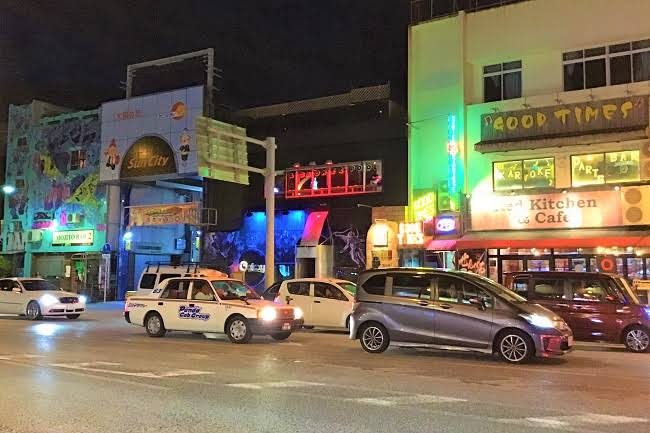
FactThe town of Koza (today's Okinawa City), which spread out in front of the gates of Kadena Air Base, grew into a base town lined with restaurants and bars catering to American servicemen. Establishments that met US military hygiene and other standards were granted an "A-sign" licence, and a distinctive culture awash with dollars was born. During the Vietnam War, the streets overflowed with soldiers heading to the front, and it was here that Okinawan rock took shape.
FactIn the early hours of 20 December 1970, the handling of a traffic accident caused by an American serviceman sparked an outburst of anger among the residents who had gathered, and more than 80 American vehicles were set on fire (the Koza Riot, also called the Koza Uprising). Behind it lay years of frustration that incidents and accidents involving US servicemen went unpunished.
15 May 1972
FactAmong the residents, a movement calling for reversion to Japan spread. On 15 May 1972, administrative authority over Okinawa was returned from the United States to Japan, and Okinawa Prefecture was born again. The currency switched to the yen, at an exchange rate of 1 dollar = 305 yen.
FactEven after reversion, however, many of the US military bases remained. According to Okinawa Prefecture, about 70 percent of the land area of facilities for the exclusive use of US forces in Japan is concentrated in Okinawa Prefecture, which makes up only about 0.6 percent of Japan's land area. Issues surrounding the bases remain a major challenge for Okinawa today.
30 July 1978: "Nana-san-maru"
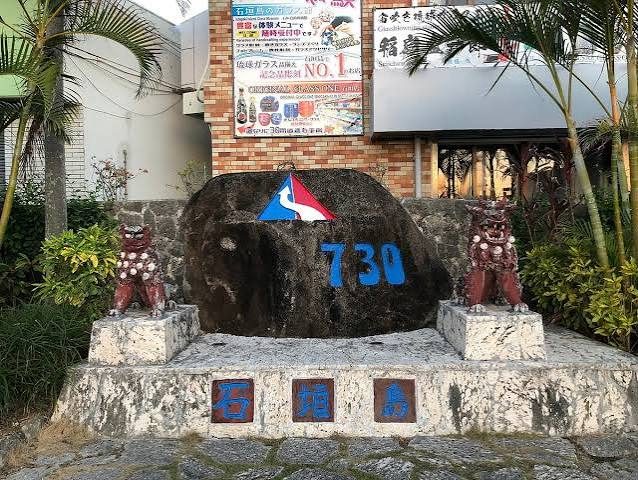
FactUnder American rule, cars in Okinawa drove on the right. Six years after reversion, at 6 a.m. on 30 July 1978, traffic across the prefecture switched all at once to driving on the left. For this change, known from its date as "730" (Nana-san-maru), road signs and traffic lights were changed over from the night before, and large numbers of buses with their doors on the right had to be replaced.
Look here: the 730 Monument on Ishigaki Island
At an intersection in central Ishigaki City stands the "730 Monument," commemorating the change in traffic rules. Locally, the intersection itself is known as "730 Intersection."
Butterfly effect: the flavours Amerika-yu left behind
Canned luncheon meat, brought in as US military rations, spread into Okinawan homes after the war and took root as "pork." In 1963, Japan's first A&W restaurant opened in Okinawa, and in 1984 taco rice was born in Kin Town. Amerika-yu changed what appeared on Okinawa's dinner tables, too (the Food room).
Main sources: Okinawa Prefectural Archives / Okinawa Prefecture, "US Military Bases in Okinawa" / Okinawa City, "History of Koza" / Okinawa Prefectural Police, materials on "730"