Home / Utaki, Noro and Yuta
06 — PRAYER
Utaki, Noro and Yuta
Okinawa's sacred sites often have no shrine building and no torii gate. There is only a forest, rocks and a small incense burner. Yet local people have long worshipped at these places as the most precious of all. We introduce Okinawa's forms of prayer — where women lead the rites, and people live alongside their ancestors.
Labels: Factdocumented Likelysupported by most sources Legendoral tradition Urban legendlocal lore and rumour
Where there is nothing is the most sacred
FactOkinawa's villages have sacred sites called utaki (sacred groves). Most are forests or rocky outcrops near the settlement, thought of as places where the gods descend or where the village's ancestors rest. The most sacred spot deep inside an utaki is called the ibi, and only a limited few may enter it.
Unlike Shinto shrines on the mainland, they do not necessarily have buildings; it is not unusual for an utaki to be nothing more than a space surrounded by trees, with stones or an incense burner set down in it. Not building anything with form is, if anything, what marks them as sacred. When visiting an utaki, it is good manners not to raise your voice and not to take away stones or plants.
Sefa Utaki — the kingdom's highest sacred site
FactSefa Utaki, in Nanjo City in the south of the main island, was one of the highest-ranking sacred sites of the Ryukyu Kingdom. The Oaraori — the ceremony held when the Kikoe-ogimi, the royal government's highest priestess, took office — was also performed here. In 2000 it was inscribed as one of the "Gusuku Sites and Related Properties of the Kingdom of Ryukyu" World Heritage site.
Look here: Kudaka Island beyond Sangui
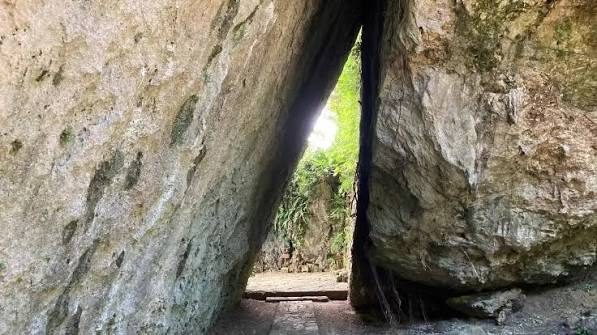
Deep inside Sefa Utaki is Sangui, a triangular gap formed where two enormous rocks lean against each other. From beyond the gap, you can see Kudaka Island across the sea. Kudaka is said to be the island where Amamikiyo, the goddess who created the Ryukyu Islands, first came down, and it has long been called the "Island of the Gods."
"Even the king entered dressed as a woman"
A story often told is that Sefa Utaki was once closed to men, and that even the king, when he came to worship, entered wearing women's clothing.
Women were at the heart of the rites
Reliable records are scarce, but it is certain that the kingdom's rituals were performed by priestesses, headed by the Kikoe-ogimi. Many sacred precincts strictly restricted the entry of men.
Women who carry the prayers — the noro
FactIn the Ryukyu Kingdom, state rituals were carried out by priestesses. At the top was the Kikoe-ogimi, usually a woman of the royal family such as the king's sister. Below her, the rituals of each village were conducted by the noro (village priestess). The noro were appointed by the royal government and were given land to support their duties.
In Okinawa there is a belief in unai-gami ("sister deity"), in which sisters spiritually protect their brothers. There are also stories of sisters giving brothers setting out to sea a lock of their hair or a hand towel to carry as a talisman. That women are at the centre of prayer is deeply connected to this belief.
Yuta — someone to turn to
FactWhile the noro conducted the village's public rituals, it was the yuta (spirit mediums) who responded to the troubles of individuals and families. Believed to have spiritual powers, they have been consulted when illness or misfortune strikes repeatedly, when building a house, or when people are unsure how to honour their ancestors.
FactFrom the days of the royal government, through the Meiji period and into wartime, the yuta were repeatedly targeted for suppression as "superstition." Even so, people never lost their trust in them, and many still go to consult them today. Okinawa even has the saying "half doctor, half yuta": take matters of the body to a doctor, and matters of the heart and the household to a yuta.
The god of the kitchen, and great tombs
In the kitchens of many Okinawan homes, the Hinukan (fire deity) is enshrined. Originally it took the form of three stones representing a hearth, but today it is usually a small altar with an incense burner and a flower vase. As the god who protects the household, it receives prayers — mainly from the women of the house — on days such as the 1st and 15th of each lunar month.
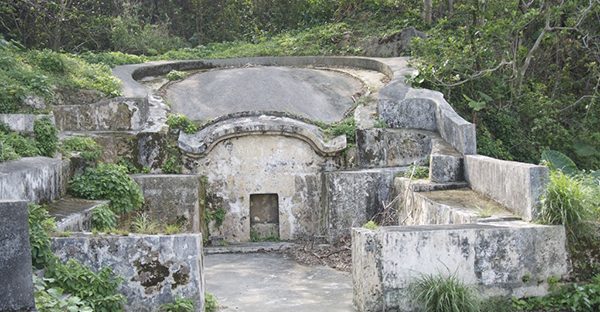
FactOkinawan tombs are large, and the turtleback tombs (kikkobaka or kamekobaka), with roofs shaped like a turtle's shell, are said to show the influence of southern China. At Shimii (the Qingming festival) around April, relatives descended from a common ancestor (a munchu, or patrilineal clan) gather in front of the tomb, spread out food in tiered boxes and eat together with their ancestors.
Main sources: Nanjo City, "Sefa Utaki" / Okinawa Prefectural Museum & Art Museum / Okinawa Prefectural Board of Education, Okinawan Folklore