Sapporo is a rare thing in Japan: a city designed from the start. With no castle and no port, the state set out to build a capital on open wilderness—an unprecedented project that began with a single canal and took shape through the passion and setbacks of many people.
Prologue — 1866
Before the Development Commission, there was a canal
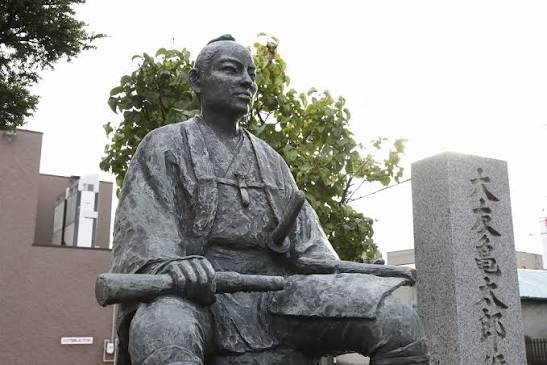
Statue of Otomo Kametaro, watching over the origin of Sapporo
Sapporo’s development is often thought to have begun in the Meiji era, but three years earlier, in 1866, someone had already broken ground:
Otomo Kametaro, an agricultural administrator trained in the teachings of Ninomiya Sontoku. Sent by the shogunate, he brought in farmers, opened fields—and dug a canal to water them.
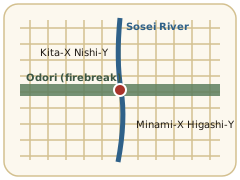
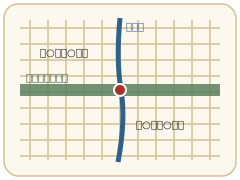
This “Otomo Canal” later became the Sosei River, the line that divides “East” from “West” in every Sapporo address.
When the Development Commission arrived, this man-made line of water was already there, and the city’s designers adopted it as one of their axes.
ORIGIN
Every “East” and “West” in Sapporo is counted from a farm canal dug before the Meiji Restoration.
— The Sosei River and the Otomo Canal
1869 — Passion and setback
“The first city of the five continents”: Shima Yoshitake’s six months
In 1869 the Meiji government created the Development Commission (Kaitakushi) and renamed Ezo as Hokkaido. The man sent to build the new capital was Commissioner Shima Yoshitake of the Saga domain.
Arriving in Sapporo in late autumn with winter closing in, he is said to have looked out over the plain from a hill to the west (around today’s Maruyama) and envisioned a grid-plan capital like Kyoto.
A poem he wrote expressed the dream that this land would one day become “the first city of the five continents”—the greatest city in the world.
But construction stalled for lack of money and labor. Only about three months after entering Sapporo, and less than six months after his appointment, Shima was dismissed.
It was long said that he overspent; today many historians point instead to his clash with the powerful merchants who controlled Hokkaido’s fisheries.
Back home, Shima joined Eto Shinpei in the Saga Rebellion of 1874 and was executed after its defeat.
Sapporo, however, went on to grow along the lines he had drawn. Statues of Shima still stand at Hokkaido Jingu Shrine and in the lobby of City Hall.
Local know-how
At the Rokkatei tea house in the grounds of Hokkaido Jingu, a freshly grilled rice-cake sweet called “Hangan-sama” is a local favorite. “Hangan” means commissioner—it’s named after Shima Yoshitake. Sapporo remembers its founding father as a snack.
1871 — A line against fire
Odori Park started out as empty land
Under Shima’s successor Iwamura Michitoshi and others, a strip of open land about 105 meters (58 ken) wide was laid out through the middle of town in 1871. This is today’s Odori.
Its purpose was a firebreak, to stop fires from spreading between wooden houses.
The line also divided the town in two. To the north lay government land, with the Commission’s offices and residences; to the south, townspeople’s land for merchants and craftsmen.
That offices and government buildings cluster on the station side while the shopping arcades of Tanukikoji and the nightlife of Susukino spread to the south is a legacy of this 150-year-old line.
The open land was later used for flower beds and exhibitions and gradually turned into a park from the late Meiji era. It was formally designated an urban park only in 1980.
Insider note
For a time, Odori was called “Shiribeshi-dori.” It became “Odori” when today’s “jo/chome” address system was introduced in 1881. Summer beer gardens, the winter Snow Festival, the autumn food festival—it’s a curious twist of history that Sapporo’s seasonal celebrations all take place in a firebreak.
Guarding the north, clearing the land
The tondenhei—soldiers who were also farmers
In 1875 the first tondenhei (soldier-farmers) settled at Kotoni, west of Sapporo. In peacetime they cleared land and farmed; in an emergency they would defend the north.
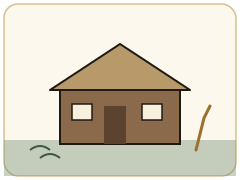
Many were former samurai from the Tohoku region and elsewhere who had lost their positions after the Meiji Restoration. Around 200 families lived in identical houses, struggling with unfamiliar cold.
A soldier-farmer house survives at Kotoni as a national historic site. Settlements were later established in places such as Yamahana (in today’s southern Chuo Ward), forming the framework of farmland and communities around Sapporo.
Symbol
Walking in search of the red star
The Development Commission adopted a red five-pointed star modeled on the Pole Star as its symbol—a guiding light for those opening up the northern frontier.
You can still find it on buildings from the Commission’s era.
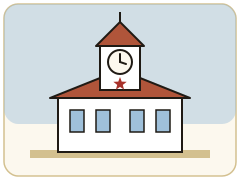
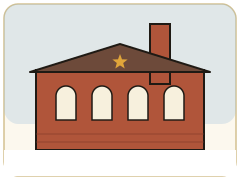
On the front of the Clock Tower (the former drill hall of Sapporo Agricultural College, 1878), on the porch of Hoheikan (1880), atop the Former Hokkaido Government Office (the “Red Brick Office,” 1888).
And on the label of Sapporo Beer, descended from the Commission’s brewery. Walk downtown looking for stars, and the layout of the Commission-era city comes into view.
Is the Clock Tower really a “disappointing sight”?
Many visitors say they were let down by the small wooden building squeezed between office towers. But the Clock Tower was built as a drill hall for students’ military drills and ceremonies—not as a tourist attraction.
The clock was ordered from the Howard company in the United States in 1878 and began striking the hours in 1881. In 1906 the entire building was moved about 100 meters south for road works.
Driven by weights, the clock is still running more than 140 years later; its chime was selected as one of Japan’s “100 Soundscapes,” and the mechanism is a Mechanical Engineering Heritage item.
Whether it’s disappointing, you can decide after you’ve heard the bell.
Who’s who
The people who designed Sapporo
Each in their own role, they drew the lines of a city on the wilderness.
Otomo Kametaro
Agricultural administrator / settled 1866
A disciple of Ninomiya Sontoku. Sent by the shogunate, he dug the Otomo Canal (later the Sosei River). A pioneer of Sapporo’s development.
Shima Yoshitake
Development Commissioner / 1869
Envisioned “the first city of the five continents” and began building the capital. Dismissed within six months; later executed after the Saga Rebellion.
Iwamura Michitoshi
Development Commissioner / 1871
Continued laying out the town after Shima. Involved in creating the firebreak (Odori) and naming Shiroishi Village.
Kuroda Kiyotaka
Vice-Director, then Director of the Commission
From Satsuma. Invited American experts and built the framework of development, including government factories and Sapporo Agricultural College.
Horace Capron
Adviser to the Commission (USA)
Resigned as U.S. Commissioner of Agriculture to come to Japan, and recommended American-style large-scale farming and surveying for Hokkaido.
Edwin Dun
Livestock expert (USA)
At the Makomanai ranch he taught cattle and sheep farming and butter and cheese making—the “father of Hokkaido dairy.” A memorial hall stands in Makomanai.
Read next
The Man Who Brought Beer to Sapporo
The brewery was meant for Tokyo. Hisanari Murahashi changed that—then vanished from history.