“Boys, be ambitious.” Many people think of these words when they think of Sapporo. Yet Dr. Clark was in Sapporo for only nine months, and the place where he spoke them was not Sapporo at all. And Nitobe Inazo and Uchimura Kanzo—famous as his disciples—were in fact never taught by him.
1876 — Opening
A national school in the north, taught in English
In August 1876 the Development Commission opened Sapporo Agricultural College to train people to develop Hokkaido. Its model was the Massachusetts Agricultural College in the United States,
and that college’s president, William Smith Clark, was invited to lead it.
Classes were in English: agriculture, but also mathematics, chemistry, English literature—and military drill. In the middle of the wilderness, students received an American college education.
The building erected as their drill hall is today’s Clock Tower.
9 months
Clark’s time in Sapporo
1876
Sapporo Agricultural College opens
1918
Becomes Hokkaido Imperial University
0
Classes Nitobe and Uchimura took from Clark
The truth behind the words
Where was “Boys, be ambitious” spoken?
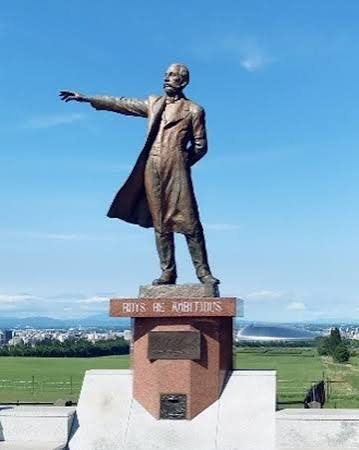
The full-length statue at Hitsujigaoka (1976)
In April 1877, his contract finished, Clark left Sapporo. His first-year students rode with him to see him off, and they parted at the post station of Shimamatsu (in today’s Kitahiroshima City), a little over 20 km southeast of Sapporo.
There, it is said, he called out from horseback: “Boys, be ambitious.” The words were born not in Sapporo, but in the neighboring city.
Accounts of what followed differ. Some testimony says he continued “like this old man”; another theory holds it was “in Christ”; still another that it was simply a common New England farewell of the time.
What is certain is that the students passed these few words down until they became a motto for Sapporo, and for Japan.
Local know-how
The popular full-length statue pointing into the distance stands at Hitsujigaoka Observation Hill in Toyohira Ward; it was erected in 1976 to mark the college’s centenary. The one on the Hokkaido University campus is a bust. Both are called “the Clark statue,” so be careful when arranging to meet.
Teacher and students who never met
Nitobe Inazo and Uchimura Kanzo were in the second class
Clark taught only the first class. He asked the students to sign the “Covenant of Believers in Jesus,” and all of the first class reportedly did.
But Nitobe Inazo, later the face of the 5,000-yen note, the thinker Uchimura Kanzo, and the botanist Miyabe Kingo were in the second class,
which entered after Clark had left Sapporo. Guided by their seniors, the second-year students signed the covenant one after another. Clark’s influence was handed down from class to class, even after he had gone.
LEGACY
Some students inherited their teacher’s spirit without ever meeting him.
— The second class of Sapporo Agricultural College
Insider note
What became of Clark
Back in America, Clark left his college presidency and started a mining company, but the business collapsed—partly due to a partner’s wrongdoing—and his last years were hard. He died in 1886 at 59. He is said to have spoken of his time in Sapporo as the proudest of his life. Those nine months may have been special for him, too.
People of the college
Graduates who went out from Sapporo
Sato Shosuke
First class / first president of Hokkaido Imperial University
Clark’s direct student. He grew the college into a university and laid the foundations of Hokkaido University.
Nitobe Inazo
Second class / educator and thinker
Wrote Bushido: The Soul of Japan in English, introducing Japan to the world. Later Under-Secretary General of the League of Nations.
Uchimura Kanzo
Second class / Christian thinker
Wrote Representative Men of Japan in English and founded the Non-Church movement, influencing many intellectuals.
Miyabe Kingo
Second class / botanist
The leading scholar of Hokkaido’s flora. As first director of the university’s Botanic Garden, he protected and nurtured a forest in the heart of the city.
Arishima Takeo
College graduate / novelist
Taught at his alma mater while writing. His Sapporo residence has been relocated to the Sapporo Art Park in Minami Ward.
Walking the campus
Memories of the college on the Hokkaido University campus
Hokkaido University’s Sapporo campus is wrapped in greenery right in the city center. Its sheer size is itself a legacy of a college that came with its own farm.
The Second Farm of Sapporo Agricultural College preserves American-style barns—the “Model Barn”—built in 1877 based on Clark’s ideas, now designated Important Cultural Properties.
The Poplar Avenue lost many trees in a 2004 typhoon but has been replanted and preserved.
The Sakushukotoni River flowing across campus, the ginkgo avenue that turns gold in autumn, the Meiji-era Western-style Furukawa Hall—the deeper you walk, the more layers of time you see.
Local know-how
For Hokkaido University students, a spring barbecue of grilled mutton with friends on campus—a “jinpa” (Jingisukan party)—is a welcome-season tradition. The smoke drifting across campus is one of the signs of spring in Sapporo (subject to the university’s rules on when and where).
Read next
Nearly Five Meters of Snow, 1.96 Million People
A festival that began with six statues, a rubber-tired subway, a bamboo-broom tram and a vast snow budget.