When someone in Sapporo says “namara kowai,” they mean “I’m really tired.” Built by people who came from all over Japan after 1868, Sapporo has its own blend of words from Tohoku, Hokuriku and beyond—and plenty of snow-country ingenuity. Here are the “Sapporo normals” locals never think twice about, but visitors find fascinating.
Words
Hokkaido words you’ll hear in Sapporo
Hokkaido speech is said to have formed as the dialects of settlers from Tohoku, Hokuriku and elsewhere mixed together. Sapporo is considered close to standard Japanese—yet these words are part of everyday life.
Word
Meaning
Usage / notes
なまら namara
very
“Namara umai” = really delicious. Younger people also say “nanmara.”
したっけ shitakke
then / see you
“Shitakke ne!” is Sapporo’s everyday goodbye.
こわい kowai
tired, worn out
In standard Japanese it means “scary”—not here.
投げる nageru
to throw away
“Throw that trash, please.” Please don’t actually throw it.
はく haku (gloves)
to put on gloves
Gloves are “worn” with the verb used for shoes and trousers.
押ささる osasaru
to get pressed (by itself)
“The button got pressed”—implying it wasn’t really your fault.
ばくる bakuru
to swap
“Let’s swap side dishes.”
いずい izui
uncomfortable, not quite right
Like grit in your eye or a clothing tag rubbing.
あずましくない azumashikunai
unsettled, uncomfortable
Said to have no exact equivalent in standard Japanese.
しばれる shibareru
bitterly cold
Not just cold—freezing hard.
なんもなんも nanmo nanmo
you’re welcome, no problem
A reply to “thank you.”
内地 naichi
mainland Japan (Honshu)
More common among older people: “someone from naichi.”
雪はね yukihane
shoveling snow
Sapporo people say “yukihane” rather than “yukikaki.”
Houses
Why Sapporo has so few pointed roofs
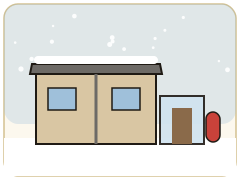
Snow-country houses are often imagined with steep roofs to shed snow. But walk through a Sapporo neighborhood and you’ll notice many flat roofs, or roofs that dip slightly toward the middle.
These are “muraku-setsu” (no-snow-fall) roofs: instead of letting snow slide off, they hold it on top and melt it, draining the water through a central duct.
In Sapporo’s tightly packed residential areas, snow sliding off a roof would block the neighbor’s yard or the street, and could hurt someone. This was an urban snow-country solution.
Entrance hood
A small glass room built outside the front door to block wind and snow and keep warmth in.
Kerosene tank
A large heating-oil tank outside the house, refilled regularly by a tanker truck making its rounds.
T-shirts indoors
Homes are kept warm, and many people wear T-shirts inside all winter. “Houses in mainland Japan are colder in winter” is a classic Hokkaido complaint.
Customs
Weddings and funerals, a little different
In Hokkaido, weddings are often run on a membership-fee basis: instead of a gift of money, guests pay a fixed fee at reception.
Friends act as organizers, a style sometimes said to echo the mutual support of the pioneer era.
At funerals, a receipt may be issued for condolence money, which surprises visitors.
And on New Year’s Eve, many families gather around a feast and start on the New Year’s osechi dishes that very night.
Local know-how
School holidays differ too: summer vacation is short and winter vacation is long. The second term starts soon after mid-August, and in exchange there is a generous break in the snowy season.
Words of the seasons
Lilac chill, Ezo rainy season, snow bugs
Sapporo’s city tree is the lilac (“lila” in French). The chilly days that come in late May when the lilacs bloom are called “rira-bie”—“lilac chill.”
The phrase came from a haiku by Hokkaido poet Shinokoya Mieko and became widely known through Watanabe Junichi’s novel Rira-bie no Machi (The Town of Lilac Chill).
It is often said that Hokkaido has no rainy season, but a spell of gloomy weather sometimes settles in around June, known as “Ezo tsuyu.”
Locals also swear that the weather tends to turn around June 14–16, during the annual festival of Hokkaido Jingu, the “Sapporo Matsuri.”
Folk wisdom
When the snow bugs fly, first snow is near
In late autumn, tiny insects wrapped in white fluff start drifting through the air. They are a type of aphid (Prociphilus oriens). Locals say, “When the yukimushi fly, the first snow is coming.” Since they fly as temperatures drop, it’s not pure superstition. Just don’t let them land on your clothes—they squash and stain.
Getting around like a local
Meeting-place slang
“Yon-chōme”
The intersection at Minami 1 Nishi 4, lined with department stores—Sapporo’s classic meeting spot.
“Satsu-eki”
Short for Sapporo Station. “Ekimae-dori” is the avenue running straight south from it.
“The Nikka sign”
The giant whisky billboard on the building at the Susukino crossing—the “face” of Susukino and a local landmark.
“Under the TV Tower”
The east end of Odori. Wait while looking up at the digital clock.
In winter, people meet not outdoors but “near exit number X” in the underground malls or Chi-Ka-Ho. Sapporo residents may know the underground map better than the one above.
Read next
Urban Legends, Fact-checked
Does the shrine glare at Russia? Who were the “tanuki” of Tanukikoji? Popular stories, checked against sources.