Snow was the enemy—and the city’s greatest resource.
On average, about 4.8 meters of snow fall on Sapporo each winter. Few cities of over a million people anywhere get this much. Sapporo’s people have shoveled it, hauled it, melted it, turned it into a festival—and finally built a second city beneath the streets. This is the story of the technology and ingenuity of a city that fought snow and then made it an ally.
Winter in numbers
The scale of a snow city
4.8m
Average annual snowfall
¥27.5bn
Snow removal budget (FY2024 plan)
6,000
Five-ton truckloads of snow for the Snow Festival
2.43M
Record Snow Festival visitors (2009)
Snow removal is one of the biggest items in Sapporo’s budget. In heavy-snow years the money runs out and a supplementary budget is not unusual.
The sight of plows moving out across the city at night is a winter tradition in itself. If the roads are passable in the morning, it’s because people have worked through the night.
1950 — Six snow statues
The Snow Festival began with students
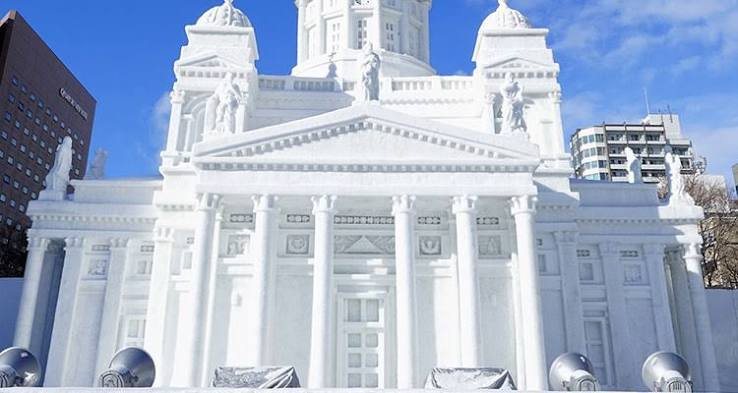
A giant snow sculpture at the Odori site
In 1950, shortly after the war, the Sapporo Tourism Association and the city held a small event to bring life back to the winter streets.
Junior and senior high school students built snow statues at Odori 7-chome—just six of them. That was the first Sapporo Snow Festival.
The turning point came in 1955, when the Ground Self-Defense Force joined in and statues over ten meters tall appeared.
International teams followed, and the festival became a global event, drawing 2.43 million visitors in 2009.
The snow for the Odori site alone amounts to about 6,000 five-ton truckloads, brought in from places like Moerenuma Park and Satoland on the outskirts—and in lean years from as far as Nakayama Pass.
Because of COVID-19, the on-site festival was canceled in 2021 and 2022 and held online instead.
Insider note
There used to be a large site at Makomanai, near a Self-Defense Force base, famous for snow slides and statues kids could play on. It closed in 2005; today the “Tsudome” site in Higashi Ward carries on that role. Plenty of Sapporo people will tell you, “We used to go to Makomanai.”
A phantom and a reality
Chosen twice for the Olympics
Sapporo had in fact once been chosen to host the 1940 Winter Olympics. As the war with China escalated, Japan returned the Games, and they became a phantom event.
In 1966 Sapporo was selected again. The Sapporo Olympics of February 1972 were the first Winter Games held in Asia.
In the 70-meter ski jump, Kasaya Yukio, Konno Akitsugu and Aochi Seiji swept the podium and were nicknamed the “Hinomaru Squadron.” The theme song “Niji to Yuki no Ballad” (Ballad of Rainbow and Snow) is still sung in Sapporo today.
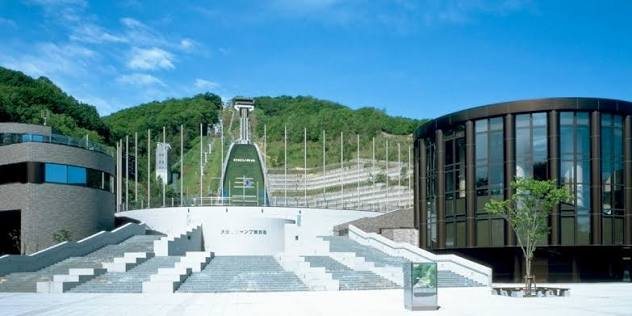
Okurayama Ski Jump Stadium, venue for the 90 m jump in 1972
The “underground Sapporo” built for the Olympics
The Olympics transformed the city almost overnight. In November 1971 the Sapporo underground shopping malls (Pole Town and Aurora Town) opened, followed in December by the Namboku subway line.
In April 1972 Sapporo became a designated city. The framework of a downtown you can cross underground on snowy days was built at this time.
In 2011, the 520-meter underground walkway “Chi-Ka-Ho” opened between Sapporo Station and Odori, finally linking the underground city into one.
A project story
Why does the subway run on rubber tires?
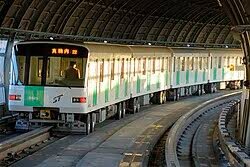
A Namboku Line train in the sheltered above-ground section
Sapporo’s subway runs not on steel wheels but on rubber tires. A single guide rail runs down the middle of the track, and the train follows it on its tires—a unique arrangement known as the “Sapporo system.”
At the time, the city was considering trolleybuses and other options to replace its streetcars. Then transport bureau chief Ōtachi Yutaka toured Europe and was struck by the quietness of the rubber-tired Paris Métro.
Less noise and vibration, better on slopes, quicker acceleration: adapted to local conditions, this became today’s Sapporo subway.
On the southern end of the Namboku Line, beyond Hiragishi Station to the terminus at Makomanai, trains run above ground—but the tracks are completely enclosed in an aluminum shelter to keep the snow out. The silver tunnel seen from the window is a uniquely Sapporo sight.
A streetcar with a century of service
The “Sasara Densha,” sweeping snow with bamboo
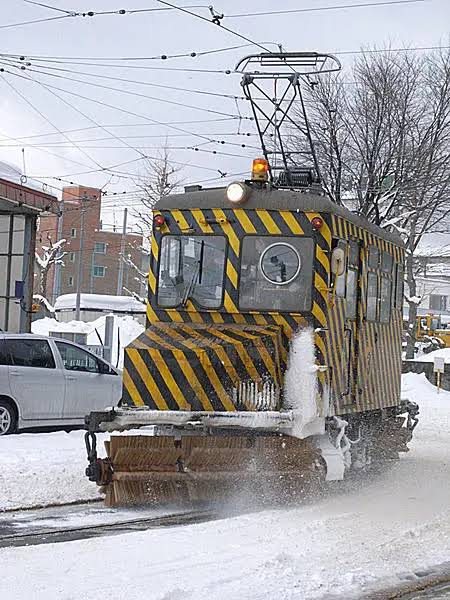
The Sasara Densha sweeping snow with bamboo brushes
Sapporo’s streetcar has special vehicles that only come out in winter. A cylindrical brush on the front spins and blasts snow off the rails as the car moves forward: the snow-sweeper known as the Sasara Densha.
The brushes are made of split bamboo, inspired by the sasara, a kitchen scrubbing whisk. Rows of fifty bamboo strips are mounted eight rows around the rotating axle.
Put into service in Sapporo in 1925, nearly a century later its first run of the season—usually from late November into December—still makes the local news as a sign that winter has arrived.
A business-documentary story
The city that gave up studded tires—and its next battle
Until the 1980s, studded tires fitted with metal pins were standard on Sapporo’s winter roads. But the pins ground up the pavement into dust—“shafun,” or road dust—which became a serious social problem.
In early spring, Sapporo’s air was hazy with it.
When studded tires were restricted by law in 1990, the air cleared. But a new problem appeared: “tsurutsuru roads,” intersections polished by studless tires into mirror-like ice.
To reduce falls, the city placed sand boxes at intersections and on slopes so anyone can scatter grit.
Tire makers’ R&D, road heating, sanding—solve one problem, and the next appears. That cycle has honed Sapporo’s winter technology.
Local know-howThe original “penguin walk” (for illustration)
In winter, Sapporo residents naturally do the “penguin walk”—short steps, landing with the whole sole. Non-slip soles are a must. Visitors tend to fall on the white stripes of crosswalks and on packed-down spots like taxi stands.
Read next
How Miso Ramen and Soup Curry Were Born
The instant noodle named “Sapporo” was born in Gunma. A curry born of herbal medicine, and a heirloom onion.