Solving the mysteryKyoto is a bread town
Picture a "Kyoto breakfast" and you probably imagine simmered tofu or rice porridge. The statistics tell another story: in the national Family Income and Expenditure Survey, Kyoto City is consistently near the top for spending on bread. Fact It's also known as a big spender on coffee and beef. Fact
Several reasons are suggested. As a city of artisans who started work early, people liked food they could eat quickly. It's a university town full of students and researchers. And above all, Kyotoites are secretly fond of the new. Likely Just as the city embraced one "Japan's first" after another in Meiji (see The City Fights Back), it has always welcomed new foods.
Reading the landTofu and yuba: gifts of the groundwater
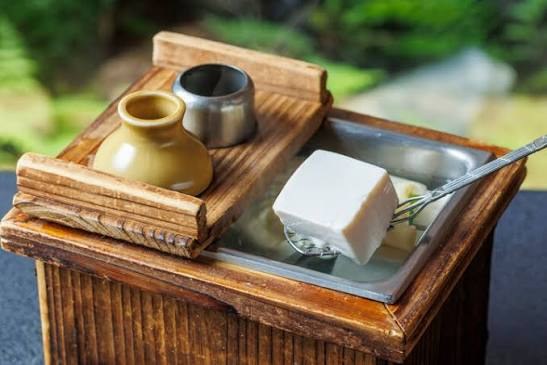
One reason Kyoto tofu is prized is water. The soft, abundant groundwater beneath the basin (see A Basin Floating on Water) brings out the flavour of the soybeans and makes silky tofu. Likely Yuba — the skin lifted from heated soy milk — is another Kyoto speciality.
The other reason is the sheer number of temples. In shōjin ryōri, Buddhist temple cuisine without meat or fish, soy products were the key protein. The famous simmered tofu (yudōfu) of Nanzen-ji and Sagano grew out of Zen temple food culture. Fact
Solving the mystery"Obanzai" is a surprisingly new word
Calling Kyoto home cooking "obanzai" is now standard. Yet the word was not commonly used in Kyoto homes. Likely
It spread from a newspaper column of that name launched in 1964 in the Kyoto edition of the Asahi Shimbun. One of its writers, essayist Ōmura Shige, introduced everyday Kyoto dishes, and the word caught on with them. Fact Even at the time, it was noted that Kyotoites rarely used the term and simply said okazu, "side dishes". Fact
Today "obanzai" signs are everywhere. The word may be new, but the simmered Kyoto vegetables, hijiki seaweed and fried tofu with greens you'll be served are genuinely the taste of Kyoto homes.
Butterfly effectHow a landlocked capital ate fish
How did a city with no sea eat fish? One answer is the route from Wakasa (Obama, Fukui) to Kyoto, known as the Saba Kaidō, "Mackerel Road". Fact Mackerel caught in Wakasa was salted and carried to Kyoto over a day and a night — arriving perfectly seasoned. "Kyoto may be far, but it's only eighteen ri (about 72 km)," the saying went. Legend Kyoto's saba-zushi, mackerel sushi, was born on this road.
The other is hamo, pike conger, the fish of Kyoto summers. Hamo is extraordinarily hardy and survives long out of water, so even without refrigeration it could be brought live from the Seto Inland Sea, it is said. Likely It's full of tiny bones; chefs make hundreds of fine cuts through the flesh without piercing the skin — honekiri, a test of a Kyoto cook's skill. It peaks during the Gion Festival, which is sometimes called the "Hamo Festival". Fact
On the front lineAn unexpected ramen and gyoza mecca
Despite its refined image, Kyoto is a ramen battleground. Tenkaippin, famous for its ultra-thick soup, started in 1971 as a street stall in Kitashirakawa, Kyoto. Fact The first Gyōza no Ōshō restaurant opened in 1967 at Shijō-Ōmiya, Kyoto. Fact
A student town, an artisans' town, a town of late-night workers: Kyoto's appetite is not all elegance.
Reading the landFushimi sake — flavour decided by water
In southern Kyoto, Fushimi's spring water, filtered under the Momoyama hills, is moderately soft and said to produce fine, mellow sake. Likely Compared with the dry "masculine sake" (otoko-zake) of Nada in Hyōgo, brewed with harder water, Fushimi's has been called "feminine sake". Likely
Breweries still line Fushimi's canals, where flat-bottomed jikkoku-bune boats carry visitors. In places you can draw the same spring water the brewers use. Follow Kyoto's food far enough and you always end up at the water beneath your feet.