Home / The Garrison Town
03 — THE GARRISON TOWN
The Garrison Town and Division Street
In 1901, the Seventh Division arrived from Sapporo and Asahikawa became a "garrison town." The single road from the station to the division was renamed "Peace Street" after the war — and eventually became Japan's first permanent pedestrian mall. This is the 70-year story of one street.
Labels: Factdocumented Likelysupported by most sources Legendoral tradition Urban legendlocal lore and rumour
The Seventh Division, "Guardians of the North"
FactThe Seventh Division was founded in Sapporo on May 12, 1896, built on a core of tondenhei (soldier-settlers). Its first commander was Nagayama Takeshiro. Because it was charged with defending the north, it became known as the "Hokuchin Unit" — the Guardians of the North.
A plan to move the division to Asahikawa got under way, and in 1899 construction of barracks began on the open plain of Chikabumi. The arrival of the railway in Asahikawa in 1898 also helped make the move possible. The division headquarters relocated in October 1901, and a new headquarters building was completed the following year.
Soldiers and their families, merchants who supplied the division, and craftsmen working on construction all flooded into the division town. The population soared, and Asahikawa rose rapidly to become the leading city of inland Hokkaido. The division's soldiers were sent to the Russo-Japanese War, and later mobilized for the Nomonhan Incident of 1939 and the Pacific War. Prosperity for the town, and many soldiers killed in battle — the garrison town had both faces.
Behind the scenes of a massive construction project
FactThe contract to build the barracks went to the Okura-gumi company, linked to the industrialist Okura Kihachiro. The huge project brought plenty of work to Asahikawa — but around the same time, a serious dispute arose over the land of the Ainu people of Chikabumi, near the planned division site (see the Kamikawa Ainu room for details). The birth of the garrison town did not mean the same thing to everyone.
Division Street → Peace Street → Shopping Park
The road running north from Asahikawa Station, across Asahi Bridge to the division, was called "Shidan-dori" (Division Street), and it grew into a main street lined with shops. In the early Showa era, it is said to have been lined with streetlamps shaped like lily-of-the-valley flowers.
FactWith defeat in 1945, the division was disbanded and the street was renamed "Heiwa-dori" (Peace Street). Then, during Japan's era of rapid economic growth, an experiment was carried out in a city center overflowing with cars.
A defining moment: the 12-day social experiment
For 12 days, from August 6 to 17, 1969, cars were banned from Heiwa-dori — a road that carried more than 16,000 vehicles a day. Many shopkeepers are said to have opposed it fiercely, fearing that customers would stop coming. But once the experiment began, the street came alive with people on foot. The town didn't suffer without cars — if anything, people came back. This result proved decisive, and on June 1, 1972, Japan's first permanent pedestrian mall, "Heiwa-dori Shopping Park", was born.
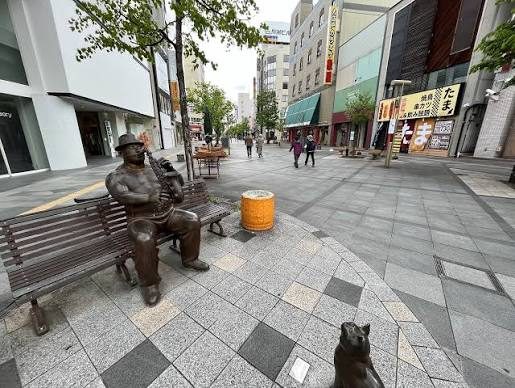
The Shopping Park runs about 1 kilometer from the station and is 20 meters wide. Benches, sculptures and flower beds were installed, and delegations came from all over Japan to see it. The idea of "a city center that's fun to walk" was first given shape in Japan on the former main street of a garrison town.
Look for this: the Hokuchin Memorial Museum and traces of the "division town"
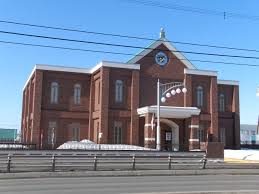
Around Shunko and Shunkocho, where the division was based, there is still a Japan Ground Self-Defense Force garrison, and within it the Hokuchin Memorial Museum displays history from the tondenhei to the Seventh Division. Walk the area and you'll still find facilities housed in former division buildings, and wide plots that were once military land.
"The Shopping Park was a failure"?
You sometimes hear this, since there was a period when big suburban stores drew customers away and the city center declined. In recent years, however, redevelopment and events have kept up efforts to bring the crowds back.
Japan's first permanent pedestrian mall
Not a Sunday-only car-free zone, but a road turned into a park as a permanent pedestrian space — the Shopping Park was the first in Japan.
Main sources: City of Asahikawa, "Overview of Heiwa-dori Shopping Park" / Hokuchin Memorial Museum exhibits / City of Asahikawa, "History of Asahikawa City"