Home / Legends and Urban Legends
10 — LEGENDS
Legends and Urban Legends
A demon's footprints left in the rocks of the Ishikari River, the proud claim that the city "was supposed to become Hokkaido's capital," and the theory that "Asahikawa's snow festival came first." The stories people pass on reflect the hopes and feelings of their times. Here we gather Asahikawa's local lore — marking where it parts ways with history.
Labels: Factdocumented Likelysupported by most sources Legendoral tradition Urban legendlocal lore and rumour
Kamuikotan — the battle of a demon and a hero-god
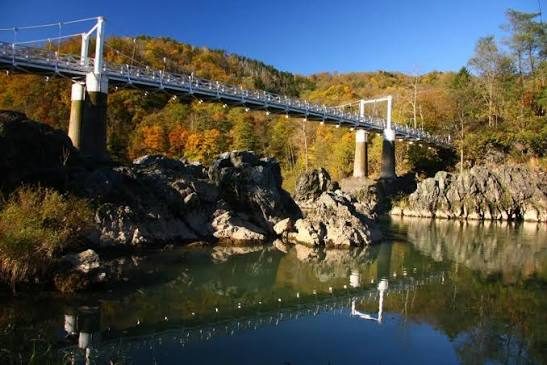
LegendWest of Asahikawa, where the Ishikari River runs through a narrow gorge, lies Kamuikotan — Ainu for "the place where the gods dwell." This legend has been handed down here:
Long ago, the demon Nitne-kamuy made its home in this gorge and tried to torment the people by damming the river. Hearing the people's prayers, the hero-god Samaykur fought the demon and at last struck it down.
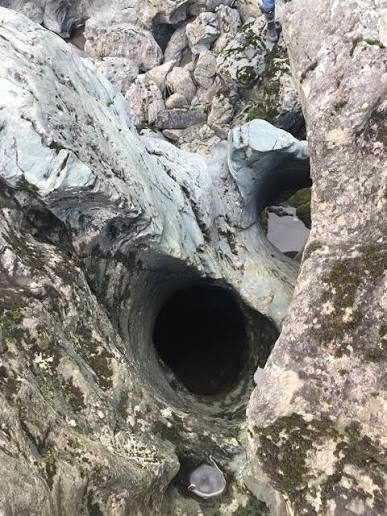
The rocky gorge is full of marks said to be traces of that battle. Round holes in the riverbed rocks are the demon's footprints, grooves cut into the stone are sword marks, and the great boulders in the river are said to be the fallen demon's body and head.
Look for this: what the "footprints" really are
In geology, the round holes said to be the demon's footprints are called potholes. Pebbles caught in the river's eddies spin round and round, grinding away the rock over countless years. Comparing the same rocks through two lenses — legend and science — is the best way to enjoy Kamuikotan.
FactIn the days when people traveled the Ishikari River by boat, Kamuikotan was the most dangerous stretch of all. Many are said to have had their boats swallowed by its rapids and rocks. The legend that "a demon lives here" was perhaps also a way of passing on the wisdom of how perilous this place was.
Local lore: fact-checked
"Asahikawa was supposed to become Hokkaido's capital"
What the government decided on was a site for an "imperial villa." The Hokkaido government did have a "Northern Capital" plan, but neither a capital nor the seat of the Hokkaido government was ever officially set for Asahikawa.
There really was a planned villa site
In 1889, the Kaguraoka area was designated as the site for an imperial villa. In 1911, the Crown Prince inspected it (The phantom "Northern Capital").
"Asahikawa's snow festival came first"
A story survives locally that around 1946, a snow event was being planned in Tokiwa Park.
On record, Sapporo's first festival came first
The Sapporo Snow Festival began in 1950, the Asahikawa Snow Festival in 1951. The answer depends on what you count as the starting point — a fun debate.
"Asahikawa is the coldest town in Japan"
The official record low is Asahikawa's −41.0°C. But in terms of everyday winter cold, other towns in Hokkaido get even colder.
The record still belongs to Asahikawa
The −41.0°C of January 25, 1902, remains Japan's lowest temperature in the Japan Meteorological Agency's official records (Memories of Minus 41°C).
Whatever happened to the Rising Sun on Asahi Bridge?
LegendBefore the war, Asahi Bridge is said to have been decorated with the Rising Sun emblem as a symbol of the garrison town. What became of that decoration after the war has been the subject of many different local stories. Perhaps it is precisely because nobody knows for sure that it lives on as local lore.
What legends teach us
Legends and urban legends may not be factually correct, but they are mirrors reflecting what the people of a place have taken pride in, and what they have feared. The demon's rocks speak of the river's dangers; "we were supposed to be the capital" speaks of the town's pride.
Main sources: City of Asahikawa, "Kamuikotan" / Agency for Cultural Affairs, Japan Heritage Portal: "The Kamikawa Ainu: Living with the Kamuy" / City of Asahikawa, "History of Asahikawa City"