Home / The Kamikawa Ainu
04 — KAMUY AND THE PEOPLE
The Kamikawa Ainu and the Land of the Kamuy
Long before Japanese settlers arrived, the Kamikawa Ainu lived along the upper reaches of the Ishikari River. People who traveled all the way to Tokyo to defend their land, a 19-year-old girl who carried her language into the future, and a surveyor who drove a railway through a gorge — Asahikawa holds many stories that textbooks rarely tell.
Labels: Factdocumented Likelysupported by most sources Legendoral tradition Urban legendlocal lore and rumour
The people of the upper Ishikari
Along the rivers of the Kamikawa Basin were scattered the kotan (villages) of the Kamikawa Ainu. Salmon swimming upstream in autumn, deer in the mountains, plants along the riverbanks. The people believed that Kamuy (gods) dwell in everything in nature, and they lived alongside rituals of gratitude and prayer.
FactThe Japan Heritage story "The Kamikawa Ainu: Living with the Kamuy — A World of Gods Handed Down in the Embrace of Daisetsuzan", applied for by the City of Asahikawa and others, has been officially recognized as a story conveying this worldview. Kamuikotan, Arashiyama and the peaks of Daisetsuzan are its stage.
The people who defended the land at Chikabumi
In the Meiji era, under government policy, the Ainu of Kamikawa were gathered into one corner of Chikabumi and allotted land as a "planned grant area." But once it was decided that the Seventh Division would move to Asahikawa, some people began to covet that land.
FactAround 1899, Okura Kihachiro and others involved in building the division sought to have the Chikabumi land sold off to them, and plans moved ahead to relocate the Ainu elsewhere. It is also said that a petition was submitted that effectively got the Ainu to agree to the move without properly telling them what it involved.
A defining moment: the petition in Tokyo
In response, Ainu representatives including Tenkawa Keizaburo set off for Tokyo in May 1900. They appealed their plight to powerful figures such as Okuma Shigenobu, and as a result the relocation order was withdrawn. It is still remembered as a moment when people defended their own land with their own voices. Even so, disputes over the land continued for a long time afterward.
Chiri Yukie — the "Ainu Songs of the Gods" left by a 19-year-old
FactChiri Yukie was born in Noboribetsu in 1903. In 1909, at the age of six, she went to live with her aunt Kannari Matsu in Chikabumi, and grew up listening to her grandmother Monashinouk recite Kamuy-yukar (songs of the gods).
When she was 15, the Ainu language scholar Kindaichi Kyosuke visited Chikabumi and recognized her talent. Yukie went on transcribing Ainu into notebooks in the Roman alphabet and adding Japanese translations. In May 1922 she traveled to Tokyo and completed the manuscript at Kindaichi's home, but her chronic heart condition worsened. On September 18, on the very night she finished the final proofs, she died at the age of 19.
"Ainu Shin'yoshu" (Ainu Songs of the Gods) was published the following year, on August 10, 1923. It became one of the first books in which an Ainu person wrote down the stories of the Ainu language, which had no writing system of its own.
Its preface is celebrated as a masterpiece expressing her feelings for her people's disappearing language and world. It is still in print today in the Iwanami Bunko paperback series (see Further reading).
Kawamura Kaneto — the surveyor who drove a railway through the Tenryu gorge
FactKawamura Kaneto (1893–1977) was a survey engineer from Chikabumi. After honing his skills on Hokkaido's railway surveys, he was put in charge of surveying the Sanshin Railway (now part of the JR Iida Line, between Tenryukyo and Mikawa-Kawai), which had to be driven through the treacherous gorge of the Tenryu River where Aichi, Shizuoka and Nagano prefectures meet.
On a site of endless cliffs, it is said that the survey team Kaneto led cut through the section that local surveyors had given up on. Despite facing discrimination as an Ainu, he won trust through the quality of his work. The line opened along its full length in 1937.
Look for this: the Kawamura Kaneto Ainu Memorial Museum
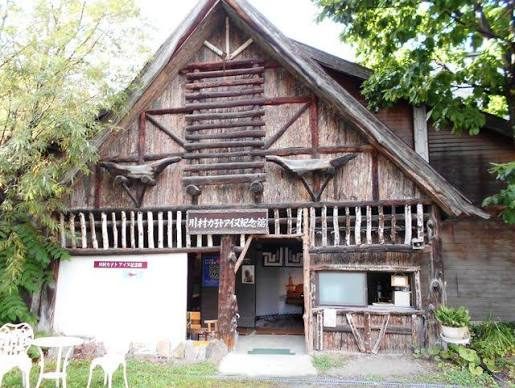
The Kawamura Kaneto Ainu Memorial Museum in Hokumoncho grew out of a collection started by Kaneto's father, Itakishiroma, and is one of the oldest Ainu museums in Japan. Through everyday tools, clothing and a cise (traditional house), visitors can experience the culture of the Kamikawa Ainu.
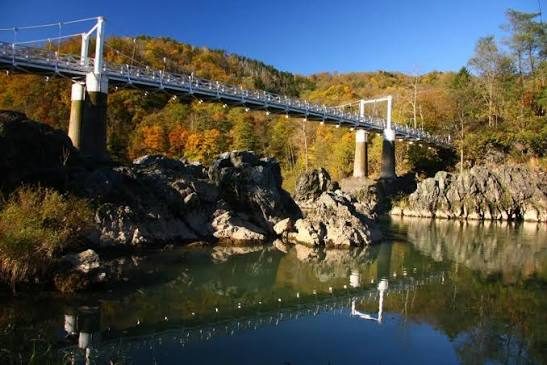
Kamuikotan
A gorge on the Ishikari River whose name means "the place where the gods dwell." Legends tell of a battle between a demon and the hero-god Samaykur (see the Legends room).
A culture that lives on
In Asahikawa, ceremonies and festivals passing on Ainu culture continue today. Every autumn the "Kotan Matsuri" (Kotan Festival) is held at Kamuikotan, with traditional dances and rituals.
Main sources: Agency for Cultural Affairs, Japan Heritage Portal: "The Kamikawa Ainu: Living with the Kamuy" / Chiri Yukie Silver Droplets Memorial Museum / Kawamura Kaneto Ainu Memorial Museum / City of Asahikawa, "History of Asahikawa City"