Home / The Capital That Never Was
01 — THE CAPITAL THAT NEVER WAS
The Phantom "Northern Capital"
In the middle of the Meiji era, a plan to put Hokkaido's capital in the inland Kamikawa Basin — and to build an imperial villa for the Emperor there — made it all the way to a government decision. The capital never came. But traces of that dream still survive in Asahikawa's map and place names.
Labels: Factdocumented Likelysupported by most sources Legendoral tradition Urban legendlocal lore and rumour
The idea of a "Hokkei"
FactIn 1882, Iwamura Michitoshi, who would later become the first Governor of Hokkaido, argued that the island's center should be placed inland at Kamikawa. Sapporo would be the "Southern Capital" and Kamikawa the "Northern Capital" — a linchpin for defending the north and opening up the frontier. The name, written with the same characters as Beijing, had nothing to do with China's capital: it meant, quite literally, "the capital of the north."
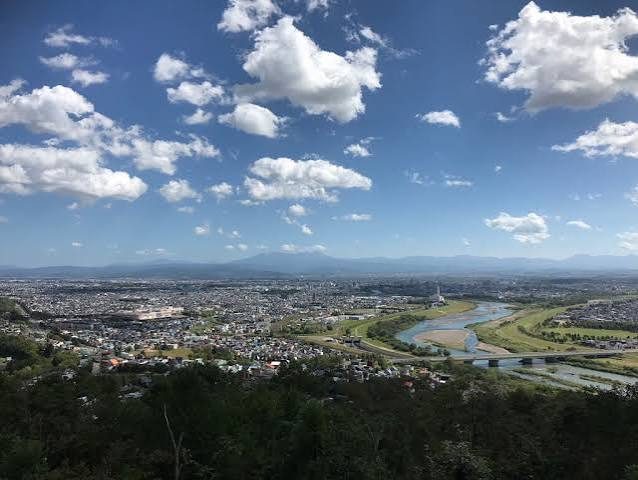
In 1885, Iwamura and Nagayama Takeshiro, commander of the tondenhei (soldier-settlers), are said to have pushed into the still roadless Kamikawa Basin and surveyed it from the top of Mount Chikabumi (Arashiyama). A broad plain, converging rivers, mountains on every side. Far from any port, beyond the reach of foreign naval guns. From both a military and a settlement standpoint, it must have looked like the ideal inner sanctum.
Look for this: the view from Arashiyama
From the observation deck on Arashiyama (Mount Chikabumi), west of the city, you can take in the whole Kamikawa Basin and the city — and on a clear day, all the way to Daisetsuzan. It's a place where you can see the Meiji surveyors' "capital candidate site" from the very same height.
The capital became an "imperial villa"
FactWhat the Hokkaido government wanted was a "Northern Capital" — a capital in its own right. The central government wouldn't go that far, but in 1889 it decided to place an imperial villa in Kamikawa: a palace where the Emperor would stay during his visits. The chosen site lay south of the Chubetsu River, in what is now the Kagura and Kaguraoka area. It covered some 10,500 hectares.
The site was protected, and roads and town blocks were laid out around it. The fact that central Asahikawa, like Sapporo, has a neat grid of streets is also thought to be a legacy of planning on the assumption of "a town worthy of a capital."
Why it never happened
LikelyThere is no single reason why the villa was never built, but these circumstances are often cited:
- The country was heading toward the Sino-Japanese and Russo-Japanese wars, and the national budget went to the military.
- Sapporo, close to the ports, cemented its position as Hokkaido's administrative and economic center.
- Instead of a villa, Kamikawa got the Seventh Division, and the role of "guardian of the north" passed to the army.
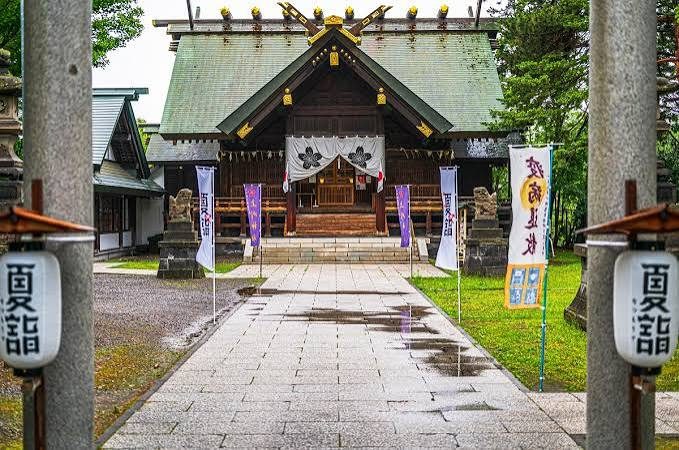
FactIn 1911, the Crown Prince (later Emperor Taisho) visited the planned villa site, but no palace was ever built. Eventually the site designation was lifted, and in 1924 Kamikawa Shrine moved to Kaguraoka, one corner of the former site. In place of a capital, the town's guardian deity came to rest on the hill.
"Asahikawa was supposed to become Hokkaido's capital"
A phrase you often hear locally. The sentiment is understandable, but what the government officially decided on was neither a "capital" nor a "prefectural seat" — it was an "imperial villa."
"A site for an imperial villa was chosen"
This part is on record. To be precise, the Hokkaido government's "Northern Capital" plan was scaled down to an "imperial villa" at the national level.
Butterfly effect: the division came to where the dream had been
The basic idea of "a stronghold inland" never went away. The capital didn't come, but the Seventh Division's relocation was chosen for the same reasons. Dream of a villa → division town → garrison city of Asahikawa. Without the Northern Capital plan, Asahikawa's path to becoming Hokkaido's second-largest city might have looked very different.
To the garrison town and Division Street →
Main sources: City of Asahikawa, "History of Asahikawa City" / Related materials from the Hokkaido Prefectural Library and Hokkaido Prefectural Archives / Kamikawa Shrine, "History"