Home / Genji
01 — Yoshitsune and the MinamotoYoshitsune's story
was “closed” in Morioka.
There is no record that Minamoto no Yoshitsune ever set foot in Morioka. But the century of the Northern Fujiwara — the family who sheltered him — came to its end within today's city. There his brother Yoritomo re-enacted a victory ritual performed by their ancestor 127 years earlier. Eight hundred years later, that ritual would make a lotus bloom.
From Yoshitsune's death to the fall of the Northern Fujiwara.
In the leap fourth month of 1189, Minamoto no Yoshitsune was attacked at his residence on the Koromo River in Hiraizumi by the forces of Fujiwara no Yasuhira, fourth head of the Northern Fujiwara, and took his own life. Yasuhira sent Yoshitsune's head, preserved in sake, to Kamakura as a sign of submission — despite his father Hidehira's dying instruction to make Yoshitsune their general and stand together.
But Yoritomo wanted not Yoshitsune's head but the north itself. Citing the crime of having sheltered Yoshitsune, he sent a great army north. Hiraizumi burned, and Yasuhira, fleeing north, was killed at Nie-no-saku (near today's Ōdate, Akita) by his own hereditary retainer, Kawada Jirō.
On the sixth day of the ninth month, Kawada Jirō arrived at Yoritomo's camp with his master's head. The camp was at Jingaoka, a hill in present-day Shiwa Town, about 20 km south of central Morioka.
Far from rewarding Kawada Jirō, Yoritomo had him executed for “forgetting generations of his lord's favor”. The chronicle Azuma Kagami records the scene in detail — a vivid illustration of Kamakura warrior ethics: betraying one's lord was unforgivable even when it helped the enemy.
The eight-sun nail: a 127-year-old ritual, re-enacted.
Here comes one of the most connoisseur-friendly moments in Morioka's history. According to the Azuma Kagami entry for 1189/9/6, Yoritomo had Yasuhira's head handled according to a specific precedent.
That precedent came from 1062, the end of the Former Nine Years' War. Yoritomo's ancestor five generations back, Minamoto no Yoriyoshi, had the head of Abe no Sadatō — killed at Kuriyagawa — received by his vassal Yokoyama Tsunekane, and ordered the retainer Korenaka to nail it up with an iron nail eight sun (about 24 cm) long.
Yoritomo reproduced this in detail. To receive the head, he chose a great-grandson of Yokoyama Tsunekane. To hang it, he specially summoned Nanata Hirotsuna, a descendant of Korenaka. The nail, too, was “as in that earlier time”. Members of the same families played the same roles, with the same tools, 127 years apart.
The nail was the same as in that earlier precedent.Azuma Kagami, 1189/9/6 (paraphrased)
For Yoritomo this was no mere execution. It is thought to have been political theater staged before the eastern warriors, proclaiming him the rightful heir of Yoriyoshi, who had pacified the north in the Former Nine Years' War.
On the twelfth day, Yoritomo left Jingaoka and moved further north into the Kuriyagawa stockade. He stayed about a week, accepting the surrender of the Hizume and other remnants of the Fujiwara, granting pardons and confirming lands. The postwar settlement of the Ōshū campaign took place on the very spot where his ancestor had destroyed the Abe.
Kuriyagawa was thus the final stage of two wars that destroyed independent northern powers: the Former Nine Years' War (1062) and the Ōshū campaign (1189). For the Minamoto it was a site of two victories; for the Abe and the Northern Fujiwara, the place where their stories ended.
Morioka has a neighborhood called “Zenkunen”.
The Kuriyagawa stockade is thought to have stood on the bluff above the confluence of the Kitakami and Shizukuishi rivers — today's Abetate-chō in Morioka, whose name means “Abe residence”. Nearby there is even a district called Zenkunen, “Former Nine Years”. A war's name turned into a street address is rare anywhere in Japan.
The fall of Kuriyagawa was brutal. The Minamoto are said to have filled the moats and set fire to timber torn from houses and piled against the stockade. Abe no Sadatō, badly wounded, was captured and brought before Yoriyoshi, dying soon after.
The moats and enclosures visible today at the Abetate site are thought to belong mainly to a medieval fortified residence (of the Kuriyagawa Kudō family). The exact site of the Heian-period Kuriyagawa stockade — and of the nearby Ubato stockade — remains uncertain.
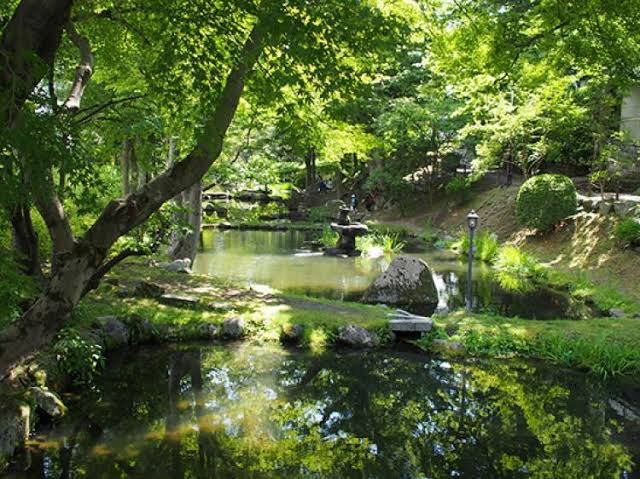
800 years later, the casket's lotus bloomed where the nail ritual began.
The story does not end there. Yasuhira's nailed head was later returned to Hiraizumi, placed in a black-lacquered casket and laid in the Konjikidō of Chūsonji beside his father Hidehira. Then the centuries passed.
- 1062Minamoto no Yoriyoshi nails up Abe no Sadatō's head at Kuriyagawa with an eight-sun nail.
- 1189Yoritomo re-enacts the precedent with Yasuhira's head, which is later placed in Chūsonji's Konjikidō.
- 1950A scientific survey of the Konjikidō finds about 80 lotus seeds in Yasuhira's head casket. Marks thought to be from the nail are also found on the skull.
- 1993Under researcher Nagashima Tokiko, working at Chūsonji's request, the 800-year-old seeds germinate.
- 1998The lotus blooms. The pale pink Japanese lotus is named the “Chūsonji lotus” (Yasuhira lotus).
- 2012As a “flower of recovery” after the Great East Japan Earthquake, the first divided plant goes to the Ichinokura residence garden in Abetate-chō, Morioka.
The nail ritual Yoritomo copied from his ancestor began at Kuriyagawa. And now, in Abetate-chō — the presumed site of Kuriyagawa — a lotus grown from the casket of the ritual's victim blooms more than 800 years later. Nobody planned it, yet the circle closes almost too neatly.
The Ichinokura lotus blooms in summer. Lotus flowers open early in the morning and begin to close around midday, so morning is the time to visit.
The Nanbu, who founded Morioka, were Minamoto too.
The Nanbu clan, who built Morioka's castle town, trace their roots to Nanbu-gō in Kai Province (today's Nanbu Town, Yamanashi) and belong to the Kai Genji — descendants of Minamoto no Yoshimitsu, younger brother of Yoshiie. In other words, they share the Kawachi Genji bloodline of Yoriyoshi and Yoshiie, who destroyed the Abe at Kuriyagawa.
According to Nanbu family tradition, the founder Nanbu Mitsuyuki followed Yoritomo in the Ōshū campaign and was rewarded with the land of Nukanobu (eastern Aomori to northern Iwate). If the tradition is true, the very war that destroyed Yoshitsune's protectors brought the Nanbu north — and Morioka's origins lie in the Ōshū campaign.
Mitsuyuki's grant of Nukanobu comes from the Nanbu family's own tradition and cannot be confirmed in contemporary sources. The Nanbu are thought to have become a real power in the north from the late Kamakura to the Nanbokuchō period.
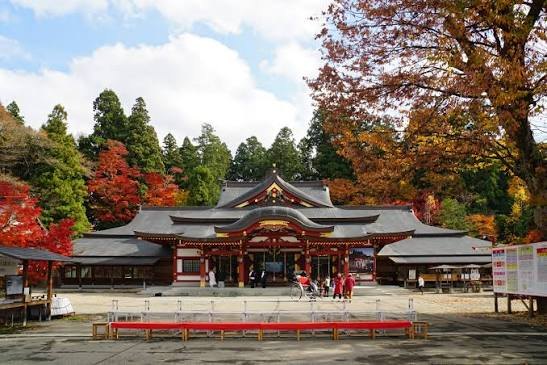
The Minamoto's tutelary god is Hachiman. Morioka Hachimangū was founded in 1680 by the fourth lord Nanbu Shigenobu and has been the townspeople's beloved “Hachiman-san” ever since. During the Morioka Autumn Festival in September, floats and processions of Nanbu horses parade through the old castle town.
Yoshitsune did not die — he fled north.
The man who died at the Koromo River was a double; the real Yoshitsune escaped north. The so-called legend of Yoshitsune's northern flight traces a long route from Hiraizumi through Tōno, Kamaishi, Miyako, Kuji and Hachinohe to Minmaya in Aomori, and across the sea to Ezo (Hokkaidō).
What stands out is that much of this route lay within the Morioka domain (and its offshoot, the Hachinohe domain) during the Edo period. At Kuromori Shrine in Miyako, Yoshitsune's party is said to have stayed over three years copying the Great Wisdom Sutra; around Miyako and Kamaishi there are houses where he stayed and rocks Benkei carried. At Suzukuna, on National Route 106 from Morioka toward Miyako, there is even a tale that Shizuka Gozen, following Yoshitsune, died there.
As early as the 17th century, the shogunate-sponsored history Zoku Honchō Tsugan, compiled by Hayashi Razan and his circle, recorded the view that Yoshitsune did not die at Koromogawa but fled to Ezo — showing how long this legend has been growing.
In the legend, the man killed at Koromogawa was Yoshitsune's double, Suginome Tarō Yukinobu. Yoshitsune's head, preserved in sake, took more than forty days to reach Kamakura — so, the argument goes, no one could tell whose head it really was.
In the Meiji era the theory went further: Yoshitsune crossed to the continent and became Genghis Khan. Historians reject it, of course, but Hōonji in Morioka has an arhat statue nicknamed “Kublai” — Genghis Khan's grandson — so Yoshitsune fans may want to go and look him in the face (see Legends and Urban Legends).
Historians regard the northern-flight legend as unhistorical. Yet the fact that it has been told so widely and in such detail is itself a precious piece of culture, reflecting Tōhoku's sympathy for the underdog and its complicated feelings toward central power.