Home / Origins
00 — OriginsKozukata:
where the demon never returns.
Morioka was once called Kozukata — “the direction from which [the demon] does not come”. How did a place named for a demon's vow become a “flourishing hill”? From the origin of the prefecture's name to the poem that renamed the town, this is Morioka's beginning told through its names.
A demon pressed its hand into the rock.
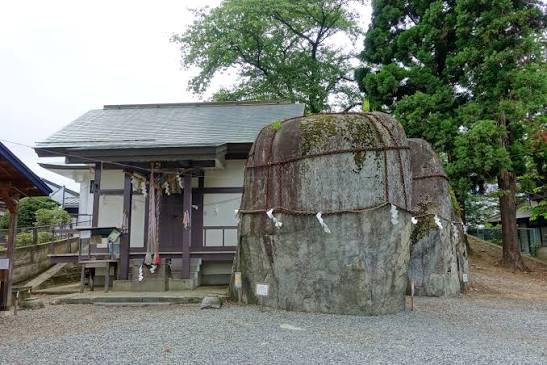
In a residential street in Nasukawa-chō, northeast of central Morioka, stands a small shrine called Mitsuishi Jinja. In its grounds sit three enormous granite boulders bound with sacred rope. These are the “Three Stones” said to have given Iwate Prefecture its name.
Long ago, the story goes, a demon called Rasetsu terrorized the people here. In desperation they prayed to the god of the Three Stones, who seized the demon and bound it to the rocks. The demon swore never to return, and as proof pressed its hand into the stone before leaving.
A hand (te) on the rock (iwa): Iwate. “The direction from which it does not come”: Kozukata. And the villagers who danced around the stones shouting “sansa, sansa” in celebration are said to have started the Sansa Odori dance. A prefecture's name, an old place name and a summer festival — all from a single legend.
In some tellings, the Three Stones were flung here by an eruption of Mt. Iwate. The handprint has weathered away over the centuries and is now hard to make out, but around the shrine you may still meet someone who will point and say “the handprint was about there”.
For Morioka people, Sansa Odori is not just a summer festival but a celebration of the demon's defeat. The Morioka Sansa Odori each August has even been recognized for the world record for the most taiko drums played simultaneously.
The northern edge of the ancient state was in Morioka.
There is firmer history than the demon, too. In 803, the shōgun Sakanoue no Tamuramaro built Shiwa Fort in what is now Ōta, Morioka. The year before, the Emishi leader Aterui had surrendered, pushing the court's reach further north, and this fort became its front line.
Shiwa's outer enclosure measured about 840 m on each side — comparable to Taga Castle, seat of the provincial government. Less a remote outpost than a northern stronghold city. Yet within about a decade it was abandoned. The reason: flooding of the Shizukuishi River. Its functions moved south to Tokutan Fort in present-day Yahaba.
The rivers would trouble Morioka again. The castle later built by the Nanbu clan struggled for decades with floods from the Nakatsu and Kitakami. In many ways, Morioka's history is the history of living with three rivers.
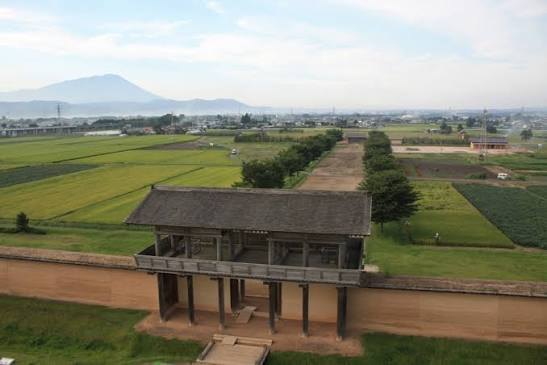
The site is now Shiwa Castle Ancient Park, with the south gate, earthen walls and a watchtower reconstructed at full scale. It is about 20 minutes by car from Morioka Station. The view of Mt. Iwate across the lawns may be much the same one soldiers saw 1,200 years ago.
Morioka exists because the Nanbu lost Tsugaru.
In the Middle Ages the Nanbu were a great power in the far north, based at Sannohe in today's Aomori Prefecture. Why did they build a castle so far south, at Kozukata? It started with a vassal's “betrayal”.
- 1571–Ōura (later Tsugaru) Tamenobu, from a branch of the Nanbu house, begins seizing castles in the Tsugaru region and moves toward independence.
- 1590Tamenobu reaches Hideyoshi's siege camp at Odawara before the Nanbu and is recognized as lord of Tsugaru. The Nanbu lose their northwest.
- 1591An internal feud erupts into the Kunohe Masazane Rebellion. After Hideyoshi's army crushes it, Nanbu Nobunao moves to Kunohe Castle (renamed Fukuoka Castle).
- 1590sWithout Tsugaru, Sannohe lies too far north of the domain. Advised by Gamō Ujisato and Asano Nagamasa, Nobunao chooses Kozukata — central, and a hub of Kitakami River transport.
- c.1597Castle building begins at Kozukata: the birth of Morioka Castle and its town.
Had Tsugaru Tamenobu not broken away, the Nanbu might have stayed in Sannohe, and Iwate's capital might be a different town. In a sense, Morioka was created by its northern rival. That rivalry lasted through the whole Edo period (see The Nanbu Domain's Pride).
From Kozukata to Morioka (森岡), and from 森岡 to 盛岡.
The Nanbu lords did not like the name of their new home. Kozukata can also be read as “the place nobody comes to” — hardly auspicious for a lord hoping his castle town would thrive.
So the area came to be called Morigaoka, “wooded hill”, and then Morioka, written 森岡. Then, in 1691, according to tradition, the fourth lord Nanbu Shigenobu and the priest Seisan of Eifukuji — the temple guarding the castle's unlucky northeast — exchanged linked verses, and from them came a new way of writing the name: 盛岡, “a hill that rises and flourishes”.
Through many springs — / is this the dew of the blossoms' grace? / A treasure-pearl, / the flourishing hill-mountainLinked verse said to be the origin of the name (Genroku era, English rendering)
Eifukuji's formal “mountain name” is still Hōju Morioka-san. The original of the city's name survives inside the name of a temple.
Accounts differ on who first named the place 森岡 (Nobunao or his successor Toshinao) and when. Most sources agree the change to 盛岡 dates to the Genroku era, though some point out that the characters appear occasionally before that.
The name Kozukata has not disappeared. It lives on in Ishikawa Takuboku's famous poem, in school names and nicknames, and even in the name of the city's mobile library bus. To Morioka people, “Kozukata” is a slightly proud poetic name for their home.
A castle that took thirty-six years to build — against the rivers.
Morioka Castle was built on a hill at the confluence of the Kitakami and Nakatsu rivers. The rivers made natural moats, but also meant the site took floods head-on. Construction began in 1597 or 1598, was repeatedly interrupted by flooding, and the castle only became the lord's permanent residence under the third lord Shigenao in 1633 — thirty-six years of difficult work.
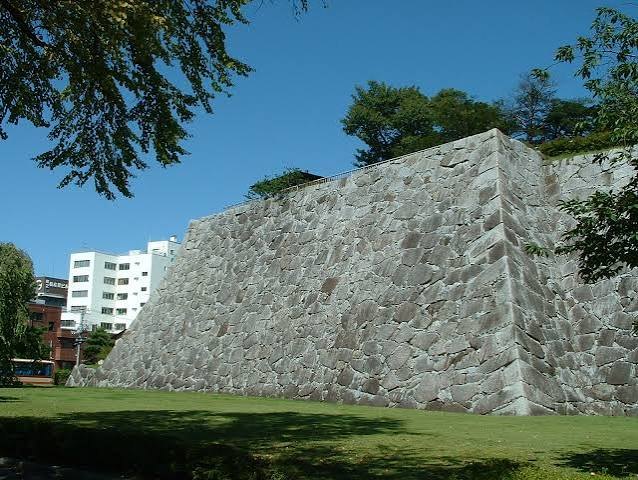
Its highlight is something rare in Tōhoku: walls built entirely of stone. The whitish granite ramparts vary from place to place — near-natural stones in one section, split and fitted stones in another, precisely cut blocks in a third — so you can read the different eras of construction in the walls.
During construction, a huge rock shaped like an eboshi court hat was dug out of the ground. Taken as a good omen, the “Eboshi Rock” was treasured as the castle's guardian. It can still be seen in the castle park, and next to the walls its size is striking.