Home / Townscape
05 — TownscapeThe blueprint of the castle town
survives in names, stones and bridges.
Central Morioka still preserves much of its Edo-period layout. Street names, bridge railings, the way stone walls are stacked, the rules for using spring water — walk the familiar streets as if reading them, and the 400-year-old plan of the castle town rises to the surface.
“Kōji” for samurai, “chō” for townspeople.
Look at Morioka's old place names and a pattern appears. Uwa-kōji, Shita-kōji, Katabira-kōji, Ōsawakawara-kōji… Many of the samurai residential streets around the castle carry the name kōji, “lane”. Shita-kōji, for instance, was named for the samurai lane below Mt. Atago, lined with the narrow-fronted houses of lower-ranking retainers.
The merchant and artisan districts, governed by the town magistrate, were collectively called the “Twenty-Eight Chō of Morioka”: Kon'ya-chō (dyers), Sakana-chō (fishmongers), Shōga-chō (ginger), Senboku-chō and more. Today's names still carry traces of trades and origins; Senboku-chō is said to have been settled by people from the Senboku region of Akita.
Morioka's 肴町 is read “Sakana-chō”. Today it is a covered shopping street loved by locals. Visitors who read it “Sakana-machi” put a tiny bit of distance between themselves and the locals.
Four-hundred-year-old bronze on the way to work.
Three bridges cross the Nakatsu River in the middle of the old castle town: from upstream, Kami-no-hashi, Naka-no-hashi and Shimo-no-hashi. Built with the castle, they were completed in 1609, 1611 and 1612 respectively.
Their railings carry onion-shaped bronze finials (giboshi), and 36 bearing Keichō-era inscriptions survive (two of the originals are lost). Those on Kami-no-hashi are designated Important Art Objects. Metalwork more than four centuries old lines an ordinary street, and schoolchildren touch it without a second thought.
The finials on Shimo-no-hashi originally belonged to Naka-no-hashi. When Naka-no-hashi was rebuilt as a modern Western-style bridge in 1912, eighteen finials were moved to Shimo-no-hashi. Replace the bridge, keep the finials — a very Morioka attitude toward cherishing things.
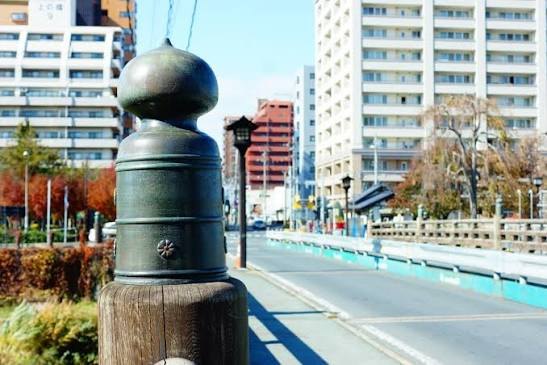
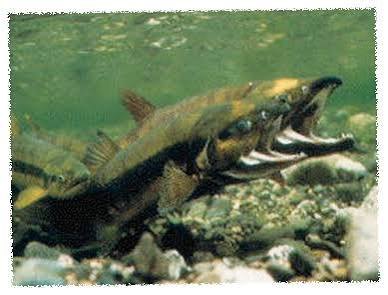
In autumn, salmon swim up the Nakatsu. Seeing wild salmon from a bridge in the center of a prefectural capital is rare in Japan, and people leaning over the railings of Kami-no-hashi and Naka-no-hashi are a seasonal sight in Morioka.
Did the rock-splitting cherry really split the rock?
In the front garden of the Morioka District Court, an Edo higan cherry grows out of a crack in a huge granite boulder: the national natural monument Ishiwari-zakura, the “rock-splitting cherry”. Said to be 350 to 400 years old, it spreads pale pink blossoms over the rock in mid-to-late April.
People say the tree split the rock, but it is more likely that a seed took root in an existing crack (perhaps caused by lightning) and has been slowly widening it as it grew. Either way, the crack reportedly still widens a little each year — a quiet contest between tree and stone that continues today.
The court grounds were once the residence of a senior Morioka retainer. In winter the cherry is carefully wrapped in protective snow screens of rope and bamboo — another familiar Morioka seasonal scene.
A red-brick bank three years older than Tokyo Station.
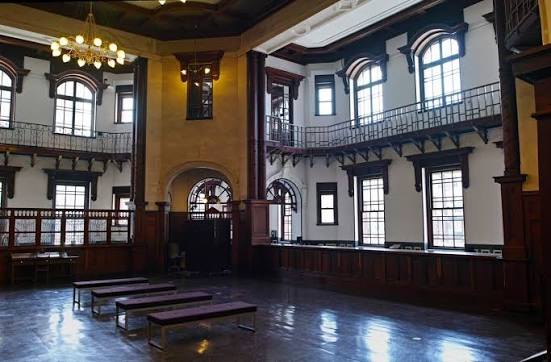
At the foot of Naka-no-hashi stands a red-brick building banded in white stone and topped with a green dome. Completed in 1911 as the head office of Morioka Bank, it is today's Iwate Bank Red Brick Building.
It was designed by the Tatsuno–Kasai office of Tatsuno Kingo and Morioka-born Kasai Manji. Its “Tatsuno style” of red brick and white stone bands belongs to the same lineage as Tokyo Station, completed in 1914. Since Morioka's came three years earlier, locals fondly call it “Tokyo Station's big brother” or “mini Tokyo Station”.
Remarkably, it served as a working bank branch until 2012. An Important Cultural Property that was an active bank for a century, it is now open to visitors, who can see the old vault and the grand banking hall.
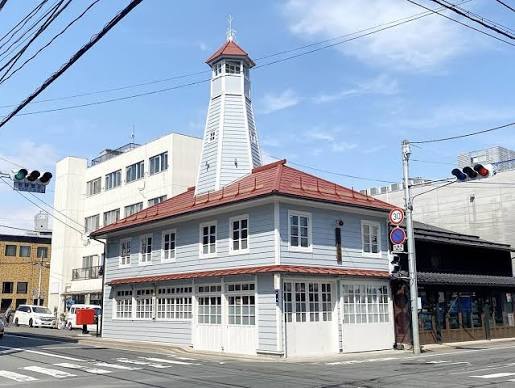
Nearby in Kon'ya-chō stands the Kon'ya-chō Banya, a fire station built in 1913. The Western-style wooden building with its lookout tower served as a working fire station for many years. Old merchant buildings, including long-established shops selling rush mats and bamboo crafts, are scattered around it.
The springs have an order of use.
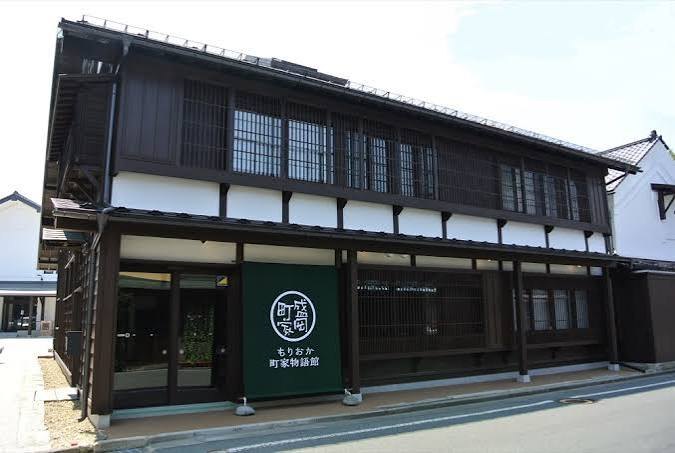
South of the old castle, around Nataya-chō, rows of old townhouses called Morioka machiya still stand. Narrow at the front and deep at the back, they have a shop facing the street with living quarters and storehouses behind.
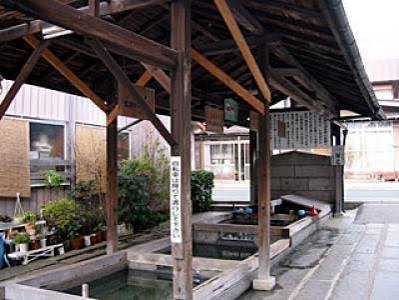
Don't miss the springs long used as communal wells: Daiji Shimizu and Seiryūsui. Each is divided into several basins, and their use is fixed from upstream: drinking water, then rinsing rice and vegetables, then washing. A water-users' association of neighbors still manages them, and they remain in careful use under these rules.
When using the springs, always use the proper basin — that's Morioka manners. It's not unusual to see a neighbor who has come to draw water exchange a word with a visitor.
You cry when you arrive, and cry when you leave.
Heading from Morioka Station into town, the first bridge you cross is Kaiun Bridge over the Kitakami River. Its nickname is “Nido-naki-bashi” — the bridge where you cry twice.
People transferred to Morioka for work or study cry as they cross it, feeling they have come somewhere far to the north. After a few years, when it is time to leave, they cry again — reluctant to part with the warmth of the people and the comfort of the town. On a clear day Mt. Iwate rises beyond the river, and many still say they looked back at that view one last time and wept.