Home / Literature
06 — LiteratureA fifteen-year-old heart,
and a book nobody ordered.
Ishikawa Takuboku and Miyazawa Kenji, the two great writers of Iwate, both spent their impressionable teens in Morioka — one a boy lying in the grass of the castle ruins, the other a student who climbed Mt. Iwate again and again. The traces of their youth are still scattered around the town.
The boy who lay in the castle grass.
In 1898, twelve-year-old Ishikawa Hajime — later Takuboku — left Shibutami village to enter Morioka Middle School. The castle ruins seem to have been a hideout for boys skipping class. Years later, living in poverty in Tokyo, Takuboku remembered himself like this:
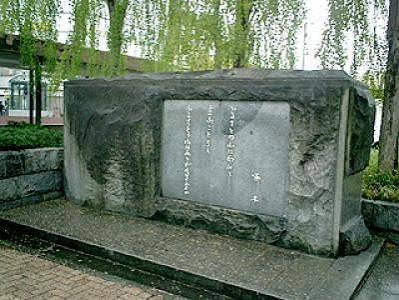
Lying down in the grass / of Kozukata Castle — / my fifteen-year-old heart / drawn up into the sky.Ishikawa Takuboku, A Handful of Sand (1910), English rendering
A monument with this poem stands in the castle park. That he chose the old poetic name “Kozukata” rather than “Morioka” reveals his special feeling for home.
Absorbed in literature, Takuboku neglected his studies, and after an exam-cheating incident he left Morioka Middle School in 1902 without graduating. The sixteen-year-old went to Tokyo — and the one who kept supporting him was his senior from school, Kindaichi Kyōsuke.
A wedding without a groom.
In 1905, nineteen-year-old Takuboku was to marry Horiai Setsuko, his sweetheart since middle school. But on the day of the wedding in Morioka, the groom did not appear. On his way back from Tokyo he had stopped in Sendai and stayed for days. The ceremony went ahead without him.
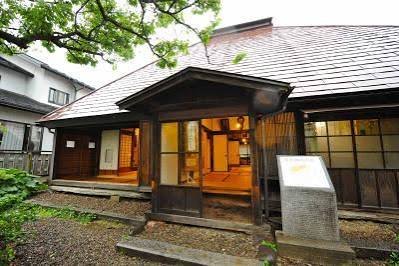
The house where Takuboku finally lived with his family for about three weeks survives near Chūō-dōri as the “Takuboku Newlyweds' House” — a small thatched house with the air of a samurai residence, which Takuboku described in his essay “My Four-and-a-Half-Mat Room”.
The Newlyweds' House is the only surviving residence in Morioka associated with Takuboku, and is open to the public. Say “the newlyweds' house” in Morioka and people will know you mean Takuboku's.
Mt. Iwate, Hōonji and Azalea.
In 1915, Miyazawa Kenji of Hanamaki entered Morioka College of Agriculture and Forestry (today's Faculty of Agriculture, Iwate University) at the top of his class. As a student he was passionate about geology and soil surveys, and climbed Mt. Iwate many times for fieldwork and pleasure, sometimes walking through the night to see the sunrise from the summit.
With dormitory friends he launched the literary magazine Azalea, publishing tanka and prose, and he practiced Zen at Hōonji in the northern temple quarter — a temple where Takuboku's uncle had once been head priest. Imagining Kenji sitting in meditation there, you feel the lines of the two writers strangely cross.
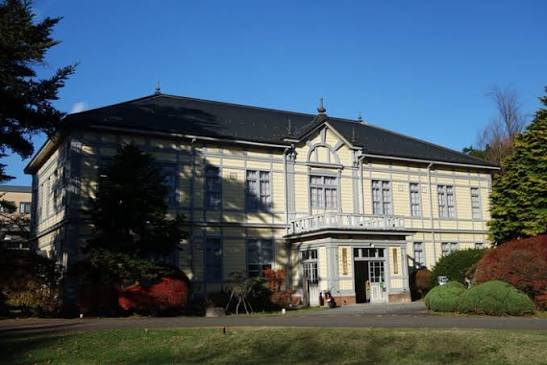
The college's former main building survives as Iwate University's Agricultural Education Museum, an Important Cultural Property. Inside this Meiji-era wooden Western-style building you can see Kenji's student records and other materials.
The publisher's name was chosen by Kenji.
In 1924, Kenji's first collection of stories, The Restaurant of Many Orders, was published by Kōgensha in Morioka. The founder, Kenji's junior from the college, had visited him at Hanamaki Agricultural School and taken away a mountain of manuscripts. The name “Kōgensha” was given by Kenji himself.
Yet the book barely sold. Kōgensha's own history wryly calls it the book of “few orders”. Kenji's work only became widely read after his death at 37.
Kōgensha still operates in Zaimoku-chō as a shop for folk crafts, lacquerware and Nanbu ironware. Through the courtyard lies the café Kahikan, a calm space that feels like stepping into one of Kenji's stories, loved by locals and visitors alike.
A word from Kenji gave Morioka its soul food.
Among Kenji's pupils at Hienuki Agricultural School in Hanamaki was a boy named Oikawa Tomekichi. After graduating, unable to afford further study, Tomekichi was about to give up — until Kenji introduced him to a job as an assistant at Morioka College of Agriculture and Forestry.
- 1923Through Kenji, his pupil Oikawa Tomekichi becomes an assistant in agricultural chemistry at Morioka College, studying fermentation and brewing.
- 1928Tomekichi joins a yeast manufacturer's research institute in Osaka, working on yeast at the forefront of domestic yeast development.
- 1931He marries and takes the name Fukuda: Fukuda Tomekichi.
- 1948Back in Morioka after the war, he founds Fukuda Pan, creating a large, cheap, filling koppe-pan roll for students of Iwate University — the former college.
- TodayAround 10,000 rolls a day: Morioka's soul food.
Had Kenji not found Tomekichi that job, the yeast researcher Fukuda Tomekichi might never have existed — nor the rolls that generations of Morioka children grew up on. More in Three Noodles and More.
Words left by people of this town.
I wish to become a bridge across the Pacific.Nitobe Inazō (said to have been spoken at his Tokyo University entrance interview)
A boy born in Takajō-kōji, Morioka, lived a life connecting Japan and the world.
Facing the mountain / of my hometown / I have nothing to say — / how grateful I am for / the mountain of home.Ishikawa Takuboku, A Handful of Sand (1910), English rendering
“The mountain of home” is thought to be Mt. Iwate as seen from Shibutami.
HōjakuHara Takashi's motto
To serve others without seeking reward. His calligraphy can be seen at the Hara Takashi Memorial Museum.