Home / Legends
09 — LegendsMountains grow jealous, arhats travel,
and a bridge makes people cry.
Morioka has many stories history alone can't tell: a lovers' quarrel between mountains, arhats with foreign faces, the theory that Yoshitsune became Genghis Khan. Here we introduce Morioka's legends and urban legends, labeled “history”, “folklore” or “urban legend” so you can tell them apart.
Mt. Iwate sent Mt. Himekami away.
Three mountains are visible from Morioka: Mt. Iwate towering to the northwest, graceful Mt. Himekami to the northeast, and Mt. Hayachine far to the southeast. A legend of love and jealousy connects them.
Mt. Iwate, a male god, had Mt. Himekami as his wife. But he fell for the beautiful Mt. Hayachine. Wanting Himekami out of the way, he ordered his servant Mt. Sōsen to take her far away. But Himekami could not bear to leave and stayed northeast of Morioka. Furious, Mt. Iwate erupted in rage and cut off the head of Mt. Sōsen, who had failed him.
The legend varies from place to place, and may be a way of explaining Mt. Iwate's violent eruptions as a story. Some say a feature on Mt. Iwate's eastern flank is “Sōsen's head”.
Marco Polo sits among the arhats.
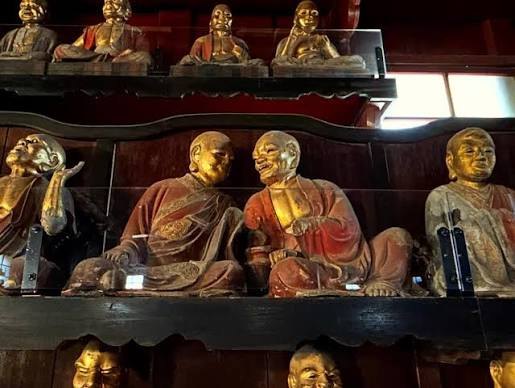
In the Rakan Hall of Hōonji, one of the northern temple quarter's temples, 499 arhat statues sit in rows. Inscriptions inside show they were made by nine Kyoto sculptors over four years from 1731. Surviving wooden arhats in such numbers, with known dates and makers, are extremely rare in Japan.
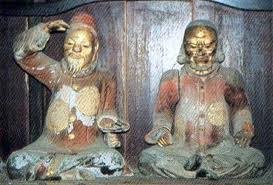
Two of them, with foreign-looking faces and clothes, are nicknamed “Marco Polo” and “Kublai Khan”. Their actual names are No. 100, Zenchū Sonja, and No. 101, Hōzō Eigō Sonja. They were not modeled on Marco Polo, of course; their exotic appearance, evoking monks of India, Central Asia and China, simply earned them the nicknames.
The wooden crates used to ship the statues from Kyoto are said to have been reused as their pedestals. There is also a saying that among five hundred arhats you will always find a face resembling yourself or someone you long to see, and many visitors search the hall slowly.
Following on from the northern-flight legend, there's a theory that Yoshitsune became Genghis Khan — and Kublai was Genghis Khan's grandson. Yoshitsune fans staring intently at “Kublai” in Hōonji may be a uniquely Morioka pastime (see Yoshitsune and the Minamoto).
A quick guide to Morioka's legends.
| Story | Category | In brief |
|---|---|---|
| A demon's handprint on the Three Stones gave Iwate its name | Folklore | Widely told origin of the prefecture's name. See Origins |
| Sansa Odori began as a dance celebrating the demon's defeat | Folklore | Told together with the Three Stones legend |
| The cherry tree split the rock | Disputed | More likely it rooted in a crack and widened it |
| Yoritomo nailed Yasuhira's head with an eight-sun nail | History | Described in detail in the Azuma Kagami |
| Yoshitsune didn't die at Koromogawa but fled north | Folklore | Rejected as history; many sites lie in the old Morioka domain |
| Yoshitsune became Genghis Khan | Urban legend | A Meiji-era theory, rejected by scholars |
| There is a statue of Marco Polo at Hōonji | Urban legend | A nickname for an exotic-looking arhat, really Zenchū Sonja |
| Kaiun Bridge is the “crying twice” bridge | Folklore | Born from the feelings of people posted to Morioka |
The bells of Chagu Chagu Umakko.
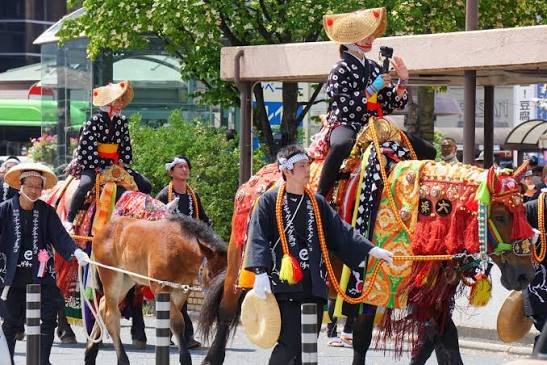
Every year on the second Saturday of June, horses in brilliant costumes hung with countless bells walk about 14 km from Sōzen Shrine in Takizawa to Morioka Hachimangū. This is Chagu Chagu Umakko.
In the Nanbu region, where people lived alongside horses, farmers traditionally brought their horses to “Sōzen-sama”, guardian of farm horses, to thank them after rice planting and pray for their health. The name comes from the “chagu chagu” jingle of the bells — a sound selected as one of the 100 Soundscapes of Japan.
Morioka people say watching the procession makes them feel “summer is coming again”. It is a festival full of deep affection for horses, from a land where people and horses once lived under one roof in L-shaped magariya farmhouses.
A few small legends.
The Eboshi Rock
The huge hat-shaped rock dug up during the castle's construction was enshrined as its guardian. Still visible at the castle ruins, it's loved as Morioka's lucky stone.
The crying bridge
Newcomers crossing Kaiun Bridge cry from loneliness, and cry again when they leave. A legend fitting a prefectural capital full of transferees.
Kenji and Mt. Iwate
As a student Kenji climbed Mt. Iwate many times. Walking all night to greet the sunrise at the summit is said to have shaped the world of his later works.
A district named for a war
Morioka has a district called “Zenkunen” — the Former Nine Years' War between the Abe and the Minamoto, turned into an address.