
If regional ramen is about differences of "place," the other kind of difference is "lineage." A new bowl created by one shop wins a following; apprentices who trained there, or shops influenced by its flavor, spread across the country, and it becomes a genre. Postwar ramen has branched out again and again in this way.
This chapter looks at where and how the main types on today's ramen shop menus were born.
Tsukemen: "Mori Soba" Born from a Staff Meal
In tsukemen, the noodles and broth are served in separate bowls, and you dip the noodles into the broth to eat them. The man credited with creating it is Kazuo Yamagishi.
According to the Shin-Yokohama Ramen Museum, it began in 1955, when Yamagishi, then working at Taishoken in Nakano, Tokyo, was eating boiled noodles dipped in broth from a teacup as his staff meal, and put it on the menu at customers' request. Its first name was "special mori soba." Taishoken in Higashi-Ikebukuro, which he opened on his own in 1961, drew long lines with this "mori soba" and trained many apprentices.
The name "tsukemen" is said to have been popularized by Tsukemen Daio, which opened in 1973. In the Heisei era, tsukemen changed dramatically. In the 2000s, "noko gyokai tsukemen" (rich seafood tsukemen), pairing extra-thick noodles with a dense pork bone and seafood dipping broth loaded with fish powder, became a huge boom. "Soup-wari," thinning the leftover dipping broth with stock and drinking it after finishing the noodles, is a pleasure unique to tsukemen.
Iekei: From One Yokohama Shop to the Whole Country
In 1974, a shop called "Yoshimuraya" opened near Shin-Sugita Station in Isogo Ward, Yokohama. A pork bone and soy sauce broth with chiyu (chicken fat) floating on top, short, thick straight noodles, spinach, three sheets of nori, and chashu. Customers can order the noodle firmness, flavor strength and amount of oil to their liking, as in "katame, koime, oome" (firm, strong, extra oil).
Because people who trained at Yoshimuraya went independent and opened shop after shop with names ending in "-ya" (家), the style came to be called "iekei" (the "house" lineage). Today there are shops calling themselves iekei all over the country, including not only those in the apprentice line but also shops and chains influenced by the flavor. Eating it with the garlic and doubanjiang (chili bean paste) on the table, and with a bowl of rice, is classic iekei.
Jiro-kei: Huge Portions in a Student District
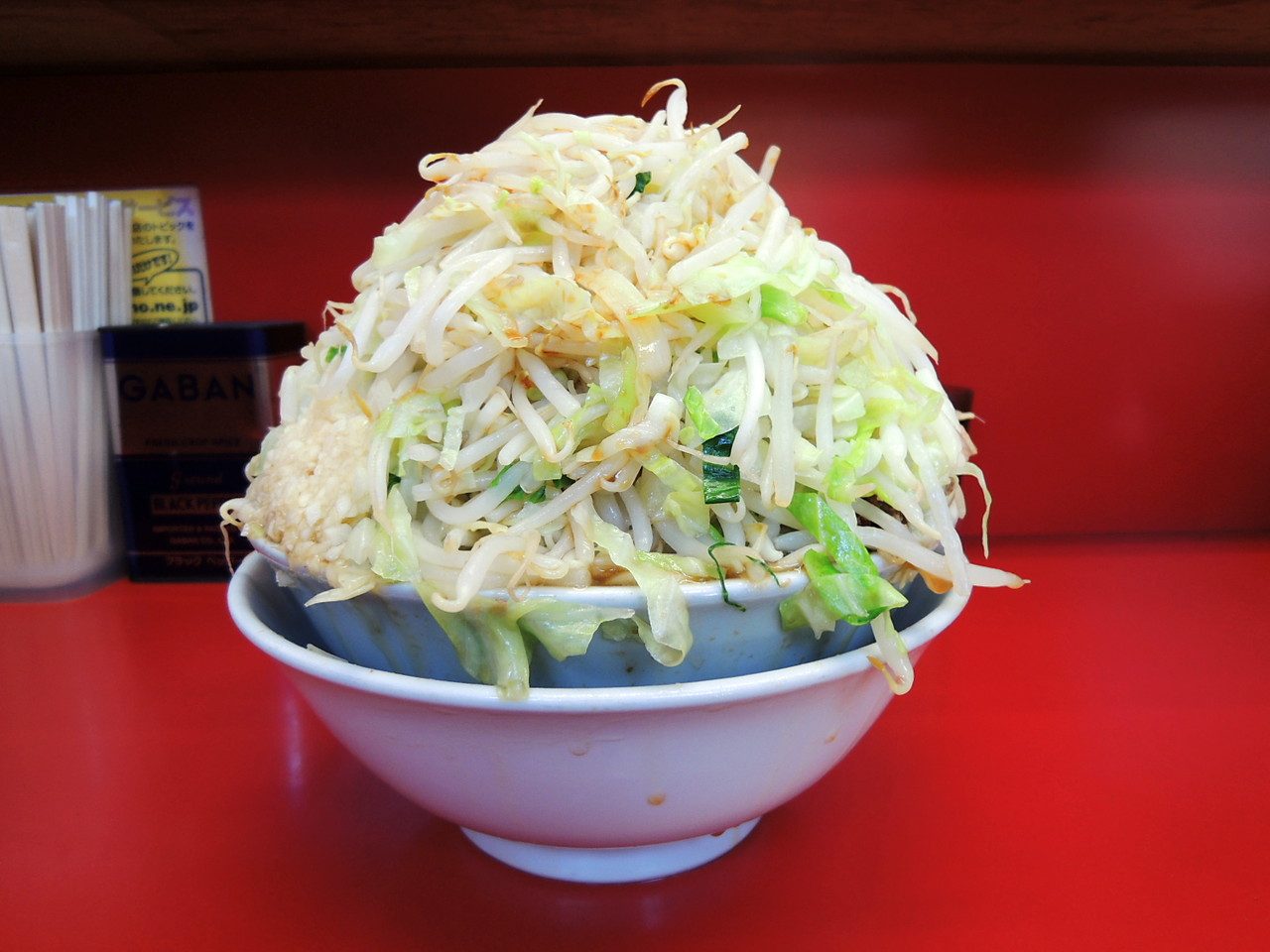
"Ramen Jiro," which opened around 1968 near Toritsu-Daigaku Station in Meguro Ward, Tokyo, moved in 1972 to Mita in Minato Ward, near Keio University, and became a shop beloved by students. Extra-thick noodles, a dense pork bone and soy sauce broth with back fat floating on it, a mountain of bean sprouts and cabbage, and thick slabs of "buta" (pork). The portions are in a different league from any other ramen.
At Jiro shops there is a unique ritual: after handing over your meal ticket, when staff ask, "Want garlic?", you answer with the toppings or flavors you want more of, such as "yasai" (vegetables), "ninniku" (garlic), "abura" (fat) or "karame" (stronger seasoning). Devoted fans are called "Jirorian." Beyond licensed Jiro branches, shops influenced by the style, known as "Jiro-kei" or "inspired" shops, have spread nationwide.
Soupless: Abura Soba and Mazesoba
There is also "shirunashi" (soupless) ramen, in which the noodles are tossed with the tare and oil in the bottom of the bowl, with no broth. According to the Shin-Yokohama Ramen Museum's timeline, abura soba is said to have been devised in 1958 at Chinchintei in Musashi-Sakai, Tokyo. It is typically eaten with vinegar and chili oil added to change the flavor as you go, and it spread mainly in Tokyo's Tama area, home to many universities.
From the late 2000s, "mazesoba," soupless noodles topped with ground meat, egg yolk, fish powder and the like and mixed before eating, also became popular. The best-known example is "Taiwan mazesoba." Despite "Taiwan" in its name, it is said to have been born around 2008 at Menya Hanabi, a shop in Nagoya.
Taiwan mazesoba takes its name from Nagoya's "Taiwan ramen." It is said to have begun in the late 1960s or early 1970s, when the Taiwanese owner (born in Japan) of Misen, a Chinese restaurant in Nagoya, created a ramen topped with spicy, chili-laced ground meat, based on tan-tsu-mien (danzai noodles) from Tainan, Taiwan. It is a "Taiwan" ramen born in Nagoya that does not exist in Taiwan.
Tantanmen, Hiyashi Chuka, and New Waves
Tantanmen is based on dandanmian, a soupless noodle dish from Sichuan, China. After the war, Chen Kenmin, the chef who popularized Sichuan cuisine in Japan, is said to have spread a tantanmen with a sesame-rich broth adapted to Japanese tastes. The "tantanmen with broth" commonly seen in Japan today is a form that grew up in Japan.
The summer staple hiyashi chuka (chilled ramen noodles) was also born in Japan. It is said to have started at Chinese restaurants in Sendai and Tokyo in the early Showa era, but there are several theories about which shop came first.
From Heisei into Reiwa, ramen branched out in even finer detail. According to the Shin-Yokohama Ramen Museum's timeline, there were booms in tori paitan (creamy chicken broth) around 2005, in rich seafood tsukemen around 2008, and around 2010 in "tanrei-kei," light and elegant ramen showcasing clear chicken or seafood broths. "Nibo-kei" ramen heavy on niboshi, ramen with shellfish stock, vegan ramen without meat or fish, Muslim-friendly ramen made without pork or alcohol so Muslims can eat it, and gluten-free noodles made without wheat have also appeared.
Back Fat, Kotteri, and Double Soup
In Tokyo in the late 1970s and 1980s, according to the Shin-Yokohama Ramen Museum's timeline, "seabura chatcha-kei" became popular from around 1975, a style traced to Hopeken in which pork back fat is strained through a mesh and sprinkled over the bowl. The back fat covers the surface of the broth, adding a rich sweetness and keeping it hot.
In the Heisei era, ramen flavors grew even more complex. In the early 2000s, "W soup" (double soup), in which an animal broth of pork bones or chicken and a seafood broth of katsuobushi or niboshi are made separately and combined in the bowl, became popular in the Tokyo area. This technique, balancing the richness of animal stock with the aroma of seafood, was later widely adopted in tsukemen and chuka soba.
When the Shop Owner Became the Star
From the late 1990s into the 2000s, the spotlight in the ramen world shifted from shop names to "shop owners." The Shin-Yokohama Ramen Museum characterizes the period around 2000 as an era when attention turned to the makers. TV programs and magazines featured owners with strong convictions, and ramen craftsmen came to be respected as chefs.
Around the same time, the internet spread, and the way ramen information traveled changed dramatically. Message boards and review sites sprang up where people posted impressions of the ramen they had tried, and sites such as "Ramen Database," gathering information and ratings on ramen shops nationwide, came to list an enormous number of shops and reviews. From the 2010s, video creators who stream themselves eating ramen gained large followings, and today shops with long lines are born not only from TV and magazines but from social media and videos as well.
Limited-Edition Bowls and the Speed of "Evolution"
At today's ramen shops, it is common to offer "gentei-men," limited-edition bowls served for a set period using seasonal ingredients and the like, alongside the regular menu. Bowls built around seasonal fish and shellfish, local vegetables or citrus are a chance for owners to try new flavors, and for customers a "only available now" treat. A flavor that wins acclaim as a limited bowl sometimes becomes a regular menu item.
A new style is born, becomes a boom, and either stays on as a standard or fades away. The speed of this "evolution" in the ramen world is rarely seen in other cuisines. This constant change may be one reason Japanese ramen attracts attention from around the world.
Kaedama and "Barikata": Hakata's Inventions
Hakata in Kyushu also gave birth to inventions in how ramen is eaten, notably "kaedama," ordering a refill of noodles alone.
LikelyKaedama is said to have originated at Ganso Nagahamaya, which started in 1952 as a stall in front of Hakata Station and moved to Nagahama along with the relocation of the fish market. To serve market workers quickly, the shop used ultra-thin noodles that cook in moments and kept portions small, and a system of adding just noodles for those who wanted more is said to have developed.
The custom of ordering noodle firmness as "yawa" (soft), "futsu" (regular), "kata" (firm), "barikata," "harigane" (wire) or "konaotoshi" (barely shaken in the water) also spread from Hakata ramen shops. "Bari" means "very" in the Hakata dialect. Today this way of ordering works at Hakata ramen shops anywhere in Japan, and overseas too.
What to Look For: Shop Names and Ticket Machines
A shop name ending in "-ya" (家) means iekei, "something Taishoken" points to the tsukemen lineage, a yellow sign means Jiro-kei. The names and signs of ramen shops hide hints about which lineage they belong to. The words on ticket-machine buttons, such as "firm noodles," "strong flavor" or "extra vegetables," also differ by lineage. Look at the sign and the ticket machine before you go in and you can guess what kind of bowl will come out.
Sources and notes for this chapter
Facts
- Tsukemen was devised in 1955 by Kazuo Yamagishi of Taishoken in Nakano, and Taishoken in Higashi-Ikebukuro opened in 1961 (Shin-Yokohama Ramen Museum timeline).
- Yoshimuraya opened in Shin-Sugita, Yokohama, in 1974 and is considered the source of iekei ramen.
- Ramen Jiro opened in 1968.
- Abura soba is said to have been devised in 1958 at Chinchintei in Musashi-Sakai (Shin-Yokohama Ramen Museum timeline).
Other Theories and Notes
- The origins of kaedama (Ganso Nagahamaya), Taiwan ramen (Misen) and Taiwan mazesoba (Menya Hanabi) are based on each shop's own accounts and news reports.
- There are several theories about where hiyashi chuka originated, including Sendai and Tokyo.
- The years of the booms are approximate, based on the Shin-Yokohama Ramen Museum's timeline, and timing varies by region.
Main References
- Shin-Yokohama Ramen Museum, "The History of Ramen in Japan"
- Official information from each shop; ramen magazines and news reports