
Peek into the kitchen of a ramen shop and you will see several huge stockpots on the fire. But what is in those pots alone does not make ramen. A bowl of ramen is assembled in the bowl itself from five broad components.
First "tare" (the seasoning base) goes into the bowl, then "aroma oil," and hot "broth" is poured over. Boiled "noodles" are set swimming in it, and "toppings" are placed on top. The ways these five are combined create the countless differences between ramen.
Broth: Chintan and Paitan
The foundation of the broth is what the stock is made from: "animal" ingredients such as chicken carcasses, pork bones and beef bones; "seafood" such as niboshi (dried sardines), katsuobushi (dried bonito), sababushi (dried mackerel) and kombu (kelp); and "vegetables" such as onions, long green onions and ginger. Each shop combines these to make its broth.
Broths fall into two broad groups by appearance and method. One is clear "chintan." The ingredients are simmered gently without boiling, and the scum is skimmed off. Most old-fashioned soy sauce and salt ramen use chintan.
The other is cloudy white "paitan." When bones are boiled hard on high heat for a long time, the gelatin, fat and marrow that dissolve out of them break into tiny particles that disperse through the water and emulsify. For the same reason milk looks white, the broth turns cloudy. Kyushu's tonkotsu broth and the tori paitan (chicken paitan) that became popular in the 2000s belong to this group (Chapter 4).
Tare: The "Core" of the Flavor
When ramen flavors are labeled "soy sauce," "salt" or "miso," the label refers not to the broth but to the tare (also called kaeshi or motodare) placed in the bottom of the bowl. The broth is, in effect, "stock"; only when it meets the tare does it become salty "ramen soup."
Soy sauce tare is made by adding mirin, sake, kombu, dried shiitake mushrooms, chashu braising liquid and the like to soy sauce. Salt tare combines salt with kombu, shellfish or seafood stock. Miso tare is made by blending several kinds of miso with garlic, ginger, sesame, spices and so on.
It is often said that "ramen's four great flavors are soy sauce, salt, miso and tonkotsu," but tonkotsu alone is a type of broth, not a tare. Hakata tonkotsu ramen is actually seasoned with soy sauce or salt tare. Because tonkotsu broth has such a strong character, it came to be treated as a separate category.
Umami Multiplied
What underpins ramen's deliciousness is "umami." In 1908, Kikunae Ikeda of Tokyo Imperial University discovered that the source of umami in kombu stock was glutamic acid, and named it "umami." Later, in 1913, Shintaro Kodama identified inosinic acid as the umami component of katsuobushi, and in 1957, Akira Kuninaka discovered the umami of guanylic acid. Guanylic acid was later found to be the umami component of dried shiitake mushrooms as well.
Combining glutamic acid with inosinic or guanylic acid is known to make umami taste many times stronger. This is called "umami synergy." Start with a broth of chicken carcasses or pork bones (meat and bones rich in inosinic acid), add kombu (glutamic acid), then add seafood such as katsuobushi or niboshi. The "double soup," combining animal and seafood stocks, used by many shops is designed to exploit this synergy.
Building on Ikeda's discovery, an umami seasoning whose main ingredient was monosodium glutamate went on sale in 1909. Umami seasonings were widely used in postwar ramen shops and underpinned the flavor of neighborhood chuka soba. In recent years, more shops advertise "mukacho," making stock from ingredients alone without umami seasonings. Neither is "right"; it is a difference in each shop's philosophy.
Noodles: Kansui and Hydration
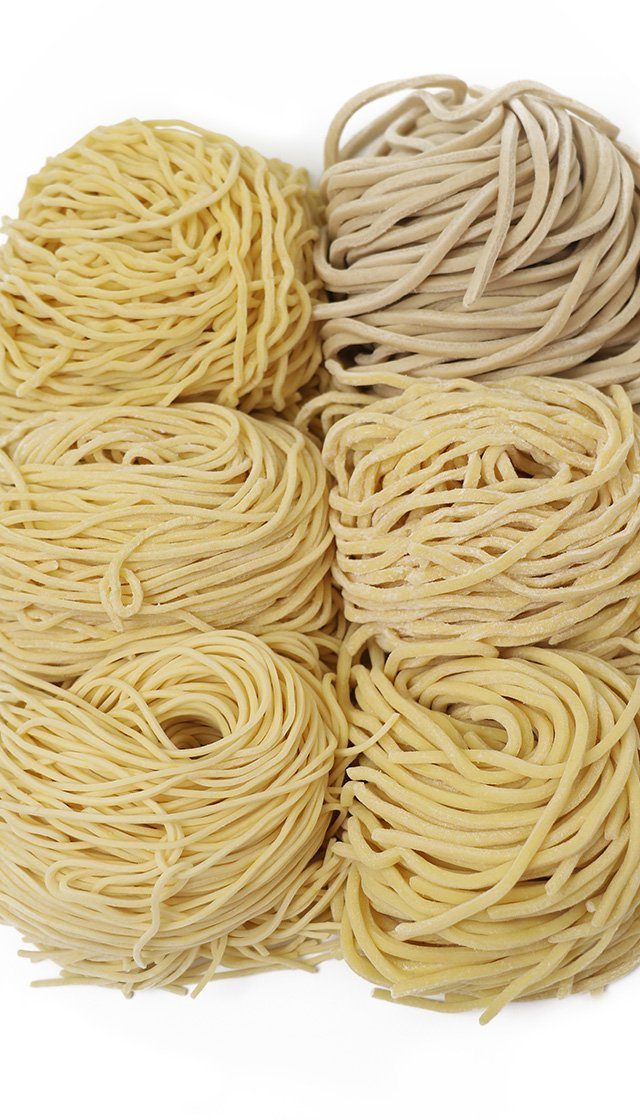
Chinese-style noodles are made by adding kansui to wheat flour (Chapter 1). The alkalinity of kansui gives the noodles their firm bite, springiness, distinctive aroma and yellow color.
A big factor in a noodle's character is its "hydration ratio": how much water (with kansui dissolved in it) is added relative to the weight of the flour. Low-hydration noodles snap cleanly when bitten and soak up broth well. Low-hydration noodles like Hakata's ultra-thin ones go soggy quickly, so they suit eating a smaller portion fast. High-hydration noodles, by contrast, are chewy with a slippery feel. Kitakata's flat noodles are a prime example.
Noodle thickness is set by the gauge number of the noodle machine's cutting blade. The number shows how many strands a 30-millimeter-wide sheet of dough is cut into; the higher the number, the thinner the noodle. On top of that, "wavy noodles," rippled by kneading by hand, hold the broth well, while "straight noodles" slide down smoothly when slurped.
Aroma Oil: The Top Layer
A layer of oil usually floats on the surface of ramen broth. This "aroma oil" keeps the broth from cooling, lifts the aroma and adds body to the flavor.
Lard, rendered pork fat; chiyu, made from chicken fat; seabura, finely chopped pork back fat; black mayu, made by blackening garlic; and negi oil, infused with the aroma of fried green onions. The lard film of Asahikawa ramen, the chiyu of iekei ramen, the back fat of Onomichi and Kyoto, the mayu of Kumamoto: many regional ramen styles express their character through aroma oil.
Stockpot Time
Making broth takes a long time. Clear chintan broth is made by simmering chicken carcasses and vegetables over low heat for several hours. For cloudy tonkotsu broth, it is not unusual for shops to crack the bones to release the marrow and keep them boiling on high heat for more than half a day. In Hakata and Kurume, some shops use a method called "yobimodoshi," keeping back a little of the previous day's broth and continuing to cook it while adding new bones and water.
Broth changes a little every day with the season, the weather and the condition of the bones bought in. Many shop owners taste the broth over and over during service and fine-tune the amount of tare. That is why so many say, "The hardest thing is keeping the flavor the same."
The Pattern on the Rim
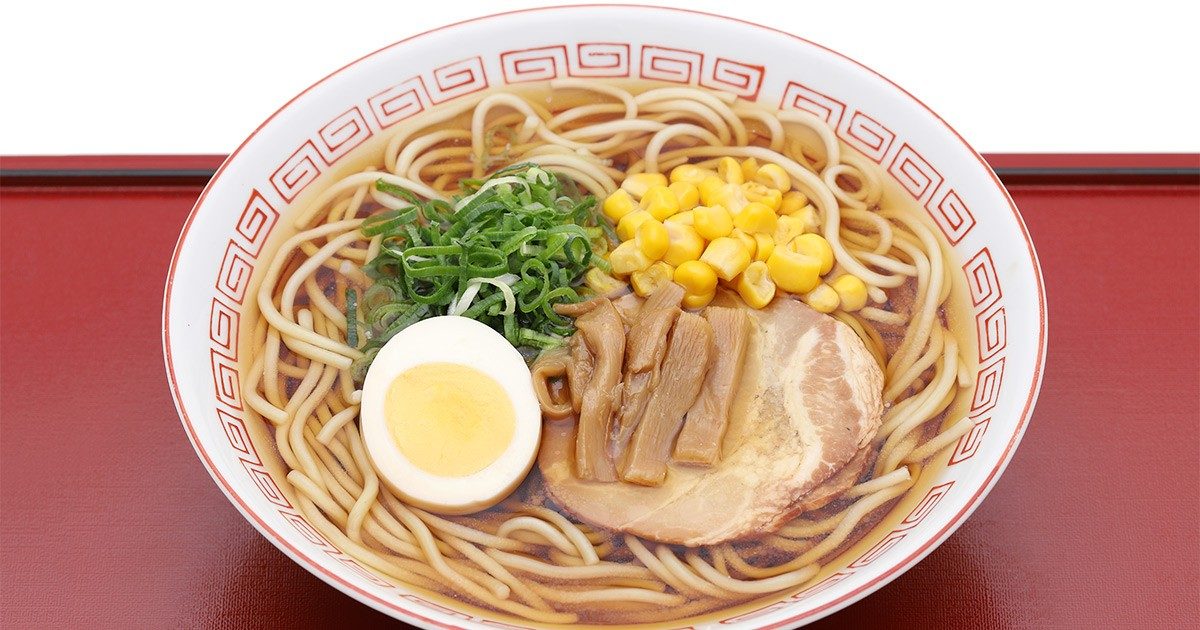
Look closely at the rim of a ramen bowl and you may see a row of square, spiral-like patterns. This is the "raimon" (thunder pattern), a motif also found on ancient Chinese bronzes. It is a stylized design of thunder and lightning and is said to ward off evil.
Dragons and phoenixes are sometimes painted inside the bowl too. The "double happiness" symbol (囍), two "joy" characters side by side, is an auspicious character originally used in China for weddings and other celebrations. The many Chinese-style patterns on ramen bowls are a legacy of ramen spreading in Japan as Chinese food. These days, more shops use plain white or black bowls, or bowls like Japanese tableware, and the pattern on a bowl, too, hints at the kind of ramen a shop is aiming for.
Noodle Makers and House-Made Noodles
Most ramen shops buy their noodles from seimenjo, noodle makers. Noodle makers vary the type of flour, the amount of kansui, the hydration ratio, the thickness and the degree of waviness for each shop, making noodles that suit that shop's broth. It is not uncommon for the owner of a popular shop and a noodle maker to go through trial after trial to perfect a single noodle.
At the same time, more shops are "jika-seimen," installing a noodle machine and making their own noodles in-house. Making your own noodles lets you fine-tune them to your broth and adjust the hydration to the day's temperature and humidity. Some shops have a noodle-making room visible through glass near the entrance.
Toppings: Small Histories on Top of the Bowl
Each ramen topping has its own origin.
Chashu was originally "char siu" from Guangdong in China, pork skewered and roasted. At Japanese ramen shops, though, chashu usually means "nibuta," pork simmered in a soy sauce tare rather than roasted, and the braising liquid also goes into the tare.
Menma is made from ma bamboo (machiku) shoots that are fermented and then dried. Before the war it was imported in large quantities from Taiwan and called "shinachiku." After the war, the name "menma" is said to have spread from the product name of a food company that used ma bamboo from Taiwan. Today much of what is on the market comes from China and elsewhere.
Naruto is a type of kamaboko made from fish paste, named because the spiral pattern on its cross-section resembles the whirlpools of Naruto. The Shin-Yokohama Ramen Museum notes that naruto was originally a topping for soba. Yaizu in Shizuoka Prefecture is known as a production center.
Then there are nori, green onions, bean sprouts, nitamago (ajitama, a soy-marinated soft-boiled egg), Sapporo's butter and corn, and Kyushu's red pickled ginger and kikurage (wood ear mushrooms). Lined up in miniature on top of the bowl is the history of the shop and of its town.
What to Look For: The "Layers" in the Bowl
When your ramen arrives, try a sip of the broth on its own first. The aroma of the oil on the surface should hit first, followed by the umami of the stock and the saltiness of the tare. Lifting the noodles to see how the broth clings to them is worth doing too. Wavy or straight? Thin or thick? Keep the five components in mind and you will see more in the very same bowl.
Sources and notes for this chapter
Facts
- Kikunae Ikeda discovered the umami of glutamic acid in 1908. Inosinic acid was identified by Shintaro Kodama in 1913, and guanylic acid by Akira Kuninaka in 1957.
- Combining glutamic acid with nucleotide umami components makes umami taste stronger (umami synergy).
- An umami seasoning whose main ingredient was monosodium glutamate went on sale in 1909.
- The gauge number of a cutting blade indicates how many strands a 30-millimeter-wide sheet of dough is cut into.
Other Theories and Notes
- The leading theory is that the name "menma" spread from a food company's product name.
- Standards for classifying noodle hydration and thickness vary between noodle makers and shops.
Main References
- Published materials from the Japan Umami Seasoning Association and the Umami Information Center
- Shin-Yokohama Ramen Museum, "Ramen Encyclopedia" and "Ramen Trivia"
- Published materials from noodle industry associations