
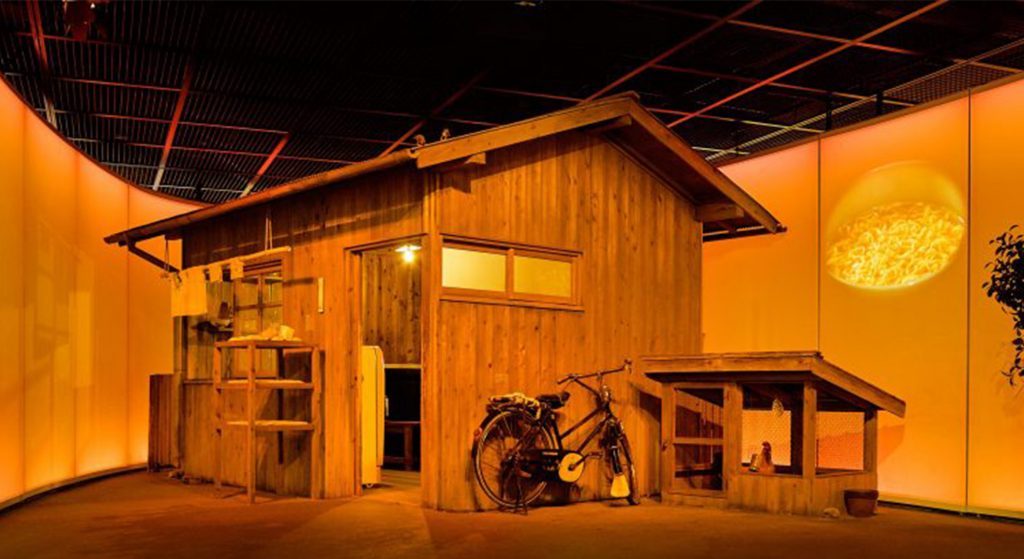
In 1957, a small shed went up in the backyard of a house in Ikeda, Osaka Prefecture. Inside were just a secondhand noodle-making machine and a large wok. In this shed, a 47-year-old man fried noodles all by himself, every day from early morning until late at night.
His name was Momofuku Ando. He would go on to found Nissin Foods and to create "instant ramen," a food eaten more than 100 billion times a year around the world.
An Inventor Born in Taiwan
Momofuku Ando was born in 1910 in Taiwan, then under Japanese rule. He lost his parents as a young child and was raised by his grandparents, who ran a textile wholesale business. While still young he started a knitwear company in Taipei, and later moved his base to Osaka and expanded his business.
After the war he worked on developing nutritional foods and served as chairman of a credit union, among other roles. But in 1957 the credit union he chaired went bankrupt, and he lost nearly everything he owned. All he had left was his house in Ikeda.
What Ando remembered was a scene he had witnessed at the black market in Umeda, Osaka, right after the war. Under a cold sky, people stood in a long line to eat a bowl of ramen. Would people really queue this long for one hot bowl? If only there were ramen you could eat at home right away, with nothing but hot water. That, Ando himself said, was where his research in the backyard shed began.
Inspiration from Tempura
Ando set out to make ramen that met five conditions: it had to be tasty, keep well, be easy to prepare, cheap, and safe. The hardest part was getting the noodles into a state that would keep for a long time while still softening quickly once hot water was poured on.
The hint, it is said, came from watching his wife, Masako, fry tempura in the kitchen. When the batter hits the oil, moisture bursts out of it, leaving countless tiny holes on the surface. If seasoned noodles were fried in oil, the water would be driven out and the noodles dried so they would keep. And hot water could then seep in through those tiny holes, softening them quickly.
This was the birth of the "instant hot-oil drying method" (flash frying). By seasoning the noodles with chicken broth before frying them, Ando completed a ramen you could put in a bowl, cover with hot water, put a lid on, and eat after two minutes.
The 35-Yen "Magic Ramen"
On August 25, 1958, "Chicken Ramen" went on sale. It cost 35 yen a packet. In an era when a portion of udon noodles could be bought for around 6 yen, that was by no means cheap. Wholesalers were unenthusiastic.
Once it hit the shelves, though, the convenience of "just add hot water" became a sensation. Chicken Ramen was dubbed "magic ramen" and became such a huge hit that, within a short time of its launch, other companies were rushing to join in. The Shin-Yokohama Ramen Museum credits the success of Chicken Ramen with spreading the name "ramen" nationwide.
Instant ramen turned ramen from "something you eat at a shop" into "something you eat at home." From the mid-1960s into the early 1970s, one company after another released packaged noodles, and they became a staple of Japanese home kitchens.
A Cup and a Fork
In 1966, Ando traveled to the United States to sell Chicken Ramen. There he watched supermarket buyers break Chicken Ramen into pieces, put them in paper cups, pour in hot water and eat them with forks. In America, there were no ramen bowls and no chopsticks. That difference in food culture became the hint for his next invention.
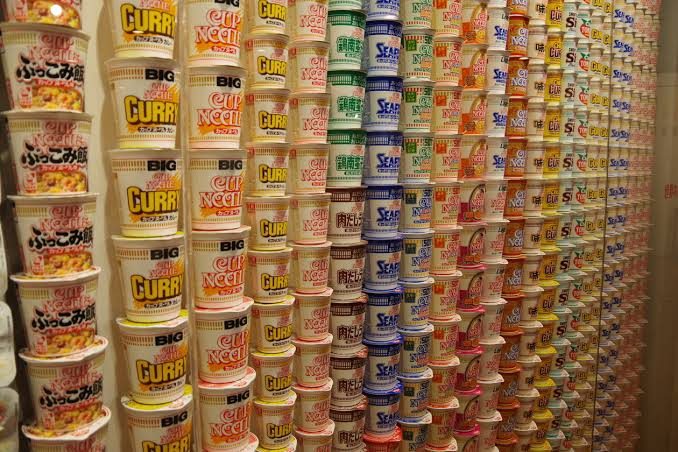
The result, launched on September 18, 1971, was "Cup Noodle." The noodles went into a polystyrene foam container that served as both the pot and the bowl. It was packed with innovations, such as the "middle suspension" that holds the block of noodles in place so it floats in the middle of the cup. The price was 100 yen, a luxury item at a time when a packet of instant noodles cost about 25 yen.
LikelyOne event often credited with making Cup Noodle known nationwide is the 1972 "Asama-Sanso incident." Live television coverage showed riot police, standing guard for hours in the snowy mountains, eating Cup Noodle, and many viewers reportedly began to wonder, "What is that?"
The Golden Age of Packaged Noodles
Seeing Chicken Ramen's success, food companies piled into the instant ramen business one after another. Following the Shin-Yokohama Ramen Museum's timeline, many classic products still sold today were born from the early to the mid-1960s.
Beyond pre-seasoned noodles like Chicken Ramen, packaged noodles with "separate soup" appeared, the powdered or liquid soup sealed in its own sachet, and flavors broadened to soy sauce, salt and miso, just like ramen at a shop. In 1966, Sanyo Foods launched "Sapporo Ichiban" and Myojo Foods launched "Charumera"; in 1968, Nissin Foods released "Demae Itcho" and Sanyo Foods released "Sapporo Ichiban Miso Ramen." Together with television commercials, packaged noodles spread to homes all over Japan.
In 1969, "non-fried noodles," dried with hot air instead of fried in oil, appeared, and a race began to achieve a texture closer to fresh noodles. In 1989, production of cup noodles overtook packaged noodles. "Rao," released by Nissin Foods in 1992, became a big hit with noodles whose texture was close to fresh, and started a trend of instant ramen getting closer to "shop flavor."
A "Factory Tour" of Instant Ramen
At an instant ramen factory, wheat flour is mixed with kansui and other ingredients into dough, which rollers press into thin sheets that are then cut into strands. The cut noodles are rippled to give them a wave, steamed, placed into molds one portion at a time, and then either fried in oil or dried with hot air.
The waves are not just for looks or for helping the soup cling. If straight noodles were set into a block as they are, they would stick together and hot water would struggle to get inside. Waves create gaps between the strands, letting hot water circulate evenly so the noodles loosen in a short time. The block of noodles in a cup is fixed toward the top of the container for the same reason: so hot water can flow in from below.
To Space, and to the World
In time, instant ramen crossed borders. Based on Japanese technology, instant noodles with local flavors began to be made across Asia: Taiwan, South Korea, Indonesia, Thailand, Vietnam... In each country, instant noodles took root in daily life as a convenient meal.
In 2005, astronaut Soichi Noguchi took "Space Ram," a space food ramen developed by Nissin Foods, aboard the Space Shuttle and ate ramen in space. To keep the soup from flying around in zero gravity, it was made with a thickened soup and bite-sized noodles.
According to an estimate by the World Instant Noodles Association (WINA), released in August 2026, total global demand for instant ramen in 2025 was 124.21 billion servings, a new record. By country and region, China and Hong Kong led with 43.27 billion servings, followed by Indonesia (14.54 billion), India (9.60 billion), Vietnam (8.23 billion) and Japan (5.95 billion). Taiwan, where Momofuku Ando was born, came in at 930 million servings in the 2024 estimate. That works out to every person on Earth eating about 15 servings of instant noodles a year on average.
Momofuku Ando died on January 5, 2007, at the age of 96. He is said to have kept eating Chicken Ramen for lunch until late in life.
"The Greatest Invention of the 20th Century"
In a survey carried out by a private research institute in 2000, instant ramen was voted No. 1 among "20th-century inventions born in Japan."
Instant ramen has also become essential as an emergency food. After the Great Hanshin-Awaji Earthquake of 1995, cup noodles were handed out in the disaster zone alongside hot-water supply trucks, sustaining many people with something warm to eat.
On the other hand, instant ramen has its problems: lots of salt and fat, and few vegetables (Chapter 9). Manufacturers are adding more health-conscious products, such as non-fried noodles, reduced-salt versions and noodles with added dietary fiber. Eaten thoughtfully, instant ramen remains the most familiar ramen of all: "just add hot water and wait two minutes."
What to Look For: The Two Museums
At the Cup Noodles Museum Osaka Ikeda (Momofuku Ando Instant Ramen Museum) in Ikeda, Osaka Prefecture, and the Cup Noodles Museum Yokohama in Minato Mirai, Yokohama, you can see a reproduction of the research shed where Momofuku Ando fried noodle after noodle, along with instant noodle packages from around the world. Hands-on activities, such as making Chicken Ramen from scratch or designing your own Cup Noodle, are popular too (some activities require reservations, so check the official website).
Sources and notes for this chapter
Facts
- Momofuku Ando (1910–2007) was born in Taiwan under Japanese rule and founded Nissin Foods.
- Chicken Ramen went on sale on August 25, 1958, at 35 yen a packet. Cup Noodle went on sale on September 18, 1971, at 100 yen.
- The instant hot-oil drying method dries seasoned noodles by frying them in oil.
- In 2005, Soichi Noguchi ate "Space Ram," a space food ramen, aboard the Space Shuttle.
- According to the World Instant Noodles Association's estimate (released August 2026), total global demand in 2025 was 124.21 billion servings (figures by country and region are from the same estimate; Taiwan's is from the 2024 estimate).
Other Theories and Notes
- The stories of the tempura inspiration and of seeing the black market line are based on accounts by Momofuku Ando himself and by Nissin Foods.
- The story that TV coverage of the Asama-Sanso incident raised Cup Noodle's profile is widely told, but no figures have been presented showing its effect on sales.
- The No. 1 ranking among "20th-century inventions born in Japan" comes from a survey carried out by a private research institute in 2000.
Main References
- Published materials from the Nissin Foods Group and the Momofuku Ando Instant Ramen Museum
- World Instant Noodles Association (WINA), "Global Demand for Instant Noodles" (released 2025 and 2026)