1866. When Kinsuke reached Choshu, his homeland was once again braced for war.
The shogunate was preparing to send troops against Choshu a second time. Great armies of the domains were pressing in from every border of Suo and Nagato.
But the Choshu that Kinsuke saw was utterly different from the Choshu that Shunsuke and Monta had come home to two years before.
The soldiers carried new rifles bought from abroad. Units raised from farmers and townsmen alike, without regard to rank, moved through Western drill.
Choshu had changed. From the day the four-power fleet defeated it, it had lowered the banner of "expel the barbarians" and turned its helm toward learning from the foreign powers.
That summer, when the war began, Choshu's soldiers drove back the great shogunate armies on every front.
"Kinsuke!"
A loud, familiar voice rang down a corridor of the domain government in Yamaguchi.
Kinsuke turned, and caught his breath.
It was Monta.
A thick scar ran from his cheek to his lip. When he smiled, the scar pulled and his face twisted a little. Even so, the way he laughed had not changed one bit from when he used to hold his sides laughing in the sitting room in London.
"Monta-san... your face."
"Ha. Quite the handsome fellow now, aren't I?"
Monta traced his cheek with a finger and laughed again.
"This face was sewn up with a tatami needle. It's not made like your ordinary face."
Kinsuke tried to laugh and could not quite manage it. His eyes stung.
From the far end of the corridor, Shunsuke came running.
"Kinsuke-san! Your health, are you better now?"
"...I managed to make it home, somehow."
The three stood in the middle of the corridor gripping one another's shoulders, and for a while none of them could say a thing.
At last Monta spoke.
"That makes three of us together. The other two will be home before long."
At the end of that year, a British squadron came to anchor off Mitajiri in Choshu.
It had not come to fight. Admiral King had come to meet the lord of the domain. Britain and Choshu, who had once exchanged cannon fire, were now trying to join hands.
Kinsuke, together with Monta, served as interpreter for the meeting.
He carried the British admiral's words to the lord. He carried the lord's words to the admiral. The words Mrs. Williamson had taught him were alive here too.
After the meeting was over, Monta slapped Kinsuke on the back.
"You weren't just the man who went over there to cough, were you?"
Kinsuke remembered those words for a long time afterward.
The times moved at a dizzying speed.
In 1866, Satsuma and Choshu joined hands. Less than a year had passed since that night in London when Yozo and the others had talked with the young men of Satsuma.
In 1867, the shogun returned the government to the Imperial Court.
In 1868, war broke out at Toba and Fushimi, and the shogunate fell. Edo changed its name to Tokyo, and the era was renamed Meiji.
In the 11th month of that year.
A ship came into the harbor at Yokohama.
Two men stepped off it. They wore Western clothes well, with hats on their heads and bags in their hands. Five years ago they had been the young men who, their topknots freshly cut, awkward in unfamiliar Western clothes, had clambered from a small boat in the dead of night up onto a foreign ship.
Yamao Yozo and Nomura Yakichi.
They stood on the pier and looked around them for a while.
It was the harbor they had slipped away from in the dark five years before. Back then, to be caught would have meant death. Now they stood in the same harbor with their heads held high. No one would charge them with the crime of leaving the country. Instead, a new country was waiting for them to come home.
"It's changed."
Yozo said it quietly.
"Maybe it's us that's changed."
Yakichi answered.
Out at sea, a whistle blew. It was the same sound as five years before.
Once home, Yakichi returned to the Inoue house he had been born into.
He gave back the name Nomura Yakichi and took the name Inoue Masaru.
Masaru looked for a while, with a strange feeling, at the letter of appointment written out in his new name. He had crossed the sea as Nomura Yakichi, and as Inoue Masaru he would work in this country.
Even when a name changes, some things do not.
The boy who had stood beside Risuke looking out to sea off Sagami was still inside him.
What awaited the two who had come home was a country with nothing.
The new government had no money. It had no factories. There was hardly anyone who could run a machine. All there was was a vast wilderness where the old order had collapsed, and mountains of work.
And the five scattered, each to his own wilderness.
Shunsuke, now Ito Hirobumi, rose swiftly to the heart of the new government. Monta, now Inoue Kaoru, took charge of the nation's purse.
Yozo threw himself into creating a new ministry to build up industry.
"Anybody can buy machines, as long as they have money."
Yozo said it at a meeting of officials.
"But machines break down someday. They get old. If every time we buy them from abroad and hire engineers from abroad, Japan will be at the foreigners' beck and call forever."
Yozo took that screw from inside his kimono and set it on the table.
A single screw he had carried home from Gotenyama, that had traveled with him all the way, through Shanghai, round the Cape of Good Hope, to London and to Glasgow.
"Japan can't even make this one screw yet. But if we raise people who can make it, those people will someday make Japan's industry. It's all right if we have no industry now. First, we make people."
The room fell utterly silent.
In 1870, the Ministry of Public Works, which would oversee industry, was born. The next year, 1871, it was decided to found the Kogakuryo, the school for training engineers that Yozo had argued for.
Kinsuke headed for Osaka.
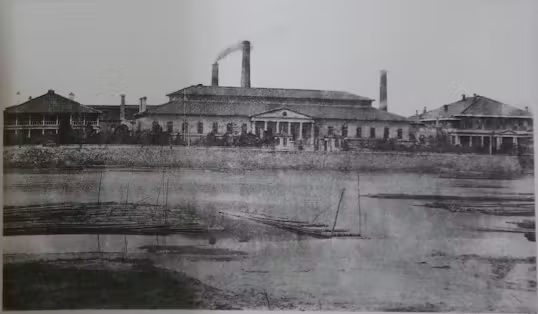
To unify the coinage of the whole country, the new government had built a mint in Osaka. It had bought the machinery of the Hong Kong mint outright. It had hired British engineers at high salaries.
At the top stood an Englishman named Kinder. A former soldier, he had headed the mint in Hong Kong.
Under him, Kinsuke became one of those in charge on the Japanese side.
In the spring of 1871, the mint began its work.
Kinsuke laid one of the first silver coins struck there on his palm.
It was heavy. The rim was neatly milled, and a dragon stood out in relief on its face.
He set it beside a Mexican silver dollar. In weight and in size, there was almost no difference.
Kinsuke flicked the new coin with his fingertip.
It rang clear.
Listening to that sound, Kinsuke closed his eyes. The money changer's counter in Yokohama. The balances in London. The machines at the Bank of England. The winter nights he had lain awake holding back his cough.
He had come this far.
But Kinsuke did not yet know that Kinder would be slow, very slow, to let Japanese stand at the machines that struck these coins.
In a room of a government office in Tokyo, Masaru sat across from Shunsuke for the first time in a long while.
No, not Shunsuke anymore. Ito Hirobumi, an official of the new government's finance ministry. With the collar of his Western suit neatly turned up and a mustache on his lip, he looked like a different person from the young man who had wasted away in the hold of the Pegasus.
But when he opened his mouth, he was the same as ever.
"Yakichi, we're going to run trains."
"Ito-san, I'm not Yakichi anymore. I'm Inoue Masaru."
"So you are. Monta's an Inoue, you're an Inoue. It's too confusing for words."
Ito laughed heartily. Then, all at once, his face turned serious.
"We're laying a railway. Tokyo to Yokohama. In time, on to Kyoto, Osaka, Kobe. There are heaps of people in the government against it. It's a waste of money, they say, do you mean to sell the country to the foreigners?"
"I'm sure."
"Okuma-san and I pushed it through, somehow. We'll borrow money from Britain too. But you're the one who'll lay it. You're the only one who's seen a real railway in Japan's place, who's learned real railways."
Masaru nodded without a word.
Ito turned his eyes to the window.
"Do you remember the sea off Sagami?"
"I've never forgotten it."
"I still haven't seen the answer to that question with my own eyes."
Ito turned toward Masaru.
"Show me. On Japanese soil."
Masaru was given charge of the railway.
From Shimbashi in Tokyo to Yokohama. About 29 kilometers. The work of laying Japan's first railway.
The engineer Morel was invited from Britain. At his side, Masaru decided the route of the line, one stretch at a time.
But the work stumbled before it even began.
"They say they won't hand over the land."
A subordinate came to report, his face pale.
Around Takanawa in Tokyo, the flat land along the Tokaido was lined with military grounds and the mansions of former daimyo. The military authorities asked how they could hand over land meant for the nation's defense to some railway nobody understood, and would not even let the surveyors through.
"If you've got money to waste on railways, buy warships."
There were those who said as much outright.
Masaru pored over the map for days.
If the land is out, then what?
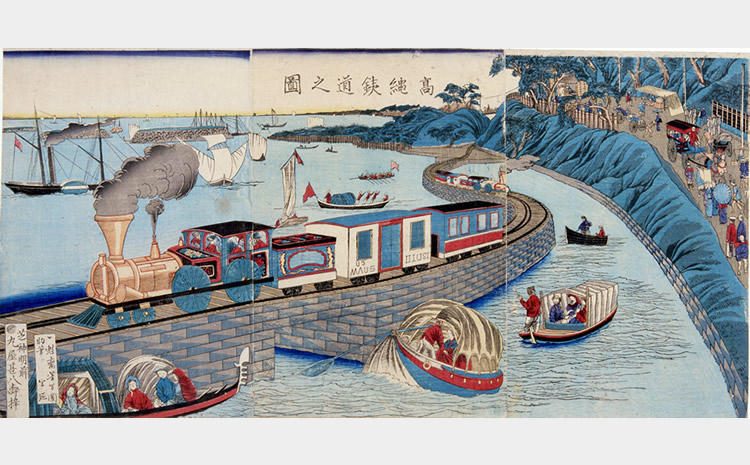
On the map, Masaru's finger traced the shoreline. Off Takanawa the sea was shallow far out.
"Then run it over the sea."
Someone came out with it. It was Okuma Shigenobu, who had been backing the railway within the government.
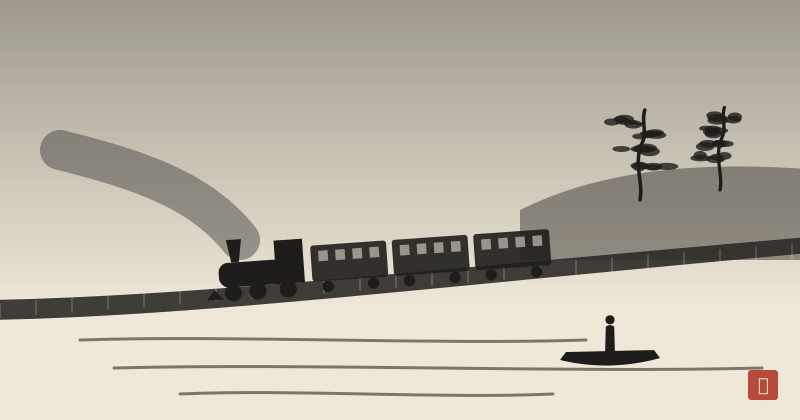
Pile stones in the sea and build an embankment. Lay the track on top of it. Without using a single tsubo of land, the train would run over the sea.
Those who heard it stared, wide-eyed.
But Masaru leapt at the idea. He had seen with his own eyes the railway that ran under the ground of London. If a train could run beneath the earth, it could run over the sea.
As for stacking stone walls, Japanese craftsmen had the skill of long generations of building castles. Put the English engineer's drawings together with the hands of Japanese stonemasons, and nothing was impossible.
Off Takanawa, a long, long stone embankment stretched out little by little.
In the midst of the work, Morel collapsed.
He was only 30. The English engineer died of illness without seeing Japan's railway completed.
Masaru stood before Morel's grave for a long time.
A man from a foreign land had worn away his life for this country, and now slept in its soil. What Professor Williamson, what Matheson, what the foreman in Glasgow had done for them, Morel had done for this country.
"I'll make it run. I promise."
Masaru said it softly to the grave.
The 9th month of the 5th year of Meiji (1872).
The front of Shimbashi station was a black mass of people.
Officials in their finery. Foreign ministers. Townsfolk from all over Tokyo who had flocked to see. And for this day, the Emperor himself had come to the station.
On the platform, a locomotive brought over from Britain waited, its black body gleaming.
Masaru stood at the end of the platform.
Not at the center of the grand ceremony. At the end of the platform, a little apart from the crowd. From there he gazed steadily at the locomotive and at the line stretching out beyond it.
Leaving Shimbashi, the line ran along the embankment over the sea toward Shinagawa. From there it passed the foot of Gotenyama and went on to Yokohama.
Gotenyama.
Right below that hill, where ten years before his comrades had set fire to a British house, Japan's first railway was today to open in all its glory.
The whistle blew.
High and long, toward the blue sky.
The driving wheels began slowly to turn.
A roar went up from the onlookers. Applause broke out, cheers rose, someone shouted, someone wept.
Masaru did not raise his voice.
He only stood without moving until the train had passed before his eyes, grown small, and vanished, leaving nothing but its smoke.
Ito was not there that day. As a member of a government mission, he was traveling far across the sea, from America on to Europe.
Risuke.
In his heart, Masaru called the name.
It's got no sails, so how does it move?
Can you see? This is the answer.
History and fiction in this chapter
Historical facts
- Endo returned home in 1866. In the war with the shogunate that summer (the Four Borders War), Choshu, equipped with Western rifles and militia units open to all classes, repelled the shogunate's forces.
- In 1866, the British Admiral King visited Choshu and met the lord of the domain; Endo served as interpreter together with Inoue Kaoru.
- The Satsuma-Choshu Alliance was formed in 1866, power was returned to the Court in 1867, and the Boshin War broke out in 1868; Edo was renamed Tokyo and the era was changed to Meiji.
- Yamao and Nomura returned home in the 11th month of 1868. Nomura went back to the Inoue family into which he had been born and took the name Inoue Masaru.
- Yamao expressed the idea that "even if there is no industry now, if you make people, those people will build industry" (according to a lecture paper published on J-STAGE). In the novel this is portrayed as a remark at a meeting.
- The Ministry of Public Works was established in 1870, and in 1871, at Yamao's urging, it was decided to found the Kogakuryo to train engineers.
- The Osaka Mint bought the machinery of the Hong Kong mint, took on the Englishman Kinder, formerly master of the Hong Kong mint, as its head, and began operations in 1871. Endo joined as a senior official on the Japanese side.
- The railway between Shimbashi and Yokohama (about 29 km) was built under the direction of the British engineer Morel. Because military land and the former Satsuma domain residence along the route could not be obtained, at the suggestion of Okuma Shigenobu an embankment about 2.7 km long was built in the sea at Takanawa between Shimbashi and Shinagawa, and the track was laid on top of it. Inoue Masaru directed construction as head of the Railway Bureau. The section between Shinagawa and Yokohama had opened provisionally in the 5th month of the 5th year of Meiji; the 9th month marked the formal opening, extended to Shimbashi.
- At the time the railway opened, Ito was traveling through America and Europe as a vice-envoy of the Iwakura Mission.
- Morel died of illness in 1871, aged 30, without seeing the opening.
- In the 9th month of the 5th year of Meiji (1872), the opening ceremony of the Shimbashi-Yokohama railway was held in the presence of the Emperor.
Fiction
- Kinsuke's reunion with Monta and Shunsuke, and conversations such as Monta's "Quite the handsome fellow now, aren't I?"
- The scene of Ito entrusting the railway to Masaru (that Ito and Okuma Shigenobu pushed railway construction forward within the government and obtained funds through a loan from Britain is historical fact).
- Yamao and Nomura's conversation in Yokohama, and the scene of Yamao setting the screw on the table at a meeting.
- The scene of Kinsuke flicking the first silver coin, the scene of Masaru speaking to Morel's grave, and Masaru's inner thoughts on the day of the opening.