The letter arrived long after the two had left London.
It was from Shunsuke. A letter from Japan took months to cross the sea to London, so everything written in it was something that had already happened long ago.
Yozo broke the seal, and Yakichi and Kinsuke peered in from either side.
The defeat at Kyoto. The death of Kusaka Genzui. The bombardment of Shimonoseki by the fleet of the four powers, and Choshu's crushing defeat.
And Monta, cut down on a road at night.
"Monta-san..."
Yakichi's voice shook.
Yozo read on in silence. The letter continued.
Monta is alive. A doctor named Tokoro sewed him up with a tatami needle, more than 50 stitches, and kept him in this world. He has a great scar on his face, but his mouth is livelier than ever.
Yakichi laughed in spite of himself, then wiped his eyes with his sleeve.
At the end of the letter it said:
We will manage things here somehow. You stay there as long as you can, even one more day, and bring back as much as you can, even one more thing. That is what Monta and I want.
Yozo folded the letter and put it away inside his kimono, together with the screw.
Life grew harder for the three day by day.
Of the money borrowed from the domain, only a worryingly small sum remained. They could not count on remittances from Japan, not now, with Choshu's hands full of war and internal strife.
The three cut back on food. They begrudged coal for the fire and read their books with their overcoats on. Even so, they never once missed a lecture.
Yakichi, above all, studied like a man possessed.
On top of his chemistry lectures, he began to learn how mines were dug and railways laid. With letters of introduction from his professors in hand, he went around the mines and railway works of England. He borrowed surveying instruments, followed the engineers about, and filled notebook after notebook with how bridges were built, how tunnels were bored, how the gradient of a line was set.
"Yakichi, get some sleep."
Yozo said it to him late one night, when Yakichi was still at his calculations under the gas lamp.
"I don't have time to sleep."
Yakichi did not even look up.
"Monta-san got cut to pieces and he's still alive. Shunsuke-san is risking his life to keep the country in one piece. If we've got nothing to bring back, I won't be able to look either of them in the face."
Early summer, 1865.
A new party of Japanese arrived in London.
Nineteen of them. Students and envoys sent by the Satsuma domain.
When they heard the news, the three looked at one another.
Satsuma was the enemy. The summer before, it had been the troops of Aizu, and of Satsuma, that routed Choshu's army in Kyoto. Kusaka Genzui had died in that battle.
"Are we meeting them?"
Kinsuke said it in a low voice.
"We can hardly not. We're in the same city."
Yakichi answered.
A few days later, at Matheson's house, the three were introduced to the young men of Satsuma.
The moment they entered the room, the air went taut. The Satsuma men knew these were Choshu men. No one would meet anyone's eye. Someone's hand unconsciously felt at his hip, though there was no sword there anymore.
It was Matheson who broke the long silence. With the air of a man who knew nothing at all, the English gentleman said pleasantly:
"You are all from the same country, so I'm sure you will get along famously."
Someone burst out laughing.
It was the youngest of the Satsuma men.
"From the same country, he says."
He could not keep the laughter in.
"And back home we're cutting each other down."
At that, the tension suddenly eased. Yozo gave a wry smile. Yakichi laughed too. Even Kinsuke's mouth softened.
It was true. To the people of this city there was no Satsuma and no Choshu. They were just young men from the same far-off island country in the East, all with the same faces.
That night the three and the Satsuma men talked until late. About the harbor at Shanghai. About their hardships aboard ship. About how bad the food in London was. And about the future of their country.
The more they talked, the clearer it became. Every Japanese who had come to this city, whatever his domain, had seen the same things and felt the same things.
This was no time to be fighting among themselves.
1866.
Kinsuke's cough could no longer be hidden.
The damp London air was eating away at his chest. The doctor said that if he stayed in this city, it would cost him his life.
Kinsuke refused to agree to the very end.
"I haven't got anything to take back yet."
He said it from his bed, in a hoarse voice.
"The machines at the Bank of England, the balances, I don't understand half of them. If I go back now, I'll be the man who spent the domain's money to come here and cough."
"Kinsuke-san."
Yozo knelt beside the bed.
"Monta-san said it, didn't he? The five of us are one."
Kinsuke looked at Yozo.
"What you've seen is in your head, Kinsuke-san, all of it. You don't have to understand everything. You can do the rest in Japan. What we bring back and what you bring back, put together, that's what makes it one."
Kinsuke stared at the ceiling for a long time.
Then he picked up the Mexican silver dollar that lay by his pillow.
"...When I get back, I want to make coins like this in Japan."
He flicked the coin with his fingertip. It rang with the same clear note it had made at the money changer's counter in Yokohama.
"Money no one doubts. Whoever holds it, wherever they take it."
1866. Endo Kinsuke, ill as he was, went home to Japan.
Now only two, Yozo and Yakichi each chose his own road.
Yakichi would stay in London and continue his studies of mining and railways.
Yozo said he would go north.
"I'm going to Glasgow."
In the Scottish port of Glasgow stood some of the finest shipyards in the world. Not to learn the theory of ships in a classroom, but to throw himself, body and all, into the place where ships were built. That was the road Yozo had chosen.
But he had no money to get to Glasgow.
When the young men of Satsuma learned of it, one day they silently held out a small bundle to him.
Inside were gold coins. 16 pounds.
"I can't take this."
Yozo shook his head.
"You're as hard up as we are."
"Please take it."
The Satsuma man said.
"If you learn shipbuilding and go home, it won't just be for Choshu. It'll be for Japan. For our part of the country too."
Yozo held the bundle tight and for a while could not raise his face.
Back home, they were men who cut each other down. And those same men had pooled what little money they had to send him on his way.
The sky over Glasgow was lower and heavier even than London's.
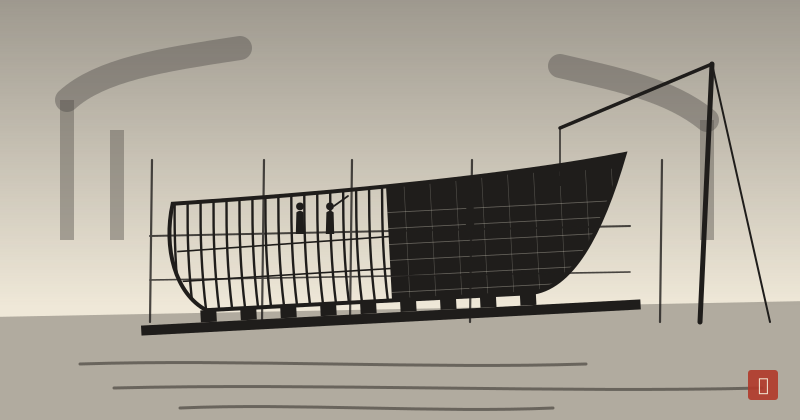
Along both banks of the River Clyde, shipyards stretched on without end. Iron frames rose toward the sky like the bones of enormous whales.
Yozo went to work at Napier's shipyard as an apprentice hand.
At six in the morning he passed through the yard gates. He hauled iron, drove rivets, tended the fire in the furnace. By day he worked as a laborer, and by night he went to evening classes at the Andersonian College in town, studying mathematics and mechanics.
At first the workmen kept their distance and watched this young man from the East. But Yozo came earlier than anyone and stayed later than anyone. Even if words did not get through, hands did not lie. Within half a year, the foreman would watch the rivets Yozo drove and give a silent nod.
The evening classroom was full of workmen done with their day's labor and young apprentices. All of them smelled of oil and soot. Under the lamps the lecturer drew diagrams of machines on the blackboard and wrote out equations of force.
In the seat next to Yozo there usually sat a young Scot. An apprentice more than ten years younger than Yozo, with something of the boy still about him.
The young man seemed unable to stop wondering about this silent man from the East. He would lean over curiously to watch Yozo write in his notebook in Chinese characters.
One evening, the young man worked up his nerve and spoke to him.
"Where are you from?"
"Japan."
Yozo answered.
"Japan..."
The young man repeated the name, as if rolling it around in his mouth.
"Are there schools like this there? Schools that teach machines, and how to build ships?"
Yozo thought for a moment, then shook his head.
"No. Not yet."
Then he added, slowly:
"Someday, I will build one."
The young man looked at Yozo with wide eyes. Then he grinned, as though he had found something interesting.
The young man's name was Henry Dyer. Many years later he would cross the sea and teach engineering to the young men of Japan at the school Yozo built, but at that moment neither of them knew it yet.
Clang, clang, clang.
The sound of hammers rang through the whole shipyard. Hundreds of hammers that seemed to strike at random, and yet somewhere they became one great swell. Yozo loved working inside that sound.
One day, Yozo's eye fell on one of the workmen.
The man did not talk with the others. Instead, he moved his fingers and palms quickly, conveying something. His mates answered by moving their hands the same way. The man could not hear.
Even so, his work was surer than anyone's. The angle at which he drove a rivet, the way he fitted the seams of the iron plates. Again and again Yozo saw the foreman give the hardest jobs to that man first.
He cannot hear, and still he can do work like this.
In Japan, those who could not hear and those who could not see were given almost no place to learn and no place to work. If only Japan, too, had somewhere such people could learn.
Yozo watched the movements of the man's hands for a long, long time.
Yakichi, left behind in London, was alone.
The Williamsons' sitting room suddenly felt much larger. The nights when the five of them had rolled about laughing seemed long ago.
As if to drive away the loneliness, Yakichi threw himself into his studies. He attended lectures, sat examinations, and built up his learning in mining and railways. In time, he would hold the certificate that marked its completion.
On his days off, he visited the works where locomotives were built.
Huge driving wheels were turned out one at a time on the lathes. The iron plates of boilers were joined with red-hot rivets. At the back of the works, a newly assembled locomotive was blowing off steam for its trial run.
The whistle blew.
At the sound, Yakichi closed his eyes without meaning to.
More than ten years had passed since the day on the sea off Sagami when Risuke had asked, "It's got no sails, so how does it move?" Now Yakichi could give the whole answer, from the thickness of the boiler plates to the diameter of the driving wheels.
But knowing the answer was not yet enough.
Japan was a country of mountains. Its rivers were steep, its plains narrow. How were you to lay track in a country like that? Bore the tunnels, build the bridges, level the gradients. And it had to be done by Japanese hands.
On his way back from the works, Yakichi stopped on the bank of the Thames in the evening light.
Across the river a train ran trailing smoke. Yakichi pictured the day that smoke would drift among the mountains of Japan.
The end of 1867.
A letter from Yakichi in London reached Yozo's lodgings in Glasgow.
Something big seems to have happened in Japan. They say the shogun has returned the government to the Imperial Court. It was in the newspaper, a small item. I don't know any details yet.
Yozo clutched the letter and looked out the window.
A leaden sky hung low over the Clyde. The hammers of the shipyards were ringing again today, far and near.
All at once, the sound seemed to be calling him.
The time had come to go home.
History and fiction in this chapter
Historical facts
- After Ito and Inoue returned home, Yamao, Nomura and Endo stayed on in London and continued their studies. Nomura studied mining and railway engineering at UCL and visited mines and railways around the country.
- In 1865, a party of 19 students and envoys from the Satsuma domain arrived in London and, like the Choshu students, studied under Professor Williamson. In the Kinmon Incident the year before, Satsuma had fought against Choshu.
- Endo returned home in 1866 (said to be in the latter half of the year) because of illness. In Britain he had observed banknote printing at the Bank of England, and he later established coinmaking by Japanese at the Mint.
- Yamao moved to Glasgow (some accounts say 1865, others 1866), where he worked as an apprentice at Napier's shipyard while studying at evening classes at the Andersonian College. Henry Dyer, later principal of the Imperial College of Engineering (then an apprentice at a different works), attended the same evening classes, but there is no record that the two spoke closely at the time.
- In his 1871 proposal for establishing a school for the blind and deaf, Yamao wrote that at the Glasgow shipyard there were men who, though deaf, worked with full skill.
- In the 10th month of 1867 (the 3rd year of Keio), the shogun Tokugawa Yoshinobu returned political power to the Imperial Court (the Restoration of Imperial Rule).
Probable
- It is said that when Yamao lacked the money to go to Glasgow, the Satsuma students raised 16 pounds and gave it to him.
Fiction
- The text of Shunsuke's letter, the details of the three's daily life, and the conversations between Yakichi and Yozo.
- The meeting and conversation with the young Satsuma men at Matheson's house. The details of how the two domains' students actually came to know each other are fictional.
- The conversation with Dyer in the next seat at evening classes (fiction based on the fact that the two attended the same evening classes), and the scene of Yakichi visiting a locomotive works.
- The scene of Kinsuke deciding to return home, the exchange when the 16 pounds are handed over, and the details of the scene of Yozo watching the deaf workman.