Butterfly effectKyoto was the first-choice atomic target
In May 1945 an American committee met to choose targets for the atomic bomb. Kyoto topped the list. Fact It was large, sat in a basin ringed by mountains where the blast effect could be measured, and had not yet suffered heavy air raids.
Fiercely opposed was Secretary of War Henry Stimson. Destroying Japan's cultural heart, he argued, would leave lasting bitterness and push postwar Japan toward America's rivals. Fact He insisted repeatedly that Kyoto be removed, and President Truman agreed. Nagasaki was added to the list in its place. Fact
- 1926 & 1929Stimson visits Kyoto. Fact
- May 1945Kyoto becomes a leading atomic target.
- July 1945Stimson's objections take Kyoto off the list.
- August 1945Atomic bombs fall on Hiroshima and Nagasaki.
Did Stimson honeymoon in Kyoto?
The story has a famous embellishment: that Stimson spent his honeymoon in Kyoto and couldn't bear to destroy it. A recent Hollywood film made the line widely known. Urban legend
According to nuclear historian Alex Wellerstein, however, Stimson married in 1893 and there's no record of a honeymoon in Japan. His visits to Kyoto came in 1926 and 1929, around the time he served as Governor-General of the Philippines. Fact The honeymoon story appears to be a fairly recent myth that spread from the 2000s. Likely
Kyoto & the worldParis and Kyoto — a unique "friendship pact"
Kyoto has sister-city ties with many cities, but one is special: Paris. Since Paris in principle doesn't have sister cities, the two signed a special "friendship pact" (pacte d'amitié) in 1958. Fact
Both are old capitals on rivers, and both strictly limit building heights to protect their skylines. The Seine and the Kamo, Notre-Dame and Tō-ji: two ancient capitals sharing similar worries and similar pride.
Kyoto & the worldA Ming-dynasty temple in Uji — Manpuku-ji and the "Mincho" typeface
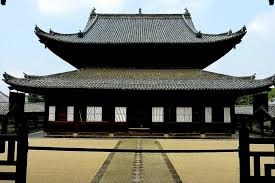
Step into Manpuku-ji in Uji and you'd think you were in China. It was founded in 1661 by the Chinese monk Yinyuan Longqi (Ingen Ryūki) from Mount Huangbo in Fujian, and is head temple of the Ōbaku school of Zen. Fact Its halls follow Ming-dynasty style, and sutras are still chanted in a Chinese manner.
Ingen is credited with bringing many things to Japan: green beans (still called ingen-mame), fucha ryōri (Chinese-style vegetarian cuisine) and the culture of steeped sencha tea. Likely
His disciple Tetsugen Dōkō carved woodblocks for the complete Buddhist canon, and those blocks are still preserved at Hōzō-in, a sub-temple of Manpuku-ji. Fact The characters carved on them are considered one of the roots of the Mincho typeface ("Ming style") used in Japanese printing today. Likely Their layout of 20 characters × 20 lines is also said to be the origin of the standard 400-character Japanese manuscript paper. Likely
Up closeWhere a president of Taiwan studied
Lee Teng-hui, the president who led Taiwan's democratisation, spent his youth in Kyoto. In 1943 he entered Kyoto Imperial University (now Kyoto University) to study agricultural economics. Fact Drafted into the army during his studies, he returned to Taiwan after the war and continued at National Taiwan University. Fact
In later years he often spoke fondly of his Kyoto student days, the books he read and the teachers he met. Likely After leaving office he visited Japan in 2004, including Kyoto. Fact
Kyoto & the worldKyoto and the world's creators
Steve Jobs, deeply drawn to Zen, visited Kyoto repeatedly; his biography recounts trips there with his children. Likely Kyoto's temple gardens — especially the dry rock gardens (karesansui) — have influenced designers and architects around the world who love minimalism.