Reading the landThe gateway to the underworld is in a residential street
Matsubara-dōri in Higashiyama is thronged with tourists heading to Kiyomizu-dera. Halfway along stands a stone engraved Rokudō-no-tsuji, "Crossroads of the Six Realms". In the Heian period this was the entrance to Toribeno, the city's eastern burial ground. Mourners said their final farewells here, and it came to be called the border between this world and the next. Fact
At the crossroads stands Rokudō Chinnō-ji, with a strange legend. Ono no Takamura, a Heian official and poet, served at court by day — and by night climbed down the temple well to the underworld to assist Enma, the King of Hell, in judging the dead. Legend The "well for commuting to the underworld" is still in the temple grounds.
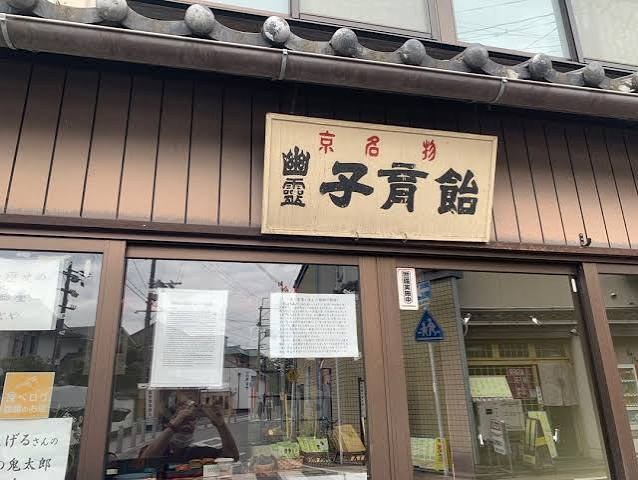
Up closeThe candy a ghost came to buy
Right by the crossroads is a small shop with the sign "Yūrei Kosodate Ame" — "Ghost's Child-Rearing Candy". Fact The story goes like this.
Long ago, a pale woman came late every night to buy a single piece of candy. Suspicious, the shopkeeper followed her — and she vanished into a graveyard. When the grave was opened, beside the body of a woman who had died pregnant, a newborn baby was sucking on a candy. Legend The mother had become a ghost to feed the child born in her grave.
The shop is still open, selling simple malt-sugar candies. Fact A gentle sweetness from a ghost-story shop: in Kyoto, the uncanny sits right next door to daily life.
Solving the mysteryPeople really did jump off the Kiyomizu stage
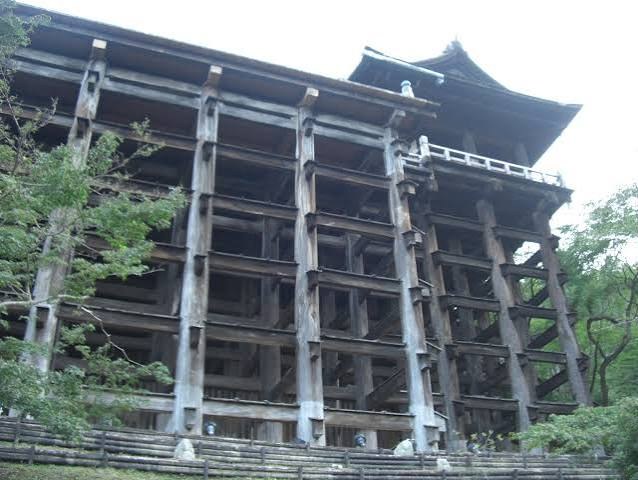
In Japanese, "to jump off the stage of Kiyomizu" means to take the plunge on a big decision. It isn't just a figure of speech. In the Edo period, many people actually jumped. Fact
Records kept at Jōju-in, a sub-temple of Kiyomizu-dera, document over 230 jumps (including attempts) between 1694 and 1864 — and a survival rate of about 85 percent. Fact
People are thought to have jumped believing that if they entrusted their lives to Kannon, the bodhisattva of mercy, their wish would come true — and surviving proved it. Likely Trees grew thickly below and the ground was softer then, which may explain the survival rate. Likely In the Meiji era, Kyoto Prefecture banned the practice. Fact
Solving the mysteryThe mound that rumbles before a national crisis
Near the top of the Higashiyama hills lies Shōgunzuka, "the General's Mound". Legend says Emperor Kanmu, founder of Heian-kyō, buried a clay general about 2.4 m tall, in armour with bow and arrows, facing the capital to protect it. Legend
The mound is said to rumble before disaster strikes the nation, and classics such as The Tale of the Heike record it doing so. Legend Next to it, Shōgunzuka Seiryūden (part of Shōren-in temple) has a large wooden stage — higher than Kiyomizu's — with a panoramic view over the city.
Butterfly effectThe man who rescued Murasaki Shikibu from hell
Near Horikawa-Kitaōji in northern Kyoto is a mound said to be the grave of Murasaki Shikibu, author of The Tale of Genji. Fact Oddly, right beside it stands a mound said to be the grave of Ono no Takamura — the man who commuted to hell. Fact They lived more than a century apart.
Why together? One legend says Murasaki was sent to hell for misleading people with fiction — and Takamura, on good terms with King Enma, talked her out. Legend In medieval Buddhism, writing made-up stories was considered a sin. The author of the world's "first novel" may have had a hard time in the afterlife.
Solving the mysteryA stone for cutting ties, a well for curses
Yasui Konpira-gū near Gion is famous as a shrine for cutting ties — with bad relationships, bad habits, illness. In the grounds is a large stone with a hole through it. Crawl through front to back holding a paper talisman with your wish, and bad ties are cut; crawl back to front, and good ties are made. Fact The stone is plastered white with thousands of talismans, and the raw honesty of the wishes written on them is overwhelming.
At the end of a narrow alley off Sakaimachi-dōri lies the Kanawa Well. A woman abandoned by her husband wore an iron trivet on her head, visited Kibune Shrine at the hour of the ox (around 2 a.m.) and became a demon to take revenge — the story of the Noh play Kanawa. Legend Some even say that making someone drink this well's water will end your relationship with them. Urban legend
Solving the mysteryMidorogaike — ghost story and natural monument
Midorogaike pond in northern Kyoto is the city's best-known "haunted spot". A taxi driver picks up a woman near the pond; when he looks back, she's gone, leaving a soaking wet seat — Kyoto's version of a ghost story told all over Japan. Urban legend
But the pond has another identity. It shelters plants thought to be relics of the Ice Age and a floating mat of sphagnum moss, and its ecosystem is a designated National Natural Monument. Fact The pond in the ghost stories is in fact a scientifically priceless window onto nature tens of thousands of years old. Behind the scary story lies a genuine wonder.