Home / Food
06 — Food
Winter thunder
means yellowtail.
In November, when thunder rolls over Kanazawa, locals murmur, “Buri-okoshi, then.” Winter bounty from the Sea of Japan, dishes whose shape was set by samurai etiquette, and a sweet tooth nurtured by the tea ceremony. Not a list of famous restaurants, but the reasons behind what Kanazawa people consider normal food.
The winter sea
“Buri-okoshi” and kanimen
Winter thunder in Hokuriku, unlike summer thunder, occurs when cold air crosses the Sea of Japan. This is exactly when fatty winter yellowtail (buri) arrive along the coast, so the first thunder of winter has long been called “buri-okoshi” — “the yellowtail waker”. Thunder signals the start of the season.
That yellowtail goes into a New Year delicacy, kabura-zushi: slices of winter yellowtail sandwiched in salted turnip and fermented with rice koji. No vinegared rice is used; it belongs to the lineage of narezushi, the oldest form of sushi.
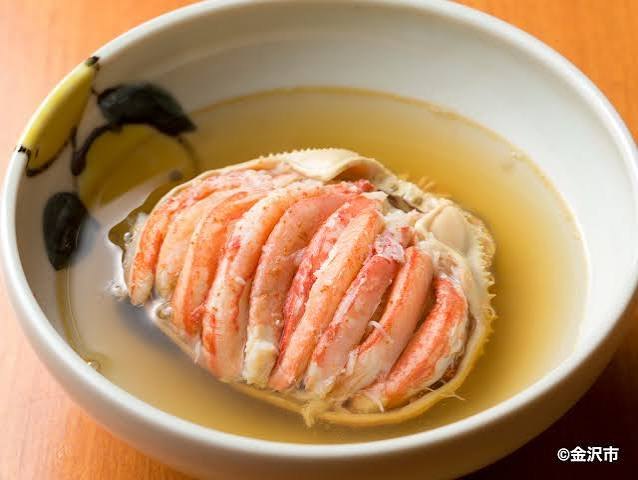
Another winter essential is kobako-gani, the female snow crab. To protect stocks, the season is short — from early November to around the end of the year. The meat and roe are picked out and packed back into the shell, then warmed in the oden pot; this is “kanimen”.
Kanazawa oden is eaten all year, not only in winter, with distinctive ingredients such as kurumafu wheat-gluten rings, bai whelks, akamaki swirled fishcake and fukashi steamed fish paste. Kanazawa is sometimes said to have an unusually large number of oden restaurants for its population.
Samurai etiquette
A mysterious name, and sea bream split from the back
Jibuni — a dish with three name origins
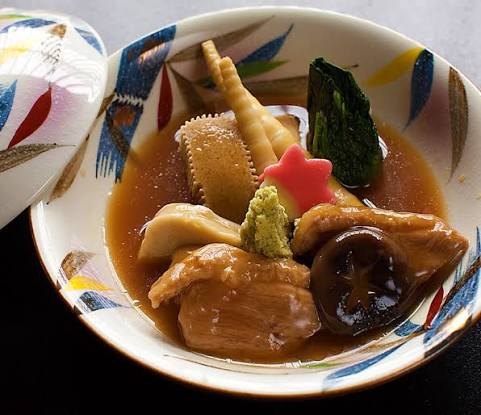
Duck (or chicken) dusted in flour is simmered so the broth thickens, then served with Kanazawa's own sudare-fu gluten and greens, topped with wasabi. There are three theories for the name of this signature Kaga dish:
- the “jibu-jibu” sound of it simmering
- Okabe Jibuemon, Hideyoshi's supply officer
- an old word meaning “stewed duck”
None is conclusive; it has even been pointed out that the old cookbook cited for the “jibu-jibu” theory actually reads “shifu-shifu”. Tradition Nobody knows where the name came from, yet the dish has been loved for nearly 400 years.
Tai no karamushi — why the belly is never cut
Tai no karamushi, served at celebrations, is a whole sea bream stuffed with seasoned okara (soy pulp) and steamed. The fish is traditionally opened from the back, not the belly — in a samurai town, cutting the belly evoked ritual suicide, or so it is explained. Tradition At weddings two fish were sometimes arranged belly to belly.
A city of wagashi
Why do Kanazawa people eat so many Japanese sweets?
In the government's Family Income and Expenditure Survey, Kanazawa has repeatedly ranked first in spending on fresh Japanese sweets among prefectural capitals and major cities, and regularly ranks high for yokan and manju too. It is one of Japan's great wagashi cities.
One reason is the tea ceremony, mentioned on the crafts page. Since the lords invited an Urasenke tea master, matcha drinking spread from samurai to townspeople, and sweets to accompany it flourished. Another is that there are occasions for sweets all year round.
Fukuume and Tsujiura
Fukuume are red and white wafer sweets shaped like the Maeda plum-blossom crest. Tsujiura contain small paper fortunes that families draw to divine the year ahead.
Himuro manju
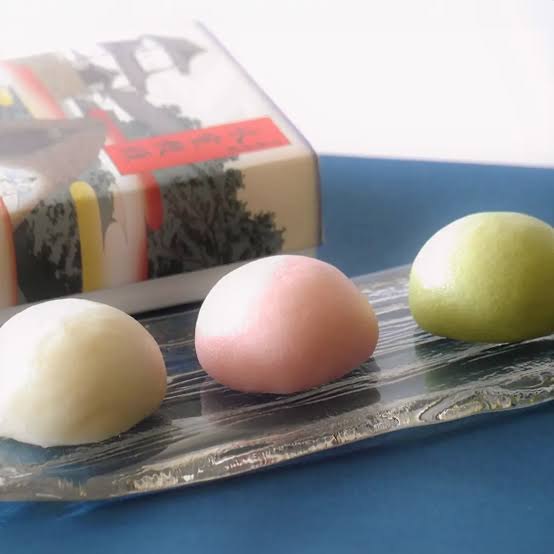
Red, white and green buns recalling how the domain presented ice from snow pits to the shogun on the first day of the sixth lunar month. Eaten for good health through summer.
Goshiki namagashi
Five sweets representing the sun, moon, mountains, sea and village, said to derive from Maeda weddings and still handed out at celebrations.
Choseiden
A pressed sugar confection attributed to the third lord Toshitsune, counted among Japan's “three great confections” (with Koshino-yuki of Nagaoka and Yamakawa of Matsue).
Kaga vegetables
A leaf that is green on top and purple underneath
Kanazawa certifies as “Kaga vegetables” those grown since before 1945 and still mainly grown in Kanazawa — fifteen in total.
- Gensuke daikon
- Kaga lotus root
- Gorojima sweet potato
- Kinjiso
- Uchiki red kuri squash
- Kaga thick cucumber
- Purple-calyx aubergine
- Kanazawa thick leek
- Futatsuka mustard greens
- Red taro stems
- Arrowhead
- Kaga hyacinth bean
- Kanazawa garland chrysanthemum
- Water dropwort
- Bamboo shoots
The most local of all is kinjiso. Its leaves are green on top and vivid purple beneath, and turn pleasantly slippery when boiled; dressed with vinegar, even the cooking water turns reddish purple. Kaga lotus root is grated and steamed into hasu-mushi — the Kanazawa way.
Yoshoku and local favourites
A “Hungarian” dish that doesn't exist in Hungary
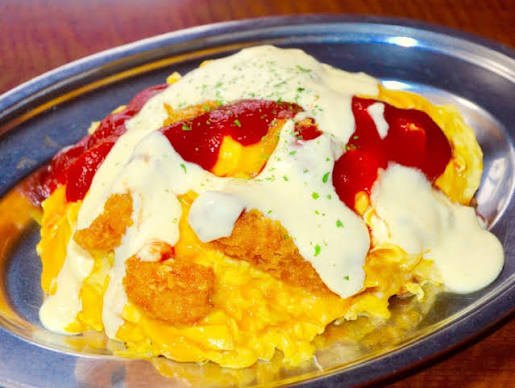
A staple of Kanazawa's Western-style diners, Hanton rice is ketchup rice wrapped in a thin omelette, topped with fried white fish, ketchup and tartar sauce. The name is said to combine “Han” from Hungary and “thon”, French for tuna. Yet no such dish exists in Hungary. Likely Even the restaurant where it began is disputed.
Then there is Kanazawa curry: thick, rich roux served on a stainless-steel plate, topped with a cutlet and sauce, with shredded cabbage on the side — eaten with a fork or a split-tip spoon rather than a regular spoon.
And the soul food of Ishikawa, Hachiban Ramen, named after its first shop on National Route 8. Its vegetable-packed ramen now has many branches abroad, especially in Thailand. From a Hokuriku highway to South-East Asia — food has its butterfly effects too.
In Ishikawa, “tea” often means Kaga bocha, roasted tea made from the stems. Fragrant and low in bitterness, it goes with meals and sweets alike. Known for having been presented to Emperor Showa, it is what locals casually serve to guests.
Next
Two rivers, three great writers
Kyoka and Shusei of the Asano River, Saisei of the Sai River — and the “three Taros” of the Fourth Higher School. Kanazawa is also a city of words.