Home / Crafts
05 — Crafts
Banned,
they kept on beating gold.
Almost all of Japan's gold leaf is made in Kanazawa. Its history was anything but smooth: in the Edo period the shogunate tightly controlled leaf production. Born in the domain's workshops and outliving the domain itself, these skills — gold leaf, Yuzen dyeing, ceramics, and even the Noh chants craftsmen sang on rooftops — show the depth of Kanazawa's craft tradition.
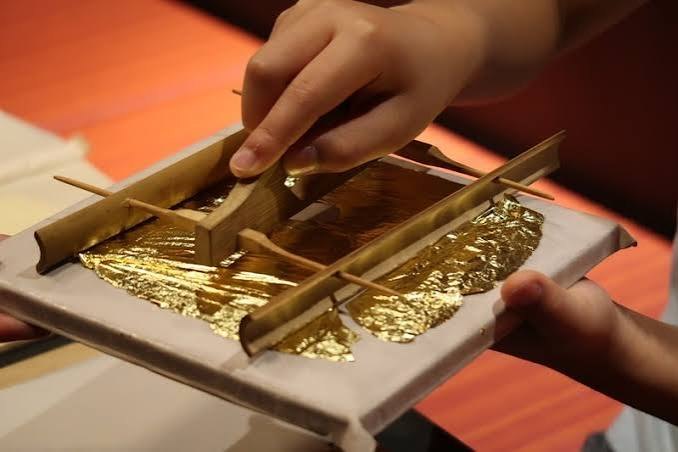
Kanazawa gold leaf
One gram of gold, beaten to half a square metre
Gold leaf is about one ten-thousandth of a millimetre thick. One gram of gold is beaten out to around 0.5 square metres. So thin you can see light through it, and so light a breath sends it flying, the leaf is handled sheet by sheet with bamboo tools.
According to Kanazawa City, its share of Japan's gold leaf production is over 98%, and of silver leaf almost 100%. Buddhist altars, temple buildings, lacquerware, folding screens, gold thread for Nishijin weaving, and now food and cosmetics — most of Japan's “gold” is shipped from Kanazawa.
Two centuries with the shogunate
Toshiie orders leaf to be beaten
During the invasion of Korea, Maeda Toshiie wrote from camp ordering gold leaf to be beaten in Nanao and silver leaf in Kanazawa — considered the beginning of Kanazawa leaf.
The shogunate sets up a leaf guild in Edo
To control gold and silver, production and sale of leaf were monopolised in Edo and banned elsewhere.
Keeping the skill alive under control
Repairs to the castle and temples required leaf. Tradition says the craft survived through domain commissions and secret “hidden beating”.
Koshino Sasuke wins official permission
Years of petitioning bear fruit; gold beating in Kanazawa is officially approved.
Deregulation and Japan's top production centre
Controls end with the abolition of the gold and silver mints; in the Taisho era leaf-beating machines boost production.
The scale and nature of Edo-period “hidden beating” remain uncertain, though traditions and interpretations of records suggest production continued in secret. Tradition
Entsuke leaf and blotting paper
The paper matters more than the gold
The secret of gold leaf lies not in the gold but in the paper. The washi used to sandwich the gold while it is beaten is made from fibres such as gampi and repeatedly soaked in liquids made with straw-ash lye, persimmon tannin and egg white, then beaten, over several months. The quality of this paper preparation decides the quality of the leaf.
The skill of making entsuke gold leaf by this traditional method was inscribed on UNESCO's Intangible Cultural Heritage list in 2020 as part of “traditional skills, techniques and knowledge for the conservation and transmission of wooden architecture in Japan”. Today there is also a faster tachikiri method using glassine paper, and the two are used for different purposes.
And the beating paper, worn out from repeated use, found an unexpected second life: because it absorbs skin oil so well, geisha and actors prized it for touching up their make-up. This is said to be the origin of oil-blotting paper. The classic Kanazawa souvenir began as a by-product of gold leaf.
Kaga Yuzen
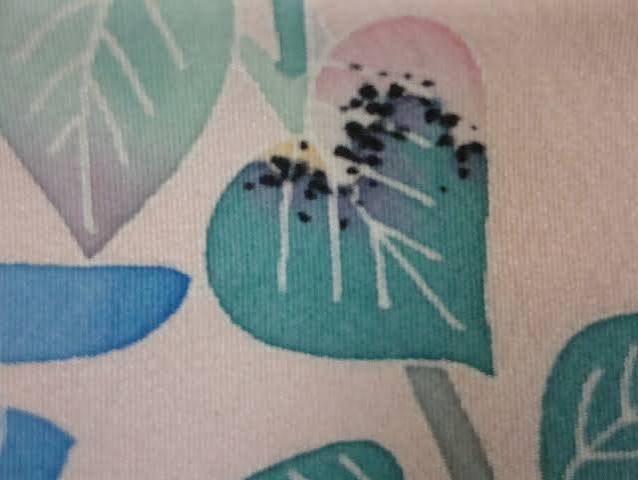
Painting even the worm holes in the leaves
The Yuzen technique of kimono dyeing takes its name from Miyazaki Yuzensai, a popular fan painter in Kyoto. Yuzensai is said to have moved to Kanazawa late in life and influenced Kaga dyeing. Likely
Kaga Yuzen is known for realistic flowers and plants and a restrained palette called the “five colours of Kaga”: crimson, indigo, ochre, grass green and ancient purple. Unlike Kyoto Yuzen, with its generous gold and embroidery, it relies on the beauty of dyeing alone.
Connoisseurs look for mushikui, “worm holes”: holes eaten by insects and the discoloration of withering leaves, deliberately painted in. Not flawless beauty but nature as it is — that is the Kaga Yuzen aesthetic. Its shading also tends to fade from the outside inward, the reverse of Kyoto's.
The twelve room cards on this site's home page: the colours along their top edges follow the five colours of Kaga — crimson, indigo, ochre, grass green, ancient purple.
Ceramics
Tea bowls made without a wheel, and a ware with a disputed birthplace
Ohi ware — a potter who came with a tea master
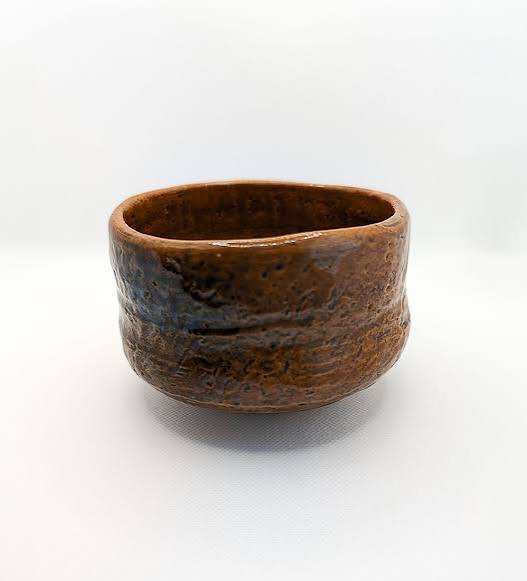
In 1666 the fifth lord Tsunanori invited Sensō Sōshitsu, fourth head of the Urasenke school of tea, from Kyoto as the domain's tea master. The potter Chozaemon, who came with him, found good clay in the village of Ohi near Kanazawa and founded Ohi ware. Fact In the Raku tradition, pieces are shaped by hand and spatula rather than on a wheel, and its warm amber glaze suits snow country. The kiln continues today.
The tea culture Sensō brought spread from samurai to townspeople. This is why Kanazawa people drink matcha as an everyday thing and eat so many sweets (see Kaga Food & Sweets).
Kutani ware — where was “Ko-Kutani” made?
Ko-Kutani (“old Kutani”) ware is said to have been first fired in the mid-17th century in the village of Kutani, in the Daishoji domain, a branch of Kaga. Famous for its bold overglaze colours, the kilns stopped after a few decades and were later revived.
But Ko-Kutani is the subject of a famous debate: were many pieces called Ko-Kutani actually made in Arita, in Kyushu? Likely Excavations and scientific analysis have produced much research supporting Arita, yet there is also evidence of production at Kutani, and the discussion continues. Among ceramics lovers it is a celebrated “birthplace controversy”.
Kaga Hosho
Chants falling from the sky
After Tsunanori promoted the Hosho school of Noh, the art spread beyond samurai to townspeople in Kaga. The domain protected “town actors” who performed Noh alongside their trades, allowing them surnames and even tax exemptions.
As a result, carpenters, plasterers and master roofers learned to chant Noh. The voices of craftsmen chanting as they laid roof tiles drifted down from above, and people said that “chants fall from the sky”. Tradition
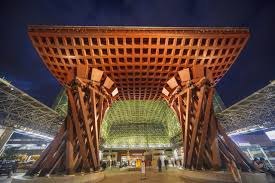
Losing the domain's patronage after the Meiji Restoration, Kaga Hosho declined for a time, but the businessman Sano Kichinosuke revived it, even building a Noh theatre with his own money. The Tsuzumi-mon Gate at Kanazawa Station's east exit is shaped like the tsuzumi hand drum used in Noh — a nod to this history.
Next
A sweet-toothed city raised on tea
Kanazawa competes for the top spot in Japan for spending on wagashi. From yellowtail season announced by winter thunder to crab in oden — to Kaga's table.