Home / Town
04 — Town
These streets were
made for getting lost.
Walk central Kanazawa and the streets soon bend, dead-end and narrow — a legacy of a castle town that deliberately blocked sight lines. Within this maze are teahouse districts, temple districts, and a place name that vanished and became the first in Japan to be revived. Maps and names reveal how the town was made.
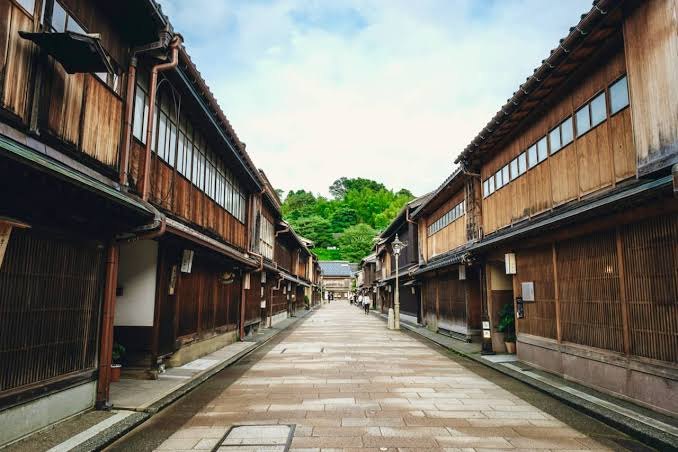
A maze of a castle town
Defence by not letting you walk straight
Castle-town streets were designed so that an enemy could not march straight to the castle: roads bent at right angles, T-junctions that hid what lay ahead, and dead ends. Kanazawa's old districts are full of them. Locals sometimes compare the winding lanes to amidakuji, the Japanese ladder lottery.
Lay an Edo-period map over a modern one and they match surprisingly well. Because Kanazawa escaped large-scale air raids, and because of the conservation efforts described below, the castle-town layout has survived almost intact.
In the lanes of Nagamachi or Teramachi, notice that crossroads are rarely clean crosses. Slightly offset junctions, which block the view, are a classic castle-town device.
Temple districts
Temples placed around the castle
Kanazawa has three temple districts: Teramachi south of the Sai River, the Utatsuyama foothills east of the Asano River, and Kodatsuno on the plateau. The domain gathered the town's temples into these areas.
Temples had large grounds, walls and buildings able to hold many people. It is often explained that in an emergency the temple districts were expected to act as outer defences — outposts of the castle. Likely On a map you can see how all three sit across the rivers or at the entrance to the plateau.
One slope from Teramachi down to the Sai River zigzags so sharply it is called “W-zaka” (officially Ishikiri-zaka). Students of the old Fourth Higher School climbed it daily, and it appears in Inoue Yasushi's novel of his student years, Kita no Umi.
Three teahouse districts
Buildings whose best face is upstairs
In 1820 the domain gathered teahouses scattered around the town into two licensed districts: Higashi (east) beyond the Asano River and Nishi (west) beyond the Sai River. Fact Add Kazuemachi, which flourished along the Asano River from the Meiji era, and you have Kanazawa's three teahouse districts.
The hallmark of teahouse architecture is a tall, grand upper floor. The rooms for entertaining guests were upstairs; the ground floor held the entrance and the geisha's dressing rooms. The fine lattices along the front, called kimusuko, make it hard to see in from outside but easy to see out.
Kanazawa's teahouse districts are still working geisha quarters. At dusk you may hear a shamisen or drum drifting from somewhere.
Teahouses traditionally follow the rule of ichigen-san okotowari — no first-time guests without an introduction from a regular. In recent years, however, there are more performances where visitors can watch geisha dance, and teahouses open to the public.
Kazuemachi
A lost place name, the first in Japan to return
The name Kazuemachi, by the Asano River, comes from the residence of Tomita Kazue, a Kaga retainer. When addresses were reorganised in the Showa era, however, the name was absorbed into “Owaricho 2-chome” and vanished from the map.
Residents wanted their historic name back, and on 1 October 1999 Kazuemachi became the first place in Japan to have an old place name officially restored. Fact Other old names in Kanazawa, such as Tobiumecho and Shimo-Ishibikimachi, soon followed.
Kazuemachi has two slopes. One is Kuragari-zaka (“dark slope”), which wealthy patrons of the Meiji era are said to have used to reach the teahouses unseen. The other is Akari-zaka (“light slope”), named by novelist Itsuki Hiroyuki, who has deep ties to Kanazawa, in memory of Izumi Kyoka, whose works were like a light in the dark — with a play on agari-zaka, an upward slope.
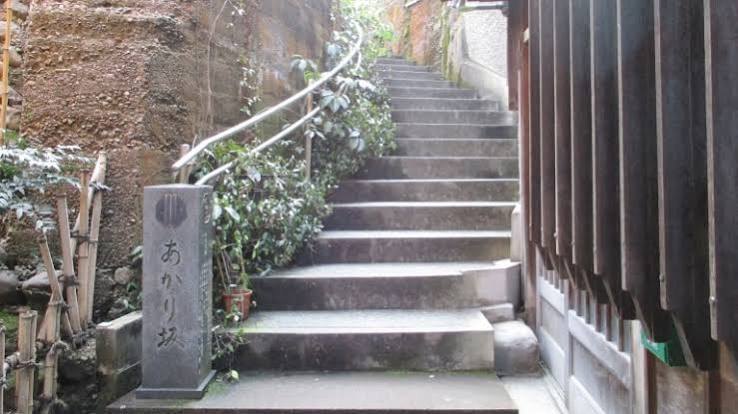
Reading place names
Korinbo was an eye-drop seller.
A monk's name
The most accepted theory: a monk from Mt Hiei named Korinbo returned to lay life, took over the Mukaida merchant family and prospered selling eye drops. Trees used for eye medicine are planted in today's Korinbo plaza.
Merchants from Toshiie's home
Said to be named after merchants Maeda Toshiie brought from his home province of Owari. Long the commercial heart of Kanazawa.
A town of Omi merchants
Named after merchants who moved from Omi (Shiga). Markets gathered here from around 1721, becoming Omicho Market.
A retainer's residence
A samurai's name that became a place name — lost, then restored in 1999.
Samurai houses in winter
When the earthen walls put on straw coats
In winter the earthen walls of the Nagamachi samurai district are covered with komo, straw mats that protect the top of the walls from snow and freezing. Hung in early December and removed around mid-March, they mark the beginning and end of Kanazawa's winter.
Earthen walls are vulnerable to water: moisture that soaks in expands when it freezes and flakes off the surface. The mats are not just for atmosphere but a practical way to protect a snow-country townscape.
Why it survived
The town that was “left behind” started protecting itself first.
The first reason Kanazawa's townscape survived is that it was not subjected to large-scale air raids. Why it was spared has no clear answer, and many theories circulate.
But escaping bombs is not enough to keep old streets. In the high-growth era, as old buildings disappeared from castle towns across Japan, Kanazawa enacted a Traditional Environment Preservation Ordinance in 1968, one of the earliest systems in the country for protecting historic landscapes. Perhaps a town “left behind” by modernisation understood sooner what losing it would mean.
Next
The story of a sheet one ten-thousandth of a millimetre thick
On teahouse walls, on altars, on ice cream. Kanazawa's gold leaf is a craft that outlived a shogunate ban.