Home / Legends
09 — Legends
True or false?
Kanazawa's urban legends examined.
Old towns gather old rumours: a “ninja temple” without ninja, a statue pigeons avoid, a shrine gate said to have guided ships at sea. We take Kanazawa's stories one by one and show, with labels, how much is confirmed history and where tradition and rumour take over.
- Factconfirmed by records
- Likelywidely accepted, with other views
- Traditionlegend or anecdote
- Urban legendrumour with little basis
One
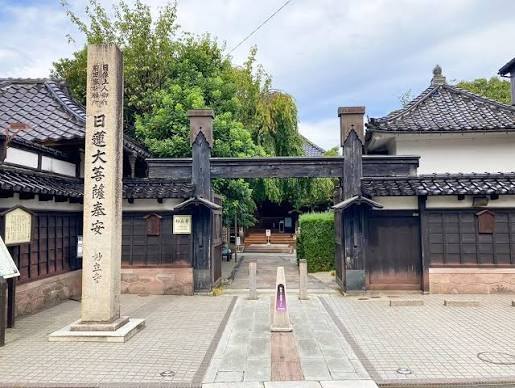
Were there ninja at the Ninja Temple?
Myoryuji, a Nichiren temple in Teramachi, is known as the “Ninja Temple”. Said to have been moved here in the time of the third lord Toshitsune, it looks like a two-storey building from outside, but inside has four floors and seven levels, reportedly with 23 rooms and 29 staircases. An offertory box that doubles as a pitfall, hidden stairs beneath floorboards, a lookout — it is a true house of tricks.
Fact The complex structure is real. But no records link it to ninja. “Ninja Temple” is a nickname inspired by the tricks, and the temple itself explains it was not a ninja base. It is more natural to see it as a building that doubled as a lookout and emergency stronghold on the town's southern approaches, in an era of tension with the shogunate. The two-storey facade is sometimes said to reflect building restrictions of the time.
Urban legend A famous story holds that the well in the main hall hides a secret tunnel to Kanazawa Castle. Given the distance and terrain, it is hard to believe it ever reached the castle.
Visits to Myoryuji require reservations. Please check the temple's latest information.
Two
The statue no pigeon will perch on
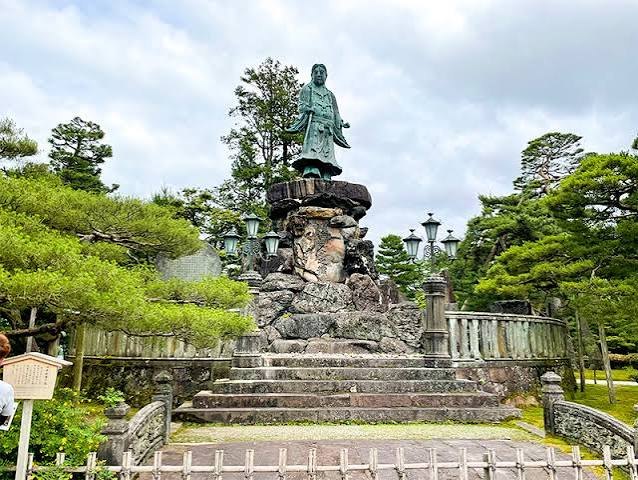
At the centre of Kenrokuen stands the statue of Yamato Takeru on the Meiji Kinen-no-hyo monument. Erected in 1880 to honour soldiers from Ishikawa who died in the Satsuma Rebellion, it is considered Japan's first outdoor bronze statue of a human figure.
An odd rumour has long surrounded it: “For some reason, pigeons and crows never land on it.”
Fact Professor Hirose Yukio of Kanazawa University investigated seriously. He found the statue's metal contains a high proportion of arsenic, which may keep birds away. In 2003 the research won an Ig Nobel Prize (Chemistry), awarded for research that “makes people laugh, then think”. A rumour became science.
Look at the pedestal, too: stones shaped like a slug, a snake and a toad are said to represent the sansukumi, three creatures that hold one another in check. Tradition
Three
Was the shrine gate a lighthouse?
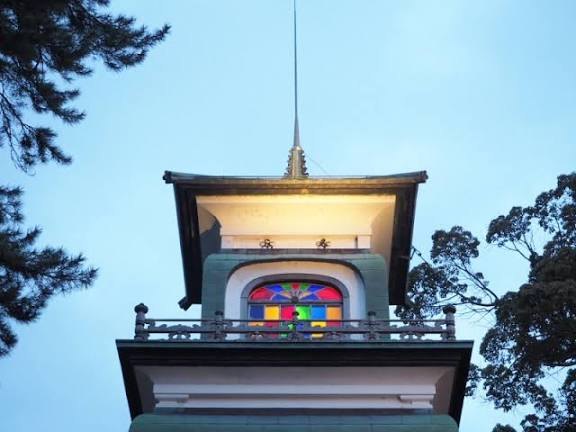
The gate of Oyama Shrine, dedicated to Maeda Toshiie and Matsu, is a three-storey gate completed in 1875. Mixing Japanese, Chinese and Western styles, it has stained glass set into its top floor, and is a national Important Cultural Property.
Tradition It is said that a light was once lit on this top floor to guide ships sailing the Sea of Japan — in other words, that it served as a lighthouse. The sea is several kilometres from the town, though, and how practical this was is unknown.
Likely On its roof is a lightning rod said to be the oldest in Japan, and still in use.
Urban legend Locally it has long been said that “a Dutchman designed this gate.” A Dutch doctor named Holtermann is said to have given advice, for example on lightning protection, but the master carpenter Tsuda Kichinosuke had drawn the first plans before Holtermann arrived in Kanazawa. The design was by a Japanese carpenter.
Four
Why do the Kenrokuen lantern's legs differ in length?
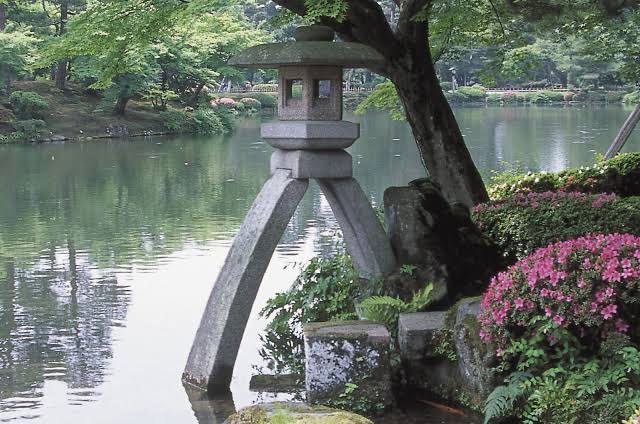
The Kotoji lantern appears on every Kenrokuen postcard. Its two-pronged legs resemble a kotoji, the bridge that supports a koto's strings. Look closely and one leg is shorter, resting on a stone in the pond.
This is sometimes explained as a master's playful touch to add variety to the waterside scene, Likely but a late-Edo scroll shows both legs equal, and the current shape is thought to have resulted from later relocation. Today's lantern is a second-generation piece installed in 1978. An asymmetry born of chance became Kanazawa's signature view.
Five
The “real reason” Kanazawa escaped the air raids
During the Second World War many of Japan's major cities were burned in air raids, but Kanazawa, home of the Army's Ninth Division headquarters, reached the end of the war without large-scale bombing.
Urban legend Explanations sometimes heard include “like Kyoto, America avoided it to protect cultural heritage” or “someone in Kanazawa lobbied the Americans”. No documents support these claims.
In reality, the order of raids is thought to have been decided by factors such as city size and war industries, and the common view is that the war simply ended before Kanazawa's turn came. The absence of any clear “reason” itself shows the weight of historical chance.
More
Legends on other pages
Imohori Togoro and the “gold-washing marsh”
Gold dust from washing yams — the origin of Kanazawa's name. See A Province Held by Peasants.
The nose-hair lord
Did the third lord grow his nose hair to look foolish? See The Maeda Survival Strategy.
Next
When someone says “kinodokuna”
From legends to language. The words Kanazawa people use every day carry the town's temperament.