Home / Origins
00 — Origins
For a century,
this province had no lord.
About a hundred years before Maeda Toshiie arrived, the provincial governor of Kaga was overthrown by an uprising, and followers of Jodo Shinshu Buddhism ran the province. Kanazawa Castle stands on the site of their head temple. Even the name “Kanazawa” begins with the legend of a man digging for yams.
- Factconfirmed by records
- Likelywidely accepted, with other views
- Traditionlegend or anecdote
- Urban legendrumour with little basis
The Ikko-ikki
A hundred years of “a province held by peasants”
In 1488, a huge force made up mainly of followers of the Honganji branch of Jodo Shinshu (True Pure Land Buddhism) surrounded Takao Castle, seat of Kaga's governor Togashi Masachika. Masachika took his own life, and from then until around 1580, for roughly a century, Kaga was controlled by these believers. Fact
A record associated with the Honganji described the situation as “as if the province were held by peasants”. The phrase is familiar from Japanese school textbooks, but connoisseurs point to the words “as if”.
百姓ノ持タル国ノヤウニ成行候From the Jitsugoki Shui, a record attributed to Jitsugo, a son of the priest Rennyo
“It has become as if the province were held by peasants.”
In reality this was no peasant democracy. Priests sent by the Honganji, local warrior families and village congregations were bound together in complex ways, and at times members of the Togashi family were kept on as nominal governors. Still, a province without a warlord for nearly a century was extremely rare in Japanese history.
What that century left behind was a faith. Jodo Shinshu took deep root among the people of Kaga and Noto, creating a “Shinshu kingdom” that later sustained demand for Kanazawa's gilded Buddhist altars and gold leaf (see Gold Leaf & Crafts).
From temple to castle
Kanazawa Castle stands on a temple site
In 1546, Oyama Gobo (Kanazawa Mido) was built at the tip of a plateau as a base for the Ikko-ikki. Fact A temple town grew around it, drawing merchants and craftsmen. Kanazawa's urban core is said to lie in this temple town.
In 1580, Sakuma Morimasa, a commander under Shibata Katsuie of Oda Nobunaga's northern army, captured the temple and turned it into a castle. But Morimasa was defeated at the Battle of Shizugatake in 1583 and executed. Soon afterwards, in the fourth month of that year, Maeda Toshiie entered the castle in his place, for a time calling it “Oyama Castle”.
Kanazawa Castle and Kenrokuen sit at the tip of the Kodatsuno Plateau, which stretches in from the south-east. To the west runs the Sai River, to the east the Asano River. Placing a castle at the “prow” of a narrow plateau between two rivers meant only the rear needed guarding — the terrain itself was a fortress. The steep slope from Kenrokuen down to Korinbo is the edge of this plateau.
The name
He washed a yam, and out came gold dust.
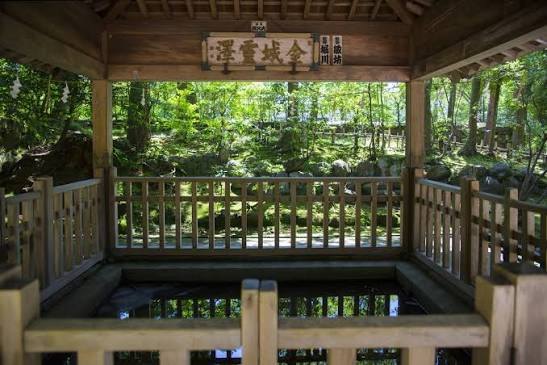
There is a well-known legend behind the name “Kanazawa”. Long ago an honest man called Imohori Togoro (“Togoro the yam-digger”) was washing wild yams in a stream when gold dust caught in the roots glittered out into the water. The stream came to be called Kane-arai-sawa, “the marsh where gold was washed”, later shortened to Kanazawa — literally “gold marsh”. Tradition
The stream is said to be Kinjo Reitaku, beside Kenrokuen, where water still wells up inside a small building. The castle's other name, Kinjo (“gold castle”), echoes the same legend.
The story continues: Togoro married Wako, daughter of a rich man from Yamato, and freely gave away the gold she brought as a dowry. Fushimi-ji temple in the Teramachi district is known for its connection with him.
A prefectural mystery
Why isn't it “Kanazawa Prefecture”?
Right after the domains were abolished, the area was briefly called Kanazawa Prefecture. But on 2 February 1872 the prefectural office moved to Mikawa in Ishikawa District (now part of Hakusan City), and the prefecture was renamed “Ishikawa” after the district. Fact
The very next year, 1873, the office moved back to Kanazawa — yet the name stayed Ishikawa. That is how the prefecture came to have a name different from its capital. “Ishikawa” (“stony river”) was originally the old name of the Tedori River, the largest river in the prefecture.
Urban legend It is often said that the Meiji government refused to name prefectures after the castle towns of domains that had leaned toward the shogunate. Indeed, several prefectures — Kanazawa's included — are named differently from their capitals. But there are many exceptions, and the reasons for moving the office are also debated, from distancing it from a former domain's power base to practical considerations. There is no settled answer.
Timeline
From temple to castle, from castle to prefecture
The Chokyo uprising
Governor Togashi Masachika dies at Takao Castle; the era of the believers begins.
Oyama Gobo founded
A base of the Ikko-ikki at the tip of the plateau.
Sakuma Morimasa captures the temple
The temple becomes a castle; the Kaga Ikko-ikki effectively ends.
Maeda Toshiie enters the castle
He moves his base from Komaruyama Castle in Noto.
Kanazawa Prefecture → Ishikawa Prefecture
The office moves to Mikawa and returns in 1873, but the name remains.
Next
How did the largest outside lord survive?
Having inherited a province of rebels, the Maeda now faced a far larger opponent: the Tokugawa.