Home / Castle
02 — Castle
A castle without a keep
speaks through its stones.
Kanazawa Castle's keep burned after a lightning strike in 1602 and was never rebuilt. What remains instead are stone walls built in different styles in different eras, white roofs of lead suited to snow country, and traces of the moats that once ringed the town twice over. Here is how to read the castle without its keep.
A museum of stone walls
The whole history of stone walls in one castle
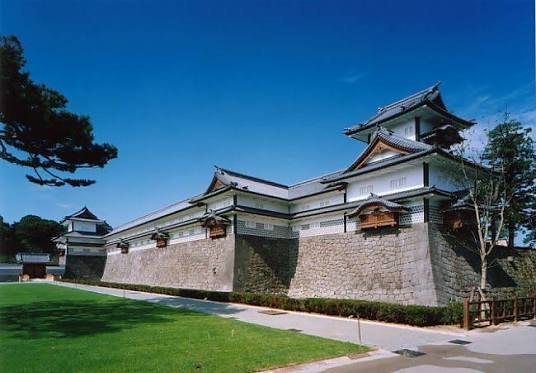
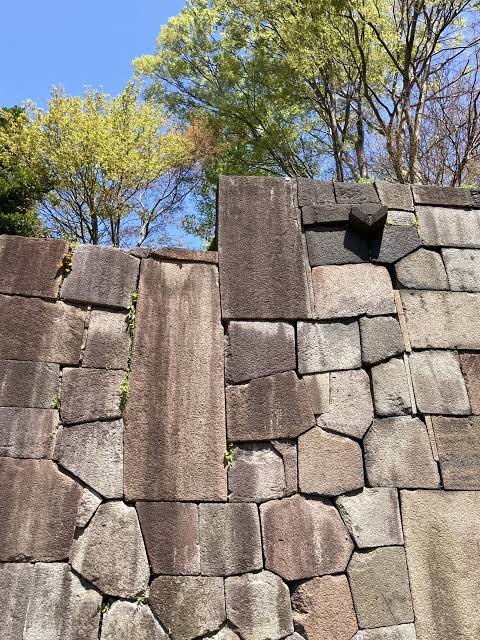
Kanazawa Castle is called a “museum of stone walls”. After repeated fires and earthquakes, the walls were rebuilt again and again, each time with the techniques of the day, so styles from the Warring States period to the late Edo period coexist in one castle.
Look at the gaps between the stones
Natural-stone walls use barely worked stones, with many gaps packed with pebbles. Roughly dressed walls use stones whose corners and faces have been split to fit. Cut-stone walls use stones squared precisely and fitted without gaps. The later the period, the smaller the gaps and the neater the face.
The masterpiece is the “shikishi-tanzaku” wall facing the Gyokusen'inmaru Garden, into which rectangular and square stones are set like poem cards, and which once had a stone spout pouring water as a waterfall. Turning a defensive wall into a work of art to be admired from a garden — this is the Kaga aesthetic in stone.
Search for marks carved into the stones. Circles, triangles and character-like symbols are thought to identify the groups of masons who cut or laid them. Many such marks have been found at Kanazawa Castle.
The white roofs
White roofs, even without snow
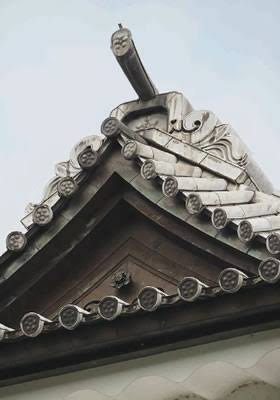
Look up at the roofs of Ishikawa Gate or Hishi Yagura and the tiles gleam a whitish grey. These are not fired clay tiles but wooden tile forms covered with sheets of lead. Lead oxidises white over time, so on a sunny day the roofs look as if dusted with snow.
Why lead? A popular explanation is that in a siege the roofs could be stripped and melted into musket balls. Tradition It sounds very much like the age of war, but there is no record of it actually being done.
A more practical explanation: clay tiles absorb water that freezes in winter and cracks them. Lead tiles are light, resist frost and look handsome — an ideal roofing for a castle in snow country. Likely Most probably both reasons played a part.
A bay window that is really a stone-drop
The walls of Ishikawa Gate and Hishi Yagura have elegant gabled bay windows. In fact they have openings in the floor — “ishi-otoshi”, for dropping stones or firing muskets on enemies climbing the wall. The diamond-patterned namako walls below protect the earthen walls from rain and snow. Beneath the beauty, there is always function and defence: that is Kanazawa Castle's style.
Hishi Yagura, as its name (“diamond turret”) suggests, is rhombus-shaped in plan, with angles of about 80 and 100 degrees rather than 90. Even the pillars are diamond-shaped in section, which made its 2001 wooden reconstruction famously demanding for the carpenters.
The sogamae moats
A moat dug in 27 days by a Christian lord
When Toshiie died in 1599, tension between the Maeda and Tokugawa Ieyasu rose sharply. The town's defences were entrusted to Takayama Ukon, then living under Maeda protection.
Ukon, a Christian lord who had lost his domain under Hideyoshi's edict expelling missionaries, served the Maeda from 1588 and was known as a skilled castle builder. From the twelfth month of that year he directed the digging of the inner sogamae moat around the castle, reportedly completing some 3 km in just 27 days. Likely It is said to have been modelled on the moats of Odawara Castle. In 1610 an outer sogamae was added, giving the town a double ring of moats.
Most of the moats were filled in after the Meiji era, but traces remain across the city: gently curving lanes, ground that suddenly drops a level, canals running beside roads. Join them up and the old line of the moats appears. Part of the eastern inner moat has recently been restored with water.
On a map of central Kanazawa, look between the straight avenues for arcing lanes and waterways. They are often remnants of the sogamae. Information boards marking the old earthworks and moats stand at several spots in the city.
The modern castle
An army, and then a university, inside the castle
In the Meiji era the castle became a military site: the 7th Infantry Regiment arrived in 1875 and from 1898 it housed the headquarters of the Ninth Division. A fire in 1881 destroyed many buildings, but Ishikawa Gate and the Sanjikken Nagaya survived and are now Important Cultural Properties.
After the war, Kanazawa University moved in. From 1949 to 1995 — nearly half a century — its campus was inside the castle. Fact Many Kanazawa people now in their fifties and older remember walking to lectures through Ishikawa Gate or dating by the moat.
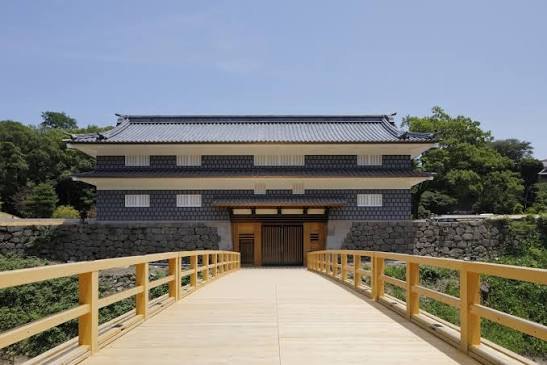
After the university moved to the suburbs, the site became Kanazawa Castle Park, and lost structures are returning one by one: the wooden Hishi Yagura and Gojikken Nagaya (2001), the Gyokusen'inmaru Garden (2015), and the Nezumi-tamon Gate and bridge (2020).
Timeline
A castle burned and rebuilt
Maeda Toshiie enters the castle
Serious castle building begins.
The inner sogamae is dug
Takayama Ukon rings the town with a moat.
The keep burns after a lightning strike
It is never rebuilt; a three-storey turret takes its place.
The Kan'ei fire
Severe damage leads to the Tatsumi Canal the following year.
The Horeki fire
Most of the castle and town burn. Ishikawa Gate is later rebuilt; today's gate dates from after this fire.
The Ninth Division headquarters
The castle becomes the heart of military Kanazawa.
Kanazawa University campus
A rare “university inside a castle”.
Wooden reconstructions continue
Hishi Yagura, Gyokusen'inmaru Garden, Nezumi-tamon Gate and more.
Next
The man who made water climb into the castle
The year after the great fire, an engineer brought mountain water up onto the plateau and into the castle. Without pumps — how?