
"...And that's the end of the story."
Inoue Masaru tapped the paving stones lightly with the tip of his stick.
Before the columns of University College London, the summer sun was beginning to sink. Before he knew it, he had been talking for a very long time. The young engineer accompanying him had not said a word since partway through, only listened, absorbed.
"It began with a fire and ended with a whistle. It's been a long story."
"Not at all."
The engineer shook his head. His eyes had gone a little red.
"Your Excellency. Does Professor Williamson's house still stand?"
"The professor died six years ago."
Masaru turned his eyes to the northern sky.
"The house is probably still somewhere in this city. But if you went, there'd be no one in that sitting room now. Not the lady who taught us how to hold a knife and fork, nor the five who laughed till our sides ached."
The two of them began to walk slowly.
Motorcars sped along the street in front of the university. There were still carriages too. When he arrived in this city 47 years ago, there had been no motorcars anywhere.
"Your Excellency."
The engineer spoke diffidently.
"Earlier you said that beneath Prince Ito's question there lay another one. That you still haven't fully answered it."
"I did say that."
"What was it?"
Masaru stopped.
It's got no sails, so how does it move?
Risuke's voice from that day came back to him, deep in his ears.
"Back then, Japan was a sailing ship."
Masaru said it slowly.
"It only moved when it was pushed by winds blowing from outside. When the wind of the Black Ships blew, it changed course in a panic. When the wind of foreign cannon blew, it changed course again. Not once had it moved forward under its own power."
The engineer listened in silence.
"I think what Risuke really wanted to ask was this. How do you become a country that moves under its own power, without relying on the wind?"
With the tip of his stick, Masaru drew a small circle on the ground.
"A steamship has a fire in its belly. Under the boiler, coal is burning. That fire boils the water, the steam pushes the pistons, and the ship moves even with no wind."
Masaru looked up.
"A country's the same. Wait for the wind, and a country won't move. It has to have a fire in its belly."
"A fire, sir?"
"People."
Masaru said it.
"People who learn, and think, and work with their hands, and try to build their own country themselves. That's the fire that burns in a country's belly. Yozo built the school that kindles that fire. Kinsuke guarded the credit of the nation's money so the fire wouldn't go out. Monta and Shunsuke put together the boiler that fire burns in, as the workings of this country. I laid the track for the trains that run on that fire."
Masaru smiled a little.
"Maybe we were five flames. Not big flames. Small fires, each on its own. But put the five together, and maybe they could bring one boiler to a boil."
The engineer sat with this for a while.
Then, as if he had made up his mind, he spoke.
"Then will you answer the other question too? Why you came to bow your heads to the very country you had tried to burn?"
Masaru looked hard at the engineer's face. Then he laughed out loud.
"You don't let go, do you? You're a lot like Shunsuke."
Masaru stopped laughing and looked up at the columns.
"The fire at Gotenyama was a fire for burning. A fire for destroying. There's always a fire in the belly of the young. What matters is what you use it for."
Masaru went on slowly.
"We came here to turn a fire for burning into a fire for moving. There's no shame at all in bowing your head. What shame can there be in learning how to use fire?"
A warrior's journey, made bearing his shame.
The poem Shunsuke had composed before leaving Yokohama passed suddenly through his mind. He had written that he went bearing his shame. But when he came home, there was no trace of shame anywhere in his face.
That night, back at his hotel, Masaru sank deep into the chair by the window.
The pain deep in his body had grown worse again. He might not have much longer. He knew that better than anyone.
Even so, his heart was strangely still.
Out in the darkness beyond the window, far off, a whistle blew.
Masaru closed his eyes.
The faces of the five rose up and faded.
Monta, gripping the rope at the ship's rail. Shunsuke, with the melted glass tucked inside his kimono. Yozo, with the screw resting on his palm. Kinsuke, flicking the Mexican silver dollar.
And a thin boy glaring out to sea off Sagami.
"Well, Risuke."
Masaru said it softly in the empty room.
"Did our ship move forward, after all?"
No one answered.
Only the lingering note of the whistle trailed long into the night, and at last faded away.
On the 2nd of August, 1910, Inoue Masaru breathed his last in London.
He was 66. In this city where, 47 years before, he had stepped ashore with his topknot cut off under the name Nomura Yakichi, Masaru met his end.
His ashes crossed the sea back to Japan.
The place where Masaru came to rest was the cemetery of Tokaiji temple, in Shinagawa, Tokyo.
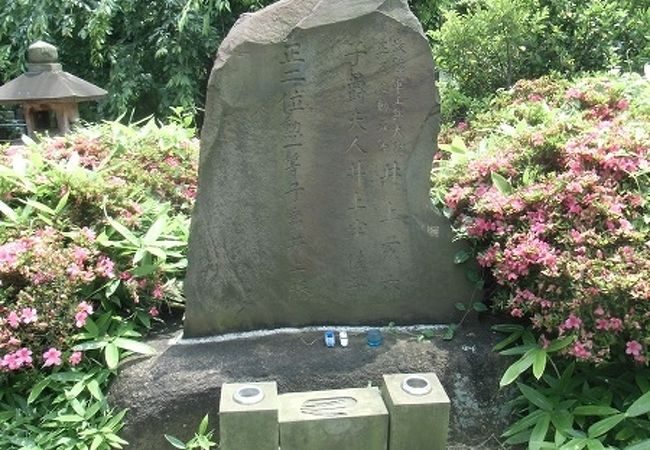
The Tokaido line runs right beside it. It is said Masaru wished to rest where he could watch over the trains coming and going.
And not far from that cemetery is Gotenyama.
That hill where, half a century before, young men had set fire to a British house.
Now, every day, countless trains run past the foot of that hill. Masaru still watches over the place where a fire for burning became a fire for moving.
Inoue Kaoru died five years later. Yamao Yozo, two years after that.
In 1993, 130 years after the five first set foot together on British soil.
A monument was erected in the grounds of University College London.
The names of the five are carved on it.
Ito Hirobumi. Inoue Kaoru. Inoue Masaru. Endo Kinsuke. Yamao Yozo.
And beside them stand the names of the 19 sent by the Satsuma domain. Among them are the names of the young men who pooled what little money they had to send Yozo to Glasgow.
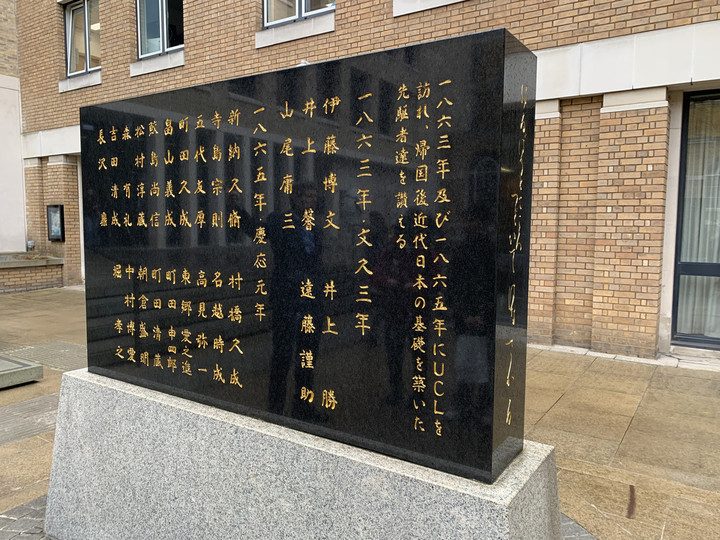
On the monument is carved a haiku by Matsumura Junzo, once a Satsuma student, together with an English translation.
"When distant minds come together, cherries blossom."
Cherry trees were planted beside the monument.
Every spring, their blossoms open beneath the London sky. Just like that avenue of cherry trees at the Mint in Osaka, which Kinsuke opened to the people of the town.
Standing before the monument, even now, you feel as if somewhere far away a whistle is blowing.
History and fiction in this chapter
Historical facts
- Professor Williamson died in 1904.
- Inoue Masaru died of illness on the 2nd of August, 1910, aged 66, in London, where he had gone to take part in the Japan-British Exhibition and to inspect European railways. His ashes were returned to Japan and buried in the cemetery of Tokaiji temple in Shinagawa, Tokyo. The grave lies right beside the tracks of the Tokaido line and other railways.
- Inoue Kaoru died in 1915, and Yamao Yozo in 1917.
- In 1993, a monument was erected in the grounds of UCL, inscribed with the names of the five from Choshu and the 19 sent by the Satsuma domain (15 students and 4 envoys). The monument bears the haiku by Matsumura Junzo, once a Satsuma student, "Harubaru to / kokoro tsudoite / hana sakaru," together with its English translation (When distant minds come together, cherries blossom), and cherry trees have been planted there.
Tradition
- It is handed down that Masaru wished to rest in a place where he could watch over the trains coming and going.
Fiction
- The scene of Masaru talking to the young engineer, and phrases such as "a fire in the belly" and "turning a fire for burning into a fire for moving."
- The scene of Masaru remembering the five by the window of his hotel.