The two men who stepped down onto the wharf were a dreadful sight.
Western clothes stiff with salt and grime. Hair grown out every which way. Hands cracked and black from more than 4 months of being worked as sailors. Shunsuke was gaunt, still unsteady on his feet.
The man who came to meet them was Hugh Matheson, a director of Jardine Matheson. The well-dressed English gentleman took one look at the two and was lost for words.
"Good heavens. You were supposed to be sent as passengers."
Only his expression got through. But that was enough. This man was angry. Angry on their behalf.
Monta bowed his head awkwardly.
"Nevigation."
He pointed at himself as he said it. Matheson looked blank for a while, but eventually he seemed to grasp what had happened, put a hand to his forehead, and looked up at the heavens.
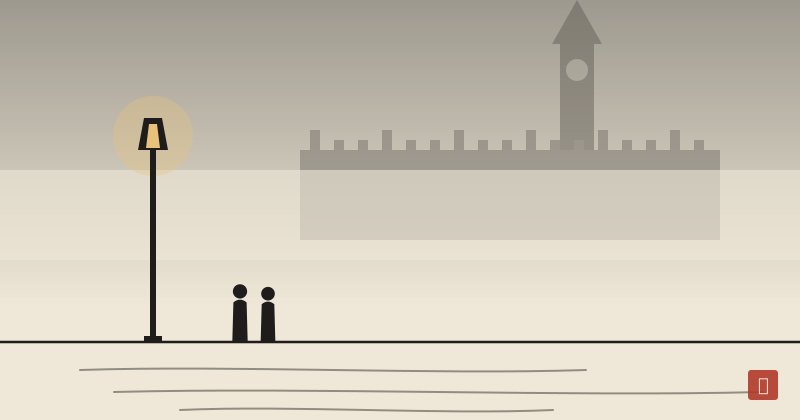
London, seen from the carriage window, was even more staggering than Shanghai.
Every street was packed with people and carriages. Gentlemen in silk hats, ladies in dresses with great spreading skirts, laborers shouldering loads, boys hawking newspapers. Everyone hurrying at a tremendous pace toward wherever they were going.
The buildings were all made of stone and brick. Three stories, four, five. Chimneys stood crammed together on the roofs, and smoke rose from every one. Though it was daytime, the sky was a murky, yellowish gray.
It was still early afternoon, yet on the street corners the gas lamps were already lit.
"Monta-san."
Shunsuke said it with his forehead pressed against the window.
"Doesn't this town have any night?"
Monta didn't answer. He only followed in silence the scenery flowing past outside the carriage. Somewhere in this town was the true face of the country that had built that legation at Gotenyama. And now he was going to see it.
Matheson took the two of them to a house in a leafy residential district in the north of London.
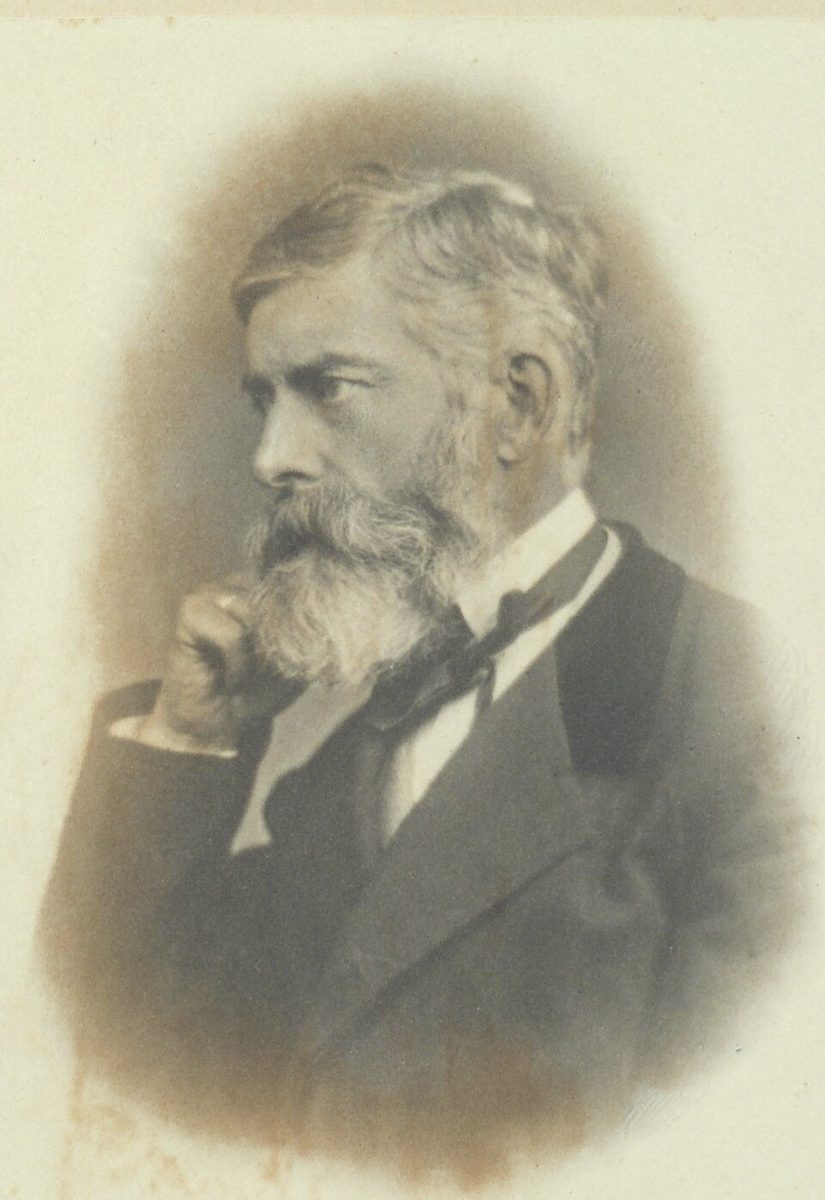
The man who greeted them had the use of only one eye, and a piercing gaze. Alexander Williamson. A professor who taught chemistry at University College London, and, they were told, president of the society that brought together Britain's chemists.
From behind the professor, his wife looked out. The moment she saw the two, she withdrew into the house without a word, and came back with her arms full of hot water, soap, and clean clothes.
That evening, for the first time in their lives, the two sat down at a Western dinner table.
On the white-clothed table were plates and a number of shining silver implements. Knives, forks, spoons of different sizes. Which to use, in what order, in which hand, they had no idea at all.
Shunsuke tried to hold his fork like chopsticks and sent his meat flying off the plate. Monta froze, gripping his knife like the hilt of a sword.
The two went bright red and looked down.
There was a soft giggle. It was Mrs. Williamson. But it was not a mocking laugh. She lifted her own knife and fork and, slowly, so the two could see, cut her meat for them.
"Knife. Right hand."
"...Knife. Right... hand."
"Fork. Left hand."
Just as when the boy sailor on the Pegasus had taught him words, Shunsuke repeated each one under his breath.
From that night on, Mrs. Williamson became the two men's English teacher.
The other three arrived only 3 days later.
Having traveled as passengers, the three from the White Adder were neat and tidy. The two from the Pegasus had bathed and changed, but their thin, sunburned faces still bore the plain marks of hardship.
"Monta-san, Shunsuke, what happened to your faces?"
Yakichi's eyes went round.
With a sour face, Monta told them about the business at the Shanghai branch. Nevigation. Seamanship. A sailor's work. The crossbeam at the ship's side, and the rope.
As the story went on, Yakichi's shoulders began to shake. Finally he couldn't hold it in any longer, and he doubled over laughing.
"Yakichi, you..."
"Sorry, sorry... but we were learning that seamanship, from a cabin, with the mate, every night..."
Yozo couldn't stand it and burst out laughing. Kinsuke too covered his mouth, his shoulders shaking. Even Shunsuke started to laugh.
Monta glared at the four with a sullen face for a while. Then at last he burst out laughing himself.
In the Williamsons' sitting room, the five laughed until the tears ran. It was the first time since they had left Yokohama that all five had laughed together, since the night they cut their topknots.
In time, the five were split between two houses for lodgings. Shunsuke, Kinsuke and Yakichi at the Williamsons', Monta and Yozo at a house on Gower Street, right by the college. Even so, the five gathered in the Williamsons' sitting room almost every night.
One evening at the dinner table, Monta put into words a question that had been in his heart all along.
His English was still halting. Stringing words together, adding gestures, sometimes getting help from Shunsuke, he somehow managed it.
"Professor. We, Choshu people. Choshu, burn British legation. Say, shoot British ships."
The professor put down his knife and fork. His wife stopped too.
"Why, professor, you help us?"
For a while, no one spoke. The fire in the hearth gave a sharp crack.
At last the professor rested his weak arm gently on the table and answered slowly.
"I am a chemist. Chemistry has no borders. Oxygen burns the same way in England and in Japan. Water freezes the same way in London and in Choshu."
The professor looked at the five faces one by one.
"I do not know what you will do when you return to your country. But a scholar who would turn away those who wish to learn is no scholar."
Monta did not understand every word. But the words "no borders," he caught clearly.
That night, even after he got back to his lodgings, Monta lay in bed and could not sleep for a long time. Nearly a year ago, he had thrown fire from this side of the border to the other. And now the people on that other side were giving him hot water, and soap, and bread, and words.
The chemistry laboratory at University College London was full of the smell of chemicals and the blue flames of gas.
The five were permitted to attend lectures, not as regular students but as auditors. Professor Williamson let them sit in on his own lectures and gave them instruction in the laboratory.
The first thing the professor set before the five was a balance in a glass case.
With tweezers, the professor placed one small weight on the pan. The needle of the balance trembled ever so slightly, and stopped.
"Chemistry begins with weighing."
The professor said it in slow English. Thanks to Mrs. Williamson, the five were gradually able to catch it.
"It is easy to say that something has changed. By how much has it changed? Only those who can measure that correctly can know how nature works."
Kinsuke did not move from in front of the balance.
The needle moved at the weight of a single hair. It was possible to weigh things this finely. In Kinsuke's mind rose that Mexican silver coin he had seen at the money changer's in Yokohama. The weight, the amount of alloy, every coin exactly the same. And what stood behind that was this balance.
"Endo, try it."
At the professor's word, Kinsuke picked up the tweezers with trembling fingers.
On days without lectures, the five walked the town of London.
Through the good offices of Professor Williamson and Matheson, the five could even enter places no ordinary traveler would ever be allowed into.
At an ironworks, red-hot masses of iron were being struck by a gigantic steam hammer. With every blow the ground shook and sparks fell like rain. Yozo forgot even to cover his ears, staring at the movement of that hammer.
At a shipyard, iron ships were being assembled from iron frames. Not wood. They were building ships out of iron. Yozo gripped the screw in his pocket. Here, hundreds of thousands of the very same thing as that one screw were being used.
At the Bank of England, they saw the machine that printed banknotes. Intricate patterns came out sheet after sheet, without the slightest deviation. Kinsuke stared at the machine through the glass as if he could devour it. Why was a scrap of paper trusted as money? A domain note became a mere scrap of paper in the next domain over, yet this paper passed anywhere in the country. He felt the answer lay in the precision of this machine, and in the system that stood behind it.
Yakichi became obsessed with the railway that ran beneath the ground.
It had opened only at the start of that year, the only underground railway in the world. Steam engines puffing smoke ran through tunnels dug beneath the earth.
Yakichi rode it again and again. Every time he rode, he wrote down in his notebook the structure of the stations, the gradient of the tunnels, the joints in the rails. Inside the tunnels the smoke was so thick you could not keep your eyes open. Even so, Yakichi kept his face pressed to the window.
One day he finally went to peer down one of the smoke vents beside the track, and came back to the Williamsons' with his face black with soot.
"Yakichi, what happened, did you take up charcoal burning?"
Shunsuke laughed till he held his sides. His face still covered in soot, Yakichi said with earnest eyes:
"Shunsuke-san. Whether there are mountains, or rivers, or even under the ground, you can lay track. Japan's nothing but mountains, but even so, trains can run there."
Shunsuke stopped laughing. Yakichi's eyes shone the same way his own had that day on the Sagami shore, watching the foreign ship.
But London was not a town that only shone.
Step one street off a main road, and the scene changed completely. In narrow alleys where the sun never reached, sooty tenements crowded together. Filthy water collected in the gutters, and a foul smell hung in the air. Barefoot children held out their hands to passersby, begging.
Shunsuke stood for a long time at the mouth of one of those alleys.
"Monta-san. This country builds ships that big, runs trains that fast, plants its flag all over the world..."
"Yeah."
"And right at its feet, there are children like these."
Monta was staring into the depths of the alley.
"A strong country isn't strong all the way through, is it."
"What's going to happen to Japan? If we copy this country, will we end up copying places like this too?"
Monta didn't answer. There was no one who could have answered.
On the way back, Shunsuke stood on the bank of the Thames looking up at a great building. It stretched long along the river, with a tall clock tower soaring above it. Matheson had told them it was the building of the Parliament, which decided how this country was governed. Not a lord, not a shogun. Chosen men argued inside that building, they said, and made the country's laws.
Shunsuke walked on, looking back at that building the whole way.
That night, Shunsuke sat at the desk in the Williamsons' house writing something until late.
As winter drew near, Kinsuke began to cough.
At first no one paid it any mind, thinking it was London's smoke. Anyone breathing this town's air would get a scratchy throat.
But Kinsuke's cough would not stop. In the middle of the night, a stifled coughing could sometimes be heard through the wall for a long time.
One night, on his way out after a long talk in the sitting room, Yozo came across Kinsuke drinking water in the kitchen. In the dim gaslight, Kinsuke's face looked pale.
"Kinsuke-san, you ought to have a doctor look at you."
"I'm all right."
Kinsuke shook his head at once.
"A doctor costs money. Money borrowed from the domain. I can't spend it on a little cough of mine."
"But..."
"Yozo-san. I haven't got hold of anything to take home yet. I can't lie around in bed here."
Kinsuke said it, and then coughed a little again.
Yozo couldn't say anything more. He only watched that thin back go, in silence.
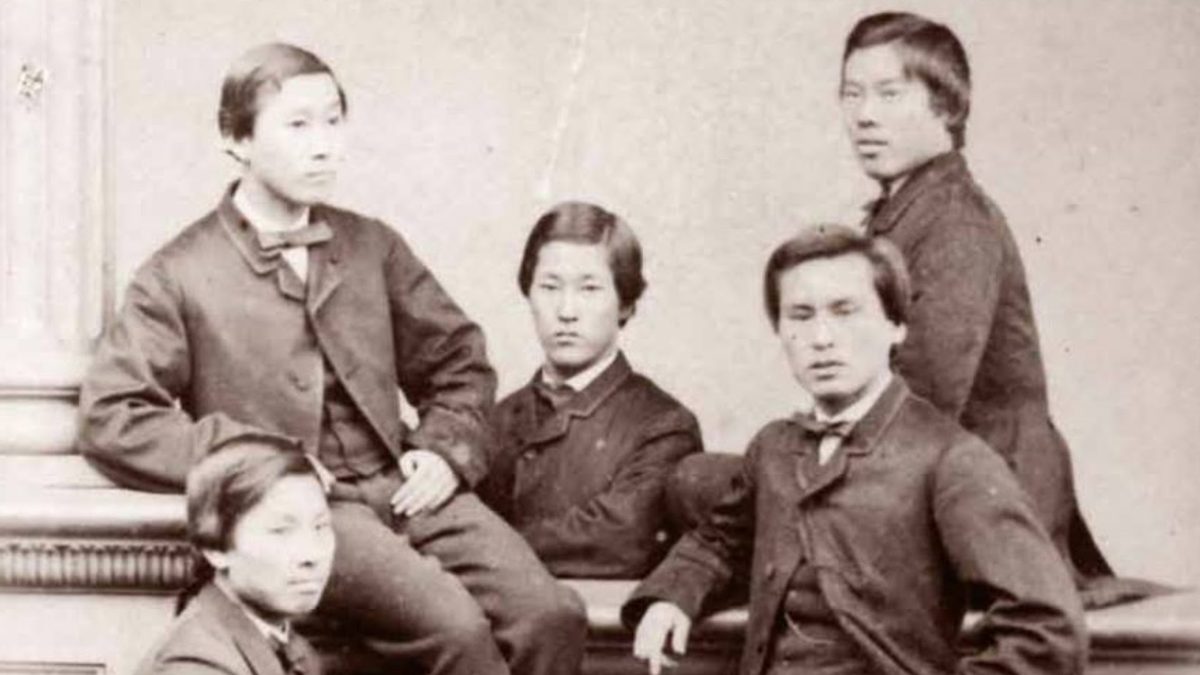
One day, the five were taken to a photographer's studio.
All five of them were to have their picture taken together. It would be good to have one, if only to let the families they had left behind in Japan know they were safe. It was Mrs. Williamson who had suggested it.
The five changed into the Western clothes they had had made in London. This time, they no longer got the buttons wrong.
The photographer arranged the five. Some sitting, some standing.
"Don't move. Hold your breath."
Without stirring, the five glared at the black box.
Monta folded his arms and puffed out his chest.
Shunsuke started to slip a hand inside his coat, then stopped.
Yozo laid his hand gently over the pocket that held the screw.
Kinsuke looked straight into the lens.
Yakichi was listening to the sound of a whistle somewhere far off.
There was a dry click.
In that one photograph, the five still glare out at us, young men who are not yet anyone at all. The five who would one day lead cabinets, take charge of diplomacy, found engineering, mint currency and lay railways stand there in a row, with the faces of men who have not yet accomplished a single thing.
The new year came: 1864.
The London winter was long and dark. Day after day, the gas lamps had to be lit even at noon.
That morning, having called at the Williamsons' as usual, Monta was in the sitting room spreading out a newspaper the professor had finished reading.
He still could not read half of an English newspaper. Even so, every morning he made a habit of picking out the words he knew.
At the headline of one article, Monta's finger stopped.
Two words he knew stood side by side.
JAPAN.
And CHOSHIU.
Monta stood up, gripping the newspaper.
"Shunsuke! Is Shunsuke here?"
History and fiction in this chapter
Historical facts
- In London, Hugh Matheson, a director of Jardine Matheson, acted as the five's guardian and introduced them to Alexander Williamson, professor of chemistry at UCL. Williamson was at the time president of the Chemical Society of London.
- The Pegasus reached London on November 4, 1863, and the White Adder on November 7.
- The Williamsons took Ito, Endo and Nomura into their home, and Mrs. Williamson taught them English and how to live in Britain. Inoue and Yamao lodged with the Cooper family on Gower Street near the college (some accounts say all five stayed at the Williamsons' at first). As a result of a childhood illness, Williamson had lost the use of one eye and one arm.
- The five enrolled as auditing students in UCL's Faculty of Arts and Laws and studied analytical chemistry under Williamson, combining lectures with practical work in the laboratory.
- They visited museums, art galleries, shipyards, factories, banks and other sites. Endo saw the banknote printing technology at the Bank of England and later put it to use in his work.
- The world's first underground railway (the Metropolitan Railway) had opened in London in January 1863.
- A photograph survives of all five together in Western dress (taken in London in 1863).
- In 1864, Ito and Inoue learned from British newspapers that Choshu was in danger of being attacked by foreign powers (depicted in Chapter 5).
Fiction
- The scene of Matheson meeting the two, the knife-and-fork scene, the reunion of the five and their laughter, the scene with the balance and the professor's words.
- The scene of Yakichi peering into the smoke vent of the underground, the scene of Shunsuke and Monta looking at the poor alley, and the scene of looking up at the Parliament building.
- The dinner-table scene where Professor Williamson says "chemistry has no borders," and the scene of Kinsuke's cough (Endo would later return to Japan because of illness in 1866).
- The taking of the photograph, and the scene where Monta notices the newspaper headline.